巴菲特致股东的信(2004年)④保险业务


Insurance

保险业务

Since Berkshire purchased National Indemnity (“NICO”) in 1967, property-casualty insurance has been our core business and the propellant of our growth. Insurance has provided a fountain of funds with which we’ve acquired the securities and businesses that now give us an ever-widening variety of earnings streams. So in this section, I will be spending a little time telling you how we got where we are.

自从伯克希尔在 1967 年买下国民保险公司(NIC)之后,财产险便成为我们的核心业务之一,更是促使不断成长的动力来源,保险业使我们取得源源不绝的资金进行投资与并购,让伯克希尔的盈利来源更多更广,所以在接下来的这一段中,我会花一点时间告诉大家我们是如何做到的。

The source of our insurance funds is “float,” which is money that doesn’t belong to us but that we temporarily hold. Most of our float arises because (1) premiums are paid upfront though the service we provide – insurance protection – is delivered over a period that usually covers a year and; (2) loss events that occur today do not always result in our immediately paying claims, because it sometimes takes many years for losses to be reported (asbestos losses would be an example), negotiated and settled. The $20 million of float that came with our 1967 purchase has now increased – both by way of internal growth and acquisitions – to $46.1 billion.

保险公司的资金来源在于浮存金,这笔资金虽然不属于我们所有,但却可暂时为我们所用,而我们的浮存金之所以增加系由于(1)保费通常在我们提供服务之前就先收取,(2)今天发生的损失不代表我们立刻就要理赔,其原因在于损害有时要在发生后好几年才会被发现,从而协调及和解(比如说石棉案就是很好的例子),这笔浮存金从1967 年最早的 2,000 万美元,经由多年的内部成长及对外并购,累积增加至如今的 461 亿美元之巨。

Float is wonderful – if it doesn’t come at a high price. Its cost is determined by underwriting results, meaning how the expenses and losses we will ultimately pay compare with the premiums we have received. When an underwriting profit is achieved – as has been the case at Berkshire in about half of the 38 years we have been in the insurance business – float is better than free. In such years, we are actually paid for holding other people’s money. For most insurers, however, life has been far more difficult: In aggregate, the property-casualty industry almost invariably operates at an underwriting loss. When that loss is large, float becomes expensive, sometimes devastatingly so.

浮存金固然不错,但前提是取得成本要够低,而其成本取决于承保绩效,也就是赔付损失与经营费用占保费收入的比例,当承保盈利时,就像伯克希尔过去 38 年来多数的情况一样,此时浮存金甚至比免费还好,在这些年度,意味着别人付费来请我们帮他们保管资金,然而对于其它大部分的保险同业来说,可就没有那么好过了,总的来说,财产意外险业通常都会承保亏损,当损失过大时,就代表浮存金的成本过高,有时甚至高得离谱。

Insurers have generally earned poor returns for a simple reason: They sell a commodity-like product. Policy forms are standard, and the product is available from many suppliers, some of whom are mutual companies (“owned” by policyholders rather than stockholders) with profit goals that are limited. Moreover, most insureds don’t care from whom they buy. Customers by the millions say “I need some Gillette blades” or “I’ll have a Coke” but we wait in vain for “I’d like a National Indemnity policy, please.” Consequently, price competition in insurance is usually fierce. Think airline seats.

保险业者的绩效之所以不好的原因其实很简单,他们销售的是同质化的商品。保单多属制式而且许多保险业者都提供相同的产品,有些甚至以互助的方式经营(公司系由保户而非股东所拥有),所以利润空间相当有限,以至于大部分的投保人根本就不在乎保单是向谁购买的。大部分的消费者或许会说"我要买吉列的刮胡刀"、"我要买可口可乐",但绝对不会有人说"给我来份国民保险的保单",也因此价格竞争在保险业界可说是相当的激烈的,看看航空公司的票价就知道是怎么回事了。

So, you may ask, how do Berkshire’s insurance operations overcome the dismal economics of the industry and achieve some measure of enduring competitive advantage? We’ve attacked that problem in several ways. Let’s look first at NICO’s strategy.

所以或许你会问,伯克希尔是如何摆脱产业普遍存在的劣势,同时保有持续的竞争优势的,我们从许多方面来克服这个问题,首先让我们来看看国民保险的策略。

When we purchased the company – a specialist in commercial auto and general liability insurance – it did not appear to have any attributes that would overcome the industry’s chronic troubles. It was not well-known, had no informational advantage (the company has never had an actuary), was not a low-cost operator, and sold through general agents, a method many people thought outdated. Nevertheless, for almost all of the past 38 years, NICO has been a star performer. Indeed, had we not made this acquisition, Berkshire would be lucky to be worth half of what it is today.

当我们买下该公司时,这是一家专门从事商用车险及一般责任险的公司,当时它显然并未拥有得以克服同业沉疴的特点,它的名气不够响亮,也没有任何信息上的优势(当时公司甚至没有精算师),营运成本也不是最低的,保单通过一般的中介销售,这在当时被视为落伍的做法,尽管如此,在往后的 38 年内,国民保险的表现却极为优异,我们可以这样说,当时要是我们没没吃下这家公司,伯克希尔的价值可能不及现在的一半。

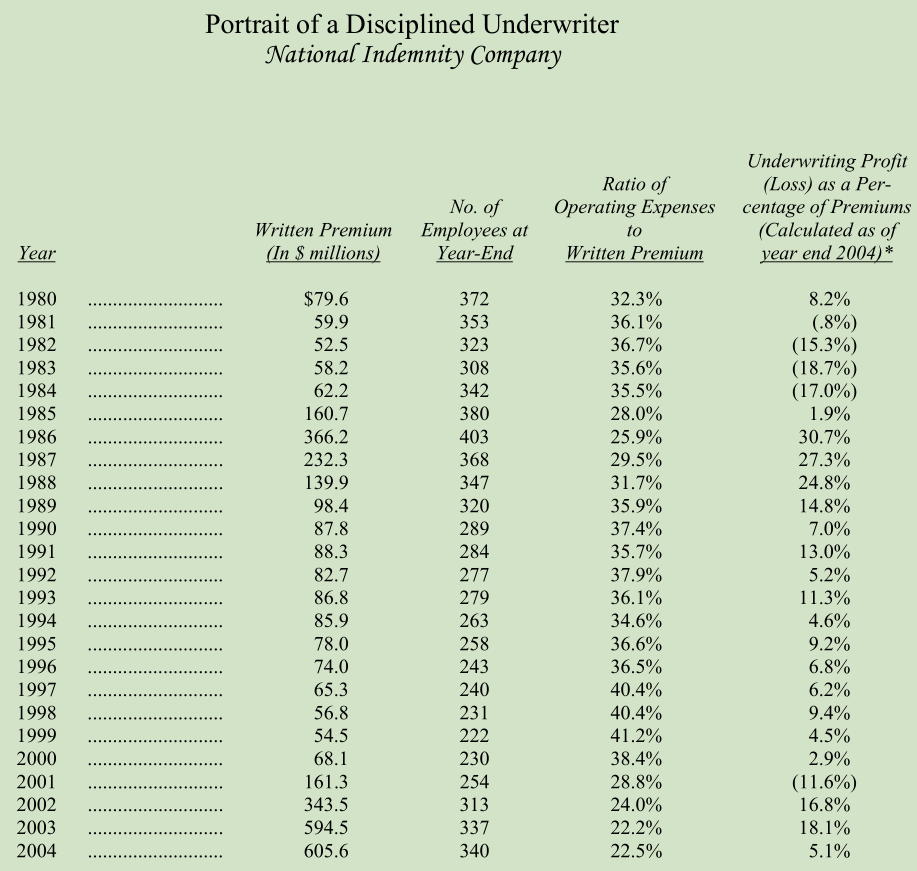
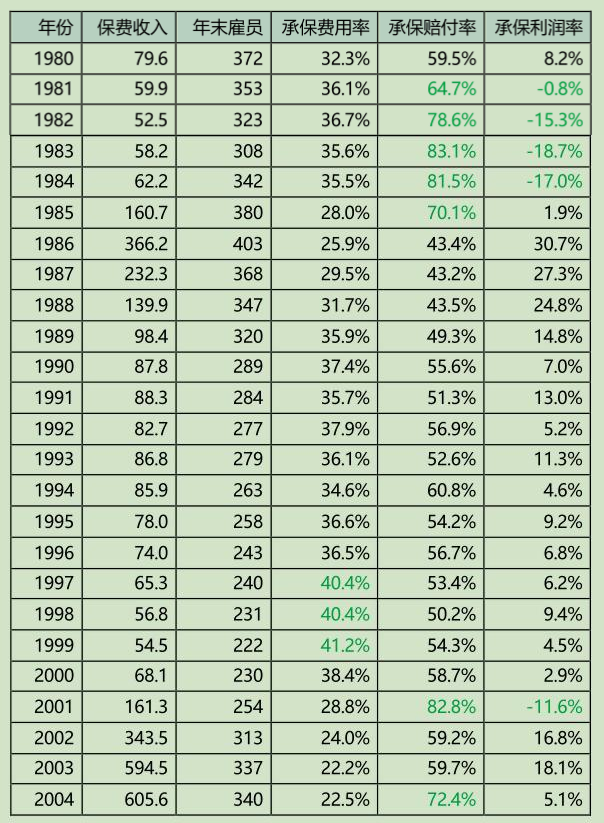
What we’ve had going for us is a managerial mindset that most insurers find impossible to replicate. Take a look at the facing page. Can you imagine any public company embracing a business model that would lead to the decline in revenue that we experienced from 1986 through 1999? That colossal slide, it should be emphasized, did not occur because business was unobtainable. Many billions of premium dollars were readily available to NICO had we only been willing to cut prices. But we instead consistently priced to make a profit, not to match our most optimistic competitor. We never left customers – but they left us.

我们所做的是一般保险业者绝对无法复制的一种管理思维,请大家看下表,大家肯定没有看过有公司可以忍受营收连续十多年(1986 年-1999 年)持续下滑的经营模式,我必须强调,那种大幅度下滑的原因并不是没有生意可做,事实上,只要我们愿意降点价格,马上就会有几十亿美元的保单上门,但国民保险宁可坚持有利润承保,也不愿为了营收与同业随波逐流,我们从来不弃客户于不顾,是客户主动离开我们。

Most American businesses harbor an “institutional imperative” that rejects extended decreases in volume. What CEO wants to report to his shareholders that not only did business contract last year but that it will continue to drop? In insurance, the urge to keep writing business is also intensified because the consequences of foolishly-priced policies may not become apparent for some time. If an insurer is optimistic in its reserving, reported earnings will be overstated, and years may pass before true loss costs are revealed (a form of self-deception that nearly destroyed GEICO in the early 1970s).

大部分的美国企业都怀有制度上的迫切需求——不愿看到营收大幅下滑,没有公司的 CEO 会愿意跟股东报告,去年不仅业务收缩,且将继续下滑。这在保险公司尤其明显,因为继续签发保单的愚昧的后果,可能要等上好长一段时间才会被发现,如果保险业者对于提列准备金过于乐观,那么帐面的收益便可能被夸大,而真正的损失可能要等好几个年头才会浮现(就是这种自欺欺人的技俩让 GEICO 在 1970 年代差点倒闭)。

*It takes a long time to learn the true profitability of any given year. First, many claims are received after the end of the year, and we must estimate how many of these there will be and what they will cost. (In insurance jargon, these claims are termed IBNR – incurred but not reported.) Second, claims often take years, or even decades, to settle, which means there can be many surprises along the way.

* 特定年度的获利情况通常需要很长一段时间以后才能知晓,其原因在于,首先,许多理赔申请通常要到年底才会提出,所以我们必须事先预估可能的数字,套句保险业的术语,这些理赔申请简称为 IBNR——发生但尚未申诉的案件,其次,理赔申请可能要好几年,有时甚至要数十年才能和解,其间可能横生许多波折。

For these reasons, the results in this column simply represent our best estimate at the end of 2004 as to how we have done in prior years. Profit margins for the years through 1999 are probably close to correct because these years are “mature,” in the sense that they have few claims still outstanding. The more recent the year, the more guesswork is involved. In particular, the results shown for 2003 and 2004 are apt to change significantly.

基于以上几个原因,上表的这些数字,仅代表我们在 2004 年底所能估算的预估,如同以往年度一样,截至1999 年的数字应该比较不会出错,因为那年以前的理赔申请案都已提出的差不多了,离现在越近的年度的数字,其估计的成份也就越大,尤其是最近两年,也就是 2003 年及 2004 年,日后大幅变化的可能性最大。

Finally, there is a fear factor at work, in that a shrinking business usually leads to layoffs. To avoid pink slips, employees will rationalize inadequate pricing, telling themselves that poorly-priced business must be tolerated in order to keep the organization intact and the distribution system happy. If this course isn’t followed, these employees will argue, the company will not participate in the recovery that they invariably feel is just around the corner.

最后,有一项恐惧因子在其间作祟——业务萎缩通常会导致裁员。为了避免被炒鱿鱼,员工通常将保费不当定价的原因合理化,告诉自己降价以保存组织完整是可以被忍受的,如此整个营销系统都将皆大欢喜,如果不这样做,员工们会声称,一旦景气回暖,公司将无法参与即将到来的复苏。

To combat employees’ natural tendency to save their own skins, we have always promised NICO’s workforce that no one will be fired because of declining volume, however severe the contraction. (This is not Donald Trump’s sort of place.) NICO is not labor-intensive, and, as the table suggests, can live with excess overhead. It can’t live, however, with underpriced business and the breakdown in underwriting discipline that accompanies it. An insurance organization that doesn’t care deeply about underwriting at a profit this year is unlikely to care next year either.

为了抵挡员工自保的天性,我们一再承诺,国民保险不会因为业务萎缩而裁员,这儿可跟唐纳德·特朗普那里不一样,国民保险不是劳力密集型公司,而正如上表所示,我们可以忍受额外的管理费用,但却绝不能忍受不当的定价,以及随之而来崩溃的核保纪律。因为现在不在乎核保利润的保险公司,以后也不可能会在乎。

Naturally, a business that follows a no-layoff policy must be especially careful to avoid overstaffing when times are good. Thirty years ago Tom Murphy, then CEO of Cap Cities, drove this point home to me with a hypothetical tale about an employee who asked his boss for permission to hire an assistant. The employee assumed that adding $20,000 to the annual payroll would be inconsequential. But his boss told him the proposal should be evaluated as a $3 million decision, given that an additional person would probably cost at least that amount over his lifetime, factoring in raises, benefits and other expenses (more people, more toilet paper). And unless the company fell on very hard times, the employee added would be unlikely to be dismissed, however marginal his contribution to the business.

当然采取不裁员态度的企业,一定要避免在景气好时人员过剩,30 年前当时大都会 CEO 汤姆墨菲用一个假想的小故事向我阐述了这一点,话说有位员工要求老板新增一个人力,这位员工认为公司一年增加 2 万美元的薪水开支没什么大不了,但他的老板却提醒他,考虑到加薪福利和其他费用(人越多用厕纸越多),因此要把它当做一个 300 万美元的提案一般慎重,因为除非公司真的快经营不下去了,否则这位员工将很难会被解雇,不管他对公司的贡献有多微薄。

It takes real fortitude – embedded deep within a company’s culture – to operate as NICO does. Anyone examining the table can scan the years from 1986 to 1999 quickly. But living day after day with dwindling volume – while competitors are boasting of growth and reaping Wall Street’s applause – is an experience few managers can tolerate. NICO, however, has had four CEOs since its formation in 1940 and none have bent. (It should be noted that only one of the four graduated from college. Our experience tells us that extraordinary business ability is largely innate.)

当然,要让像国民保险这样的文化,深植在公司的企业文化之中,必须要耗费相当大的功夫,看过这张表的人可以特别注意 1986 年到 1999 年的数字,很少有经理人可以默默忍受业务日渐下滑,特别是当其它竞争同业因为业绩大增而受到华尔街分析师的掌声之时,然而国民保险自 1940 年创立以来的四任总裁却没有一位屈服,特别要说明的是,这四位总裁只有一位拥有大学学历,经验告诉我们,非凡的商业能力大多是天生的。

The current managerial star – make that superstar – at NICO is Don Wurster (yes, he’s “the graduate”), who has been running things since 1989. His slugging percentage is right up there with Barry Bonds’ because, like Barry, Don will accept a walk rather than swing at a bad pitch. Don has now amassed $950 million of float at NICO that over time is almost certain to be proved the negative-cost kind. Because insurance prices are falling, Don’s volume will soon decline very significantly and, as it does, Charlie and I will applaud him ever more loudly.

现任国民保险的管理明星是 DonWurster,姑且称他为超级巨星(没错,拥有大学文凭的就是他),自 1989 年起便接掌该公司,他的打击率可以媲美 BarryBonds,因为跟 Bonds 一样,Don 宁愿选择保送,也不会对着坏球挥棒,总计到现在他已为我们累积了 9.5 亿美元的浮存金,而且几乎可以说是没有成本的,而由于目前的保费水准有下滑的趋势,所以国民保险的业务很可能会再度大幅下滑,关于这点,查理跟我百分之百支持他。

* * * * * * * * * * * *

* * * * * * * * * * * *

Another way to prosper in a commodity-type business is to be the low-cost operator. Among auto insurers operating on a broad scale, GEICO holds that cherished title. For NICO, as we have seen, an ebb-and-flow business model makes sense. But a company holding a low-cost advantage must pursue an unrelenting foot-to-the-floor strategy. And that’s just what we do at GEICO.

商品型的企业另一项生存之道就是,成为低成本经营者。在众多车险业者当中,GEICO 无疑荣获桂冠,至于周期起伏的国民保险,则是另外一种路遥知马力类型,但追求低成本的企业,必须努力不懈至始至终的维持成本优势,而 GEICO 正是如此。

A century ago, when autos first appeared, the property-casualty industry operated as a cartel. The major companies, most of which were based in the Northeast, established “bureau” rates and that was it. No one cut prices to attract business. Instead, insurers competed for strong, well-regarded agents, a focus that produced high commissions for agents and high prices for consumers.

一百年前,当汽车首次问世,财产意外险业是个垄断的行业,位于东北部的几家最主要的公司,订立了统一的费率,且完全不二价,没有人会杀价竞争,保险业者所竞逐的是实力强大备受好评的中介代理商,此举造成了代理商的高佣金,以及消费者的高费率。

In 1922, State Farm was formed by George Mecherle, a farmer from Merna, Illinois, who aimed to take advantage of the pricing umbrella maintained by the high-cost giants of the industry. State Farm employed a “captive” agency force, a system keeping its acquisition costs lower than those incurred by the bureau insurers (whose “independent” agents successfully played off one company against another). With its low-cost structure, State Farm eventually captured about 25% of the personal lines (auto and homeowners) business, far outdistancing its once-mighty competitors. Allstate, formed in 1931, put a similar distribution system into place and soon became the runner-up in personal lines to State Farm. Capitalism had worked its magic, and these low-cost operations looked unstoppable.

1922 年,伊利诺伊州 Merna 市的农场主 George Mecherle 创立了州立农业保险公司(State Farm),目标锁定在打破业界高成本巨头所建立的高价格同盟,州立农业保险雇用专属代理人团队,这一体系让他取得保单的成本远低于一般保险同业,其独立的代理商接二连三成功地干翻了其它业者,拜其低成本结构所赐,最终获取了25%的个人业务份额(含车险及住宅险在内),远远超越昔日强大的竞争对手,而创立于 1931 年的 Allstate 保险公司也仿效他们,设立类似的营销渠道,并一举跃居第二,仅次于州立农业保险公司,资本主义再度发挥神奇的效用,而这种低成本的营运确已势不可挡。

But a man named Leo Goodwin had an idea for an even more efficient auto insurer and, with a skimpy $200,000, started GEICO in 1936. Goodwin’s plan was to eliminate the agent entirely and to deal instead directly with the auto owner. Why, he asked himself, should there be any unnecessary and expensive links in the distribution mechanism when the product, auto insurance, was both mandatory and costly. Purchasers of business insurance, he reasoned, might well require professional advice, but most consumers knew what they needed in an auto policy. That was a powerful insight.

但此时有一个叫 Leo Goodwin 却有一个更有效率的想法,他在 1936 年以区区的 20 万美元创立 GEICO,Goodwin 计划完全淘汰代理商,而直接与车主接触(直销)。他认为汽车保险既是强制性的且又昂贵不堪时,中间为什么一定要有昂贵且不必要的代理销售机制。他认为商业保险的客户或许需要许多专业上的建议,但大多数的顾客都知道自己需要什么样的车险保单。这在当时真是真知灼见。

Originally, GEICO mailed its low-cost message to a limited audience of government employees. Later, it widened its horizons and shifted its marketing emphasis to the phone, working inquiries that came from broadcast and print advertising. And today the Internet is coming on strong.

一开始,GEICO 只是将其低价的讯息邮寄给少数的政府公务人员,之后又将范围扩大,并把销售重点摆在电话营销、广播及报章杂志渠道上,而时至今日,互联网渠道正在崛起。

Between 1936 and 1975, GEICO grew from a standing start to a 4% market share, becoming the country’s fourth largest auto insurer. During most of this period, the company was superbly managed, achieving both excellent volume gains and high profits. It looked unstoppable. But after my friend and hero Lorimer Davidson retired as CEO in 1970, his successors soon made a huge mistake by under-reserving for losses. This produced faulty cost information, which in turn produced inadequate pricing. By 1976, GEICO was on the brink of failure.

从 1936 到 1975 这 40 年间,GEICO 稳定起步并发展到 4%的市场占有率,成为全美第四大的汽车保险公司。大部分的时候,公司管理出色,营收与获利同步成长,看起来势不可挡,但直到该公司 CEO,同时也是我的好朋友 Davidson 在 1970 年宣布退休,情势随即起了变化,他的继任者犯下损失准备金提列不足的大错,此举大大扭曲了成本结构,进而导致不当的定价,1976 年,GEICO 已濒临倒闭。

Jack Byrne then joined GEICO as CEO and, almost single-handedly, saved the company by heroic efforts that included major price increases. Though GEICO’s survival required these, policyholders fled the company, and by 1980 its market share had fallen to 1.8%. Subsequently, the company embarked on some unwise diversification moves. This shift of emphasis away from its extraordinary core business stunted GEICO’s growth, and by 1993 its market share had grown only fractionally, to 1.9%. Then Tony Nicely took charge.

就在此时,Jack Byrne 加入 GEICO 担任 CEO,几乎是靠着一己之力,通过包含大幅调涨保费在内的努力拯救了公司,虽然这绝对是 GEICO 继续存活下去的必要之举,但客户却纷纷离去。到了 1980 年,市场占有率剧降至1.8%,此时 GEICO 却又做出多元化的不智之举,这使得过去赖以成长的核心业务顿时失去了重心,1993 年该公司的市占率仅微微增加到 1.9%。一直到托尼·莱斯利(Tony Nicely)接手后,事情才有了改观。

And what a difference that’s made: In 2005 GEICO will probably secure a 6% market share. Better yet, Tony has matched growth with profitability. Indeed, GEICO delivers all of its constituents major benefits: In 2004 its customers saved $1 billion or so compared to what they would otherwise have paid for coverage, its associates earned a $191 million profit-sharing bonus that averaged 24.3% of salary, and its owner – that’s us – enjoyed excellent financial returns.

这有什么不一样:2005 年 GEICO 将获得 6%的市场份额。更妙的是,托尼的增长和获利相匹配。事实上 GEICO 所有参与的成员皆同步受益:2004 年 GEICO 总计为保户节省了 10 亿美元的保费,员工领取了 1.91 亿美元的利润分享奖金,约占工资的 24.3%,至于股东们更获得了可观的投资回报。

There’s more good news. When Jack Byrne was rescuing the company in 1976, New Jersey refused to grant him the rates he needed to operate profitably. He therefore promptly – and properly – withdrew from the state. Subsequently, GEICO avoided both New Jersey and Massachusetts, recognizing them as two jurisdictions in which insurers were destined to struggle.

不仅如此,当 Jack 在 1976 年力图挽救 GEICO 之际,新泽西州拒绝其提高保险费率的提议,Jack 二话不说立刻退出该州的营运,之后 GEICO 又退出了马萨诸塞州,认定这两州监管机关的态度不利于保险业者的经营。

In 2003, however, New Jersey took a new look at its chronic auto-insurance problems and enacted legislation that would curb fraud and allow insurers a fair playing field. Even so, one might have expected the state’s bureaucracy to make change slow and difficult.

一直到 2003 年新泽西州终于开始正视其沉苛已久的车险市场,立法遏止保户骗保的行为,还给业者一个公平合理的经营环境。即便如此,人们还是预期该州的官僚主义作风会使得改革缓慢而困难重重。

But just the opposite occurred. Holly Bakke, the New Jersey insurance commissioner, who would be a success in any line of work, was determined to turn the law’s intent into reality. With her staff’s cooperation, GEICO ironed out the details for re-entering the state and was licensed last August. Since then, we’ve received a response from New Jersey drivers that is multiples of my expectations.

但恰恰相反,此时新泽西州优秀的保险官员 HollyBakke 在任何行业都会成功,他毅然决定将法律意图变为现实。在他们工作人员的配合下,GEICO 敲定了重返新泽西市场的细节计划,并于去年八月顺利取得营运执照,之后所获得的保单数量远远超过我的预期。

We are now serving 140,000 policyholders – about 4% of the New Jersey market – and saving them substantial sums (as we do drivers everywhere). Word-of-mouth recommendations within the state are causing inquiries to pour in. And once we hear from a New Jersey prospect, our closure rate – the percentage of policies issued to inquiries received – is far higher in the state than it is nationally.

目前我们拥有 14 万的保户,约占该州市场 4%,且一如其它州一样,GEICO 为他们节省了可观的保费,口耳相传的引荐使得询问电话蜂拥而至,而且据报该州的保单通过率(承保数量/询问数量)远远高于全美平均的水平。

We make no claim, of course, that we can save everyone money. Some companies, using rating systems that are different from ours, will offer certain classes of drivers a lower rate than we do. But we believe GEICO offers the lowest price more often than any other national company that serves all segments of the public. In addition, in most states, including New Jersey, Berkshire shareholders receive an 8% discount. So gamble fifteen minutes of your time and go to GEICO.com – or call 800-847-7536 – to see whether you can save big money (which you might want to use, of course, to buy other Berkshire products).

当然我们无法保证所有人都可以在我们这里拿到最低的保费,因为各家保险公司的计费标准不尽相同,但我敢保证在所有大型的保险公司当中,GEICO 可以提供多数人最低廉的保费,此外,只要是伯克希尔的股东,包含新泽西在内,都可以享受 8%的折扣,大家不妨花几分钟,去 GEICO 的公司网站,或打电话到 800-847-7536,问看看能不能省下一笔钱,(当然只要你喜欢,伯克希尔还有许多商品,任君选择)。

* * * * * * * * * * * *

* * * * * * * * * * * *

Reinsurance – insurance sold to other insurers who wish to lay off part of the risks they have assumed – should not be a commodity product. At bottom, any insurance policy is simply a promise, and as everyone knows, promises vary enormously in their quality.

再保险是保险业者为分散自身承担风险,将业务出售给同业的一项机制,不应该是一种商品型产品。说到底,保单只不过是一纸承诺,关键在于是谁所发出,所以,承诺的质量千差万别。

At the primary insurance level, nevertheless, just who makes the promise is often of minor importance. In personal-lines insurance, for example, states levy assessments on solvent companies to pay the policyholders of companies that go broke. In the business-insurance field, the same arrangement applies to workers’ compensation policies. “Protected” policies of these types account for about 60% of the property-casualty industry’s volume. Prudently-run insurers are irritated by the need to subsidize poor or reckless management elsewhere, but that’s the way it is.

至于对传统直接保险市场来说,谁做承诺就没有那么紧要,以个人险种来说,政府通常会向业者征收规费,用来支应倒闭业者付不出来的理赔金,至于商业险方面,工人赔偿保险也有类似的机制,这类具有防护机制的保险约占所有产险保单的 60%,虽然经营稳健的业者对于要被迫补贴经营不善的业者非常反感,但这行的游戏规则就是如此。

Other forms of business insurance at the primary level involve promises that carry greater risks for the insured. When Reliance Insurance and Home Insurance were run into the ground, for example, their promises proved to be worthless. Consequently, many holders of their business policies (other than those covering workers’ compensation) suffered painful losses.

其它商业保险的形式包括承诺保险,对保户来说具有更高的风险,当信实保险(Reliance InsuranceCo.成立于 1817 年,于 2001 年破产)与家庭保险公司(The Home Insurance Co.1991 年被 TVH 收购)破产时,他们的承诺最后被证实是空话,这使得许多保单持有者(不包括工伤赔偿险)蒙受痛苦的损失。

The solvency risk in primary policies, however, pales in comparison to that lurking in reinsurance policies. When a reinsurer goes broke, staggering losses almost always strike the primary companies it has dealt with. This risk is far from minor: GEICO has suffered tens of millions in losses from its careless selection of reinsurers in the early 1980s.

但这些履约风险跟再保险保单比起来根本就算不了什么,当再保险公司倒闭时,与其往来的保险公司将无一幸免遭受波及,这类的风险绝对不可等闲视之,GEICO 在 1980 年代便曾因为选择再保公司不慎而蒙受好几千万美元的损失。

Were a true mega-catastrophe to occur in the next decade or two – and that’s a real possibility – some reinsurers would not survive. The largest insured loss to date is the World Trade Center disaster, which cost the insurance industry an estimated $35 billion. Hurricane Andrew cost insurers about $15.5 billion in 1992 (though that loss would be far higher in today’s dollars). Both events rocked the insurance and reinsurance world. But a $100 billion event, or even a larger catastrophe, remains a possibility if either a particularly severe earthquake or hurricane hits just the wrong place. Four significant hurricanes struck Florida during 2004, causing an aggregate of $25 billion or so in insured losses. Two of these – Charley and Ivan – could have done at least three times the damage they did had they entered the U.S. not far from their actual landing points.

若是往后十年二十年内发生天大的灾难,这不是没有可能,可能会有一些再保险公司不支倒地,目前有史以来最大的损害当属 911 纽约世贸中心灾难,这场灾难给保险业带来了 350 亿美元损失。1992 年的安德鲁飓风给保险业带来 155 亿美元损失居次,(虽然以今日的币值应不只此数),这两起灾害都曾震惊整个保险业和再保险业界。但若一场特别强烈的超级大地震或是大飓风袭击了错误的地方,1000 亿美元以上的灾害损失也不是没有可能,2004 年在佛罗里达发生的四起飓风,合计造成 250 亿美元的经济损失,其中两起飓风(Charley 和 Ivan)差一点就登陆进入美国境内造成三倍以上的损失。

Many insurers regard a $100 billion industry loss as “unthinkable” and won’t even plan for it. But at Berkshire, we are fully prepared. Our share of the loss would probably be 3% to 5%, and earnings from our investments and other businesses would comfortably exceed that cost. When “the day after” arrives, Berkshire’s checks will clear.

许多保险业者认为 1000 亿美元以上的理赔损失根本就不可能发生,但在伯克希尔,我们却未雨绸缪,我们承担的损失比例可能在 3-5%,我们每年从投资及其它业务所赚取的收益轻松覆盖这些损失,即便是当电影《浩劫之后》(The day after)的核爆事件真的发生,伯克希尔所开出的支票依旧能兑现。

Though the hurricanes hit us with a $1.25 billion loss, our reinsurance operations did well last year. At General Re, Joe Brandon has restored a long-admired culture of underwriting discipline that, for a time, had lost its way. The excellent results he realized in 2004 on current business, however, were offset by adverse developments from the years before he took the helm. At NICO’s reinsurance operation, Ajit Jain continues to successfully underwrite huge risks that no other reinsurer is willing or able to accept. Ajit’s value to Berkshire is enormous.

虽然我们为飓风损失了 12.5 亿美元,但总的来说,去年的再保业务表现甚佳,通用再保险 JoeBrandon 也恢复往日的承保纪律,然而他在 2004 年缴出的成绩,却被他接手之前所埋下的恶果所抵销,至于国民保险公司的再保险业务,阿吉特·贾恩持续成功地接下别人不敢接的超大风险保单,阿吉特可说是伯克希尔的无价之宝。

* * * * * * * * * * * *

* * * * * * * * * * * *

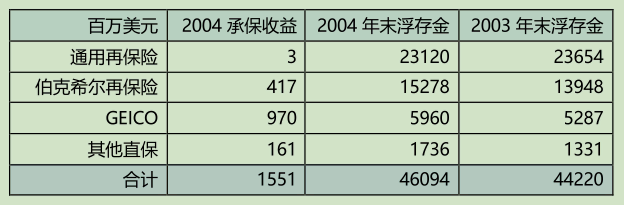
Our insurance managers, maximizing the competitive strengths I’ve mentioned in this section, again delivered first-class underwriting results last year. As a consequence, our float was better than costless. Here’s the scorecard:

我们的再保险经理人使得我们的竞争优势极大化,再度在去年缴出漂亮的成绩单,我们的浮存金成本甚至低于零,以下是他们的成绩单。
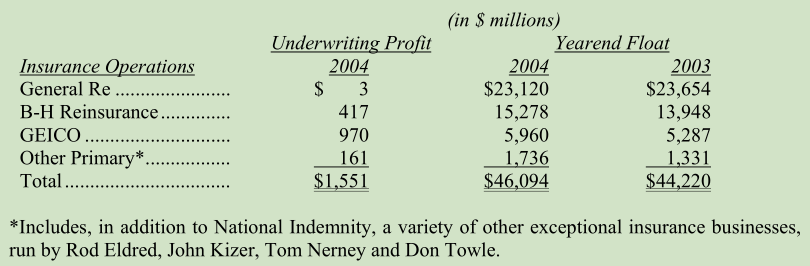
Berkshire’s float increased $1.9 billion in 2004, even though a few insureds opted to commute (that is, unwind) certain reinsurance contracts. We agree to such commutations only when we believe the economics are favorable to us (after giving due weight to what we might earn in the future on the money we are returning).

2004 年伯克希尔的浮存金又增加了 19 亿美元,虽然也有少数几位客户在到期后倾向解约,但只有在对我们有利的情况之下,我们才接受解约,也就是必须先衡量我们将钱退回给客户后,未来将因此少赚的回报。

To summarize, last year we were paid more than $1.5 billion to hold an average of about $45.2 billion. In 2005 pricing will be less attractive than it has been. Nevertheless, absent a mega-catastrophe, we have a decent chance of achieving no-cost float again this year.

总言之,去年为了保管这 452 亿美元,我们额外获得了 15 亿美元的回报,展望 2005 年市场定价较不吸引人,尽管如此,只要不发生什么重大的天灾地变,我们预计可以再次实现无成本的浮存金。

〔译文源于芒格书院整理的巴菲特致股东的信〕

© Copyright 2023 Meitiandudian. All Rights Reserved.