巴菲特致股东的信(2012年)④制造、服务和零售业务


Manufacturing, Service and Retailing Operations

制造、服务和零售业务

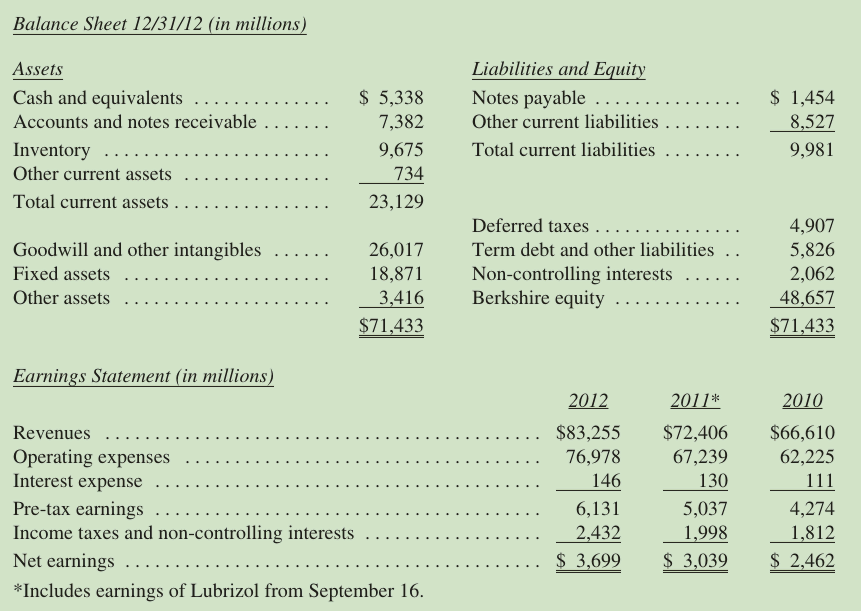
Our activities in this part of Berkshire cover the waterfront. Let’s look, though, at a summary balance sheet and earnings statement for the entire group.

我们在这部分的业务种类繁多。让我们看看整个集团的合并的资产负债表和利润表的摘要。

Our income and expense data conforming to Generally Accepted Accounting Principles (“GAAP”) is on page 29. In contrast, the operating expense figures above are non-GAAP. In particular, they exclude some purchase-accounting items, primarily the amortization of certain intangible assets. We present the data in this manner because Charlie and I believe the adjusted numbers more accurately reflect the real expenses and profits of the businesses aggregated in the table.

符合 GAAP 的收入和支出数据列示在后文。上表中的运营成本是不符合 GAAP 准则的。尤其是它剔除了一些购买法会计项目,主要是某些无形资产的摊销。我们列示这些数据是因为,查理和我认为这样的调整更准确地反映了整个业务真实的成本和利润。

I won’t explain all of the adjustments – some are small and arcane – but serious investors should understand the disparate nature of intangible assets: Some truly deplete over time while others never lose value.

我不打算逐一解释所有的调整(有些是细微并且晦涩的),但是认真的投资者必须要理解不同无形资产之间的本质区别:一些无形资产的价值随时间消耗殆尽,但是另外一些的价值永不贬值。

With software, for example, amortization charges are very real expenses. Charges against other intangibles such as the amortization of customer relationships, however, arise through purchase-accounting rules and are clearly not real expenses. GAAP accounting draws no distinction between the two types of charges. Both, that is, are recorded as expenses when calculating earnings – even though from an investor’s viewpoint they could not be more different.

比如软件,摊销费用是真实的成本。然而一些无形资产,比如客户关系,按购买法会计准则必须摊销,但是它并非真实的成本。GAAP 并不区分这两种摊销。两种费用都在计算收益时计入成本,尽管从投资者的角度看,它们是如此不同。

In the GAAP-compliant figures we show on page 29, amortization charges of $600 million for the companies included in this section are deducted as expenses. We would call about 20% of these “real” – and indeed that is the portion we have included in the table above – and the rest not. This difference has become significant because of the many acquisitions we have made.

在后文列示的 GAAP 准则的数字中,该部门 6 亿美元的摊销费用被计入了成本。我们大致认为其中的 20%是"真实"的,这也是我们上面的表格包括的部分,其他部分则不是。因为我们做了非常多的收购,这种差别变得影响巨大。

“Non-real” amortization expense also looms large at some of our major investees. IBM has made many small acquisitions in recent years and now regularly reports “adjusted operating earnings,” a non-GAAP figure that excludes certain purchase-accounting adjustments. Analysts focus on this number, as they should.

"非真实"的摊销费用还对我们一些主要的投资对象产生影响。IBM 近几年进行了许多小型并购,并且定期地报告"调整后的营业利润",一个剔除了某些购买法会计调整的非 GAAP 数据。分析师关注的是这个数字,他们理应如此。

A “non-real” amortization charge at Wells Fargo, however, is not highlighted by the company and never, to my knowledge, has been noted in analyst reports. The earnings that Wells Fargo reports are heavily burdened by an “amortization of core deposits” charge, the implication being that these deposits are disappearing at a fairly rapid clip. Yet core deposits regularly increase. The charge last year was about $1.5 billion. In no sense, except GAAP accounting, is this whopping charge an expense.

然而,富国银行没有强调它的"非真实"摊销费用,据我所知,分析师也未提及。富国银行报告收益深受"核心存款摊销"费用所累,这似乎意味着这些存款在迅速的消失。但是实际情形却是存款在不断增长。去年这项摊销是 15 亿美元。除了 GAAP 准则,这项异常巨大的摊销在哪里都不具有实际意思。

And that ends today’s accounting lecture. Why is no one shouting “More, more?”

今天的会计课到此结束。为什么没有人大声要求"再多讲一点,再讲一点?"

* * * * * * * * * * * *

* * * * * * * * * * * *

The crowd of companies in this section sell products ranging from lollipops to jet airplanes. Some of the businesses enjoy terrific economics, measured by earnings on unleveraged net tangible assets that run from 25% after-tax to more than 100%. Others produce good returns in the area of 12-20%. A few, however, have very poor returns, a result of some serious mistakes I made in my job of capital allocation.

这个板块公司销售的产品从棒棒糖到喷气式飞机的各种产品。有些公司有非常好的竞争优势,它们无杠杆净有形资产回报率从税后 25%到 100%多。其他公司的回报率介于 12-20%之间。但也有少数公司的回报率非常低,这是我们在资产配置上所犯下的严重错误。

More than 50 years ago, Charlie told me that it was far better to buy a wonderful business at a fair price than to buy a fair business at a wonderful price. Despite the compelling logic of his position, I have sometimes reverted to my old habit of bargain-hunting, with results ranging from tolerable to terrible. Fortunately, my mistakes have usually occurred when I made smaller purchases. Our large acquisitions have generally worked out well and, in a few cases, more than well.

50 多年前,查理就告诉我,以合理的价格买入一家优秀的公司,比以一个便宜的价格买入一家平庸的公司更好。尽管这个道理有着令人信服的逻辑,我还是时不时地犯捡便宜的的老毛病,其结果有些难以接受,有些则极其糟糕。幸运的是,我的错误通常发生在小额收购。大笔收购的企业通常进展顺利,少数甚至极好。

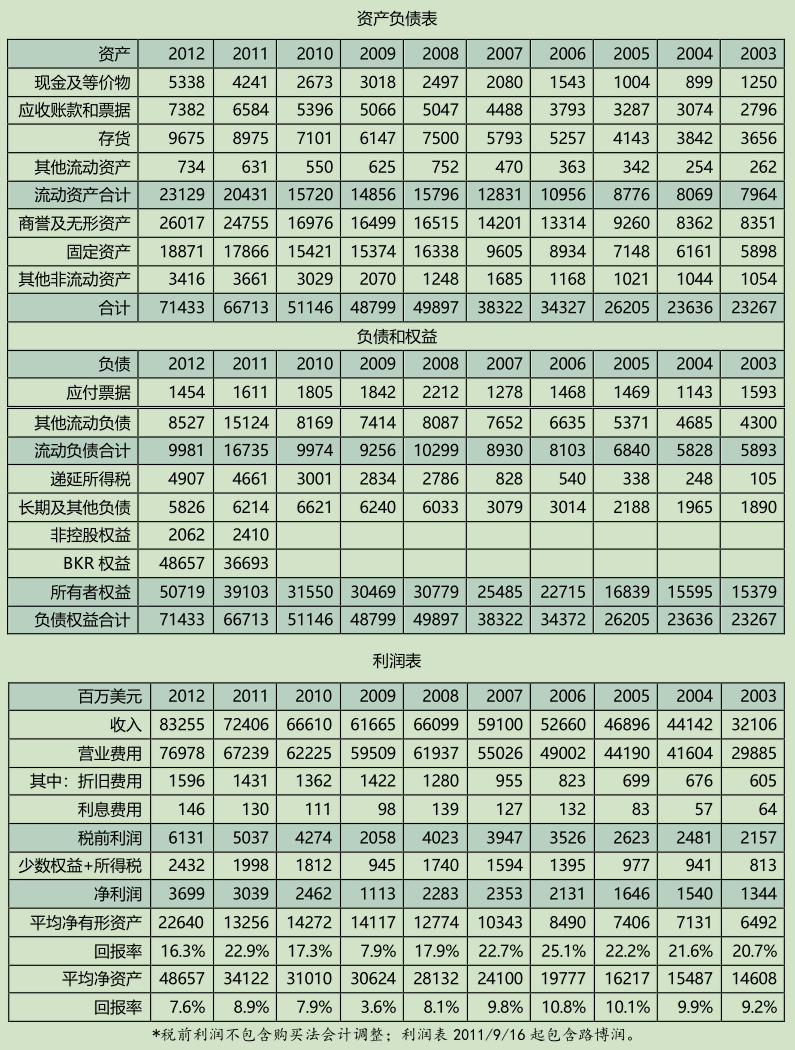
Viewed as a single entity, therefore, the companies in this group are an excellent business. They employ $22.6 billion of net tangible assets and, on that base, earned 16.3% after-tax.

把这个板块看做一个整体的话,这个企业集团的业绩非常不错。226 亿美元的净有形资产获得了 16.3%的税后收益。

Of course, a business with terrific economics can be a bad investment if the price paid is excessive. We have paid substantial premiums to net tangible assets for most of our businesses, a cost that is reflected in the large figure we show for intangible assets. Overall, however, we are getting a decent return on the capital we have deployed in this sector. Furthermore, the intrinsic value of the businesses, in aggregate, exceeds their carrying value by a good margin. Even so, the difference between intrinsic value and carrying value in the insurance and regulated- industry segments is far greater. It is there that the huge winners reside.

当然,如果出价过高,买入一些具有良好经济特性的公司也可能成为一笔糟糕的投资。我们大多数的收购里都支付了远超净有形资产的溢价,这些成本反映在财报巨额的无形资产数据中。不过总体来说,我们在该板块部署的资本收获了可观的回报。而且,这些公司的内在价值远超账面价值。需要说明的是,在保险业和受管制行业之间,内在价值和账面价值之间的差异更为巨大。那里才是真正的大赢家所在之处。

* * * * * * * * * * * *

* * * * * * * * * * * *

Marmon provides an example of a clear and substantial gap existing between book value and intrinsic value. Let me explain the odd origin of this differential.

Marmon 公司是一个说明内在价值和账面价值之间存在明显差异的极好例子。现在让我来解释一下这个这个诡异的差别源于何处。

Last year I told you that we had purchased additional shares in Marmon, raising our ownership to 80% (up from the 64% we acquired in 2008). I also told you that GAAP accounting required us to immediately record the 2011 purchase on our books at far less than what we paid. I’ve now had a year to think about this weird accounting rule, but I’ve yet to find an explanation that makes any sense – nor can Charlie or Marc Hamburg, our CFO, come up with one. My confusion increases when I am told that if we hadn’t already owned 64%, the 16% we purchased in 2011 would have been entered on our books at our cost.

去年,我告诉大家,我们 15 亿增持了 Marmon 额外的 16%股份,持股比例升至了80%(2008 年收购了 64%)。我还告诉大家,GAAP 准则要求,我们必须以远低于我们实际支付价格的成本记录这笔交易(减记 6.14 亿)。我花了一整年的时间来思考这条怪异的会计准则,但是没有找到任何合理解释。查理和CFO-MarcHamburg 也想不出来。当我得知,如果我们之前没有拥有 64%的权益,那我们 2011 年新购买的16%就可以以实际购买成本入账,我更加糊涂了。

In 2012 (and in early 2013, retroactive to yearend 2012) we acquired an additional 10% of Marmon and the same bizarre accounting treatment was required. The $700 million write-off we immediately incurred had no effect on earnings but did reduce book value and, therefore, 2012’s gain in net worth.

2012 年(实际发生在 2013 年初,但追溯调整至 2012 年底),我们又 14 亿增持了 Marmon 额外的 10%股份,同样奇怪的会计要求又出现了。立即减记的 7 亿美元没有影响我们的利润,但是降低了我们的账面价值,因此也降低了 2012 年公司的净资产值。

The cost of our recent 10% purchase implies a $12.6 billion value for the 90% of Marmon we now own. Our balance-sheet carrying value for the 90%, however, is $8 billion. Charlie and I believe our current purchase represents excellent value. If we are correct, our Marmon holding is worth at least $4.6 billion more than its carrying value.

最近 10%的收购价格意味着我们现在持有 Marmon 的 90%股份价值 126亿美元。但我们账面记录的价值仅有 80 亿。查理和我认为最近的收购价格代表了真实的价值。如果我们是对的,那我们持有 Marmon 的实际价值至少比账面价值高 46 亿美元。

Marmon is a diverse enterprise, comprised of about 150 companies operating in a wide variety of industries. Its largest business involves the ownership of tank cars that are leased to a variety of shippers, such as oil and chemical companies. Marmon conducts this business through two subsidiaries, Union Tank Car in the U.S. and Procor in Canada.

Marmon 是一家多元化公司,有 150 多家各个行业的子公司。它最大的业务是持有并租赁油罐车给各种货运公司,比如石油和化学品公司。Marmon 通过美国联合油罐(UnionTankCar)和加拿大 Procor 两家子公司运营这项业务。

Union Tank Car has been around a long time, having been owned by the Standard Oil Trust until that empire was broken up in 1911. Look for its UTLX logo on tank cars when you watch trains roll by. As a Berkshire shareholder, you own the cars with that insignia. When you spot a UTLX car, puff out your chest a bit and enjoy the same satisfaction that John D. Rockefeller undoubtedly experienced as he viewed his fleet a century ago.

Union TankCar 历史悠久,一直归 Standard Oil Trust 拥有,直到 1911 年帝国解体。有火车经过的时候留意看油罐上的 UTLX 标志。作为伯克希尔的股东,大家拥有带有这个商标的油罐车。当大家看到一辆 UTLX油罐车时,请挺起胸膛,并享受一个世纪前约翰·洛克菲勒看到自己的车队所享受到那种满足感。

Tank cars are owned by either shippers or lessors, not by railroads. At yearend Union Tank Car and Procor together owned 97,000 cars having a net book value of $4 billion. A new car, it should be noted, costs upwards of $100,000. Union Tank Car is also a major manufacturer of tank cars – some of them to be sold but most to be owned by it and leased out. Today, its order book extends well into 2014.

油罐车归货运商或者出租人所有,铁路公司并不拥有。至去年年底,UnionTankCar 和 Procor 一共拥有 9.7万辆油罐车,账面价值 40 亿美元(4.1 万美元/辆)。值得注意的是一辆新车成本约 10 万美元。UnionTankCar 还是一家主要的油罐车制造商,少部分出售但大部分自己持有并出租。现在它的订单已经排到 2012 年了。

At both BNSF and Marmon, we are benefitting from the resurgence of U.S. oil production. In fact, our railroad is now transporting about 500,000 barrels of oil daily, roughly 10% of the total produced in the “lower 48” (i.e. not counting Alaska and offshore). All indications are that BNSF’s oil shipments will grow substantially in coming years.

BNSF 和 Marmon 都受益于与美国原油生产的复苏。我们的铁路现在每天运输 50 万桶原油,大约是"下 48州"(不包括阿拉斯加和离岸州)总产量的 10%。种种迹象表明,BNSF 今年的原油运输量将会大幅增长。

* * * * * * * * * * * *

* * * * * * * * * * * *

Space precludes us from going into detail about the many other businesses in this segment. Company- specific information about the 2012 operations of some of the larger units appears on pages 76 to 79.

篇幅所限,我们不能在这里一一讨论许多其他公司的细节。其它具体业务请参见年报。

〔译文源于芒格书院整理的巴菲特致股东的信〕

© Copyright 2023 Meitiandudian. All Rights Reserved.