巴菲特致股东的信(2019年)④财产意外险业务


Property/Casualty Insurance

财产意外险业务

Our property/casualty (“P/C”) insurance business has been the engine propelling Berkshire’s growth since 1967, the year we acquired National Indemnity and its sister company, National Fire & Marine, for $8.6 million. Today, National Indemnity is the largest P/C company in the world as measured by net worth. Insurance is a business of promises, and Berkshire’s ability to honor its commitments is unmatched.

自从1967年我们以860万美元收购国民保险公司 (National Indemnity) 及其姊妹公司国民火灾及海事保险公司 (National Fire & Marine) 以来,财产意外险(简称"P/C")业务一直是推动伯克希尔成长的引擎。如今,以净资产衡量,国民保险已是全球最大的财产意外险公司。保险是一门关于承诺的生意,而伯克希尔履行承诺的能力无人能及。

One reason we were attracted to the P/C business was the industry’s business model: P/C insurers receive premiums upfront and pay claims later. In extreme cases, such as claims arising from exposure to asbestos, or severe workplace accidents, payments can stretch over many decades.

我们被财产意外险业务吸引的原因之一是这个行业的商业模式:保险公司先收保费,后赔付。在极端情况下,比如涉及石棉暴露或严重工伤事故的索赔,赔付可以延续数十年之久。

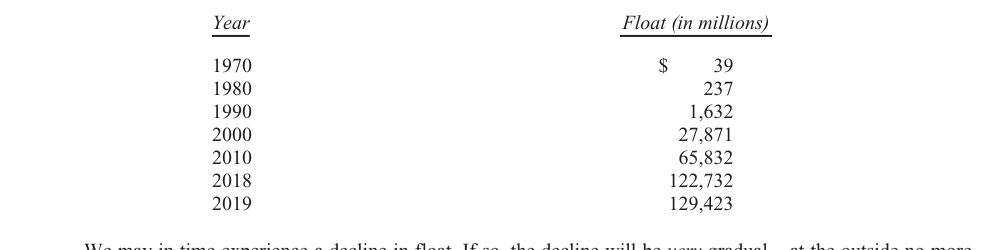
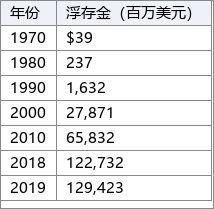
This collect-now, pay-later model leaves P/C companies holding large sums – money we call “float” – that will eventually go to others. Meanwhile, insurers get to invest this float for their own benefit. Though individual policies and claims come and go, the amount of float an insurer holds usually remains fairly stable in relation to premium volume. Consequently, as our business grows, so does our float. And how it has grown, as the following table shows:

这种"先收后付"的模式让保险公司手握大笔资金——我们称之为"浮存金"——这些钱最终要赔给别人。但在此期间,保险公司可以用浮存金为自己投资获利。尽管单个保单和索赔来来去去,保险公司持有的浮存金规模相对于保费收入通常保持相当稳定。因此,随着业务增长,我们的浮存金也随之增长。下表展示了它的增长历程:

We may in time experience a decline in float. If so, the decline will be very gradual – at the outside no more than 3% in any year. The nature of our insurance contracts is such that we can never be subject to immediate or near- term demands for sums that are of significance to our cash resources. That structure is by design and is a key component in the unequaled financial strength of our insurance companies. That strength will never be compromised.

随着时间推移,我们可能会经历浮存金的下降。如果出现这种情况,下降幅度将是非常缓慢的——任何一年至多不超过3%。我们保险合同的特性决定了,我们永远不会面临对现金资源构成重大影响的即时或短期偿付要求。这种结构是精心设计的,也是我们保险公司无与伦比的财务实力的关键组成部分。这种实力绝不会被削弱。

If our premiums exceed the total of our expenses and eventual losses, our insurance operation registers an underwriting profit that adds to the investment income the float produces. When such a profit is earned, we enjoy the use of free money – and, better yet, get paid for holding it.

如果保费收入超过了运营费用和最终赔付的总和,我们的保险业务就会录得承保利润,这将叠加到浮存金产生的投资收益之上。当我们赚到这样的利润时,我们就相当于在使用免费的资金——更美妙的是,我们还因为持有这些资金而获得报酬。

For the P/C industry as a whole, the financial value of float is now far less than it was for many years. That’s because the standard investment strategy for almost all P/C companies is heavily – and properly – skewed toward high-grade bonds. Changes in interest rates therefore matter enormously to these companies, and during the last decade the bond market has offered pathetically low rates.

对于整个财产意外险行业而言,如今浮存金的财务价值远不如从前。原因在于几乎所有财产意外险公司的标准投资策略都严重——而且恰当地——偏向高等级债券。因此,利率变动对这些公司影响巨大,而过去十年间,债券市场提供的收益率低得可怜。

Consequently, insurers suffered, as year by year they were forced – by maturities or issuer-call provisions – to recycle their “old” investment portfolios into new holdings providing much lower yields. Where once these insurers could safely earn 5 cents or 6 cents on each dollar of float, they now take in only 2 cents or 3 cents (or even less if their operations are concentrated in countries mired in the never-never land of negative rates).

结果,保险公司深受其害。由于债券到期或发行人赎回条款的原因,它们年复一年地被迫将"旧"投资组合置换为收益率更低的新持仓。曾经,这些保险公司可以稳稳地从每一美元浮存金中赚取5到6美分,现在却只能赚到2到3美分(如果业务集中在深陷负利率泥潭的国家,甚至更少)。

Some insurers may try to mitigate their loss of revenue by buying lower-quality bonds or non-liquid “alternative” investments promising higher yields. But those are dangerous games and activities that most institutions are ill-equipped to play.

一些保险公司可能试图通过买入更低质量的债券或承诺高收益的非流动性"另类"投资来弥补收入损失。但这些都是危险的游戏,大多数机构根本玩不起。

Berkshire’s situation is more favorable than that of insurers in general. Most important, our unrivaled mountain of capital, abundance of cash and a huge and diverse stream of non-insurance earnings allow us far more investment flexibility than is generally available to other companies in the industry. The many choices open to us are always advantageous – and sometimes have presented us with major opportunities.

伯克希尔的处境比一般保险公司要好得多。最重要的是,我们无可匹敌的雄厚资本、充裕的现金和庞大而多元的非保险收益流,赋予了我们远超行业同行的投资灵活性。摆在我们面前的众多选择总是有利的——有时候还会给我们带来重大机遇。

Our P/C companies have meanwhile had an excellent underwriting record. Berkshire has now operated at an underwriting profit for 16 of the last 17 years, the exception being 2017, when our pre-tax loss was a whopping $3.2 billion. For the entire 17-year span, our pre-tax gain totaled $27.5 billion, of which $400 million was recorded in 2019.

与此同时,我们的财产意外险业务保持着出色的承保记录。过去17年中,伯克希尔有16年实现了承保盈利,唯一的例外是2017年,当年我们的税前亏损高达32亿美元。在整整17年间,我们的税前承保收益合计275亿美元,其中2019年录得4亿美元。

That record is no accident: Disciplined risk evaluation is the daily focus of our insurance managers, who know that the rewards of float can be drowned by poor underwriting results. All insurers give that message lip service. At Berkshire it is a religion, Old Testament style.

这一记录并非偶然:严守纪律的风险评估是我们保险经理们每天关注的焦点,他们深知糟糕的承保结果会吞噬浮存金的投资回报。所有保险公司都把这句话挂在嘴边。在伯克希尔,这是一种旧约圣经式的信仰。

As I have repeatedly done in the past, I will emphasize now that happy outcomes in insurance are far from a sure thing: We will most certainly not have an underwriting profit in 16 of the next 17 years. Danger always lurks.

正如我过去反复强调的,我现在还要再说一遍:保险业取得好结果远非板上钉钉的事——在未来17年里,我们几乎不可能每16年都实现承保盈利。危险总是潜伏在暗处。

Mistakes in assessing insurance risks can be huge and can take many years – even decades – to surface and ripen. (Think asbestos.) A major catastrophe that will dwarf hurricanes Katrina and Michael will occur – perhaps tomorrow, perhaps many decades from now. “The Big One” may come from a traditional source, such as wind or earthquake, or it may be a total surprise involving, say, a cyber attack having disastrous consequences beyond anything insurers now contemplate. When such a mega-catastrophe strikes, Berkshire will get its share of the losses and they will be big – very big. Unlike many other insurers, however, handling the loss will not come close to straining our resources, and we will be eager to add to our business the next day.

评估保险风险的失误可能是巨大的,而且可能需要许多年——甚至几十年——才会浮出水面并爆发(想想石棉案)。一场让卡特里娜 (Katrina) 和迈克尔 (Michael) 飓风都相形见绌的大灾难终将发生——也许就在明天,也许几十年后。"终极大灾难"可能来自传统灾害,比如飓风或地震,也可能是完全出乎意料的——比方说一场网络攻击造成的灾难性后果,远超保险公司目前所能想象。当这样的超级灾难降临时,伯克希尔将承担我们应得的那份损失,而且损失会很大——非常大。但与许多其他保险公司不同的是,应对这笔损失远不至于让我们的资源捉襟见肘,而且我们会迫不及待地在第二天就扩大业务。


Close your eyes for a moment and try to envision a locale that might spawn a dynamic P/C insurer. New York? London? Silicon Valley?

闭上眼睛,试着想象一个可能孕育出一家充满活力的财产意外险公司的地方。纽约?伦敦?硅谷?

How about Wilkes-Barre?

威尔克斯-巴里 (Wilkes-Barre) 怎么样?

Late in 2012, Ajit Jain, the invaluable manager of our insurance operations, called to tell me that he was buying a tiny company – GUARD Insurance Group – in that small Pennsylvania city for $221 million (roughly its net worth at the time). He added that Sy Foguel, GUARD’s CEO, was going to be a star at Berkshire. Both GUARD and Sy were new names to me.

2012年末,我们保险业务不可或缺的经理人阿吉特·贾恩 (Ajit Jain) 打电话告诉我,他要以2.21亿美元(大致相当于当时的账面价值)收购宾夕法尼亚州那座小城里的一家小公司——GUARD保险集团 (GUARD Insurance Group)。他还说,GUARD的CEO赛·福格尔 (Sy Foguel) 将成为伯克希尔的一颗明星。GUARD和Sy这两个名字对我来说都是头一回听到。

Bingo and bingo: In 2019, GUARD had premium volume of $1.9 billion, up 379% since 2012, and also delivered a satisfactory underwriting profit. Since joining Berkshire, Sy has led the company into both new products and new regions of the country and has increased GUARD’s float by 265%.

答对了,而且双双答对:2019年,GUARD的保费收入达到19亿美元,自2012年以来增长了379%,同时也录得了令人满意的承保利润。加入伯克希尔以来,Sy带领公司进入了新的产品线和新的地区,并将GUARD的浮存金增加了265%。

In 1967, Omaha seemed an unlikely launching pad for a P/C giant. Wilkes-Barre may well deliver a similar surprise.

1967年,奥马哈似乎不太可能成为一家财产意外险巨头的起飞之地。威尔克斯-巴里很可能会带来类似的惊喜。

〔译文源于芒格书院整理的巴菲特致股东的信〕

© Copyright 2023 Meitiandudian. All Rights Reserved.