巴菲特致股东的信(1997年)
①概述


To the Shareholders of Berkshire Hathaway Inc.:

       Our gain in net worth during 1997 was $8.0 billion, which increased the per-share book value of both our Class A and Class B stock by 34.1%. Over the last 33 years (that is, since present management took over) per-share book value has grown from $19 to $25,488, a rate of 24.1% compounded annually.(1)

致伯克希尔·哈撒韦公司所有股东:

本公司 1997 年的账面价值增加 80 亿美元,A/B 股每股账面价值增长 34.1%(标普 33.4%),自现任管理层接手的 33 年以来,每股账面价值由当初的 19 美元成长到目前的 25488 美元,年复合成长率约为 24.1%。(1)

      1. All figures used in this report apply to Berkshire's A shares,
          the successor to the only stock that the company had outstanding
          before 1996. The B shares have an economic interest equal to 1/30th
          that of the A.

1. (在年报中所有的数据都适用于伯克希尔 A 级普通股,这是本公司在 1996 年以前流通在外唯一的一种股份,B级普通股只拥有 A 级普通股经济利益的 1/30)

       Given our gain of 34.1%, it is tempting to declare victory and move on. But last year's performance was no great triumph: Any investor can chalk up large returns when stocks soar, as they did in 1997. In a bull market, one must avoid the error of the preening duck that quacks boastfully after a torrential rainstorm, thinking that its paddling skills have caused it to rise in the world. A right-thinking duck would instead compare its position after the downpour to that of the other ducks on the pond.

看到我们高达 34.1%的超高回报率,大家可能忍不住要高呼胜利口号勇往直前,不过若是考虑到去年股市的状况,任何一个投资人都能可以在股市飙涨中大赚一票。牛市中,大家一定要避免成为暴雨后一只呱呱大叫的骄傲鸭子,以为是自己高超的泳技让他冲上了天。一只拥有理性思维的鸭子反而会在大雨过后,仔细观察池塘里其他的鸭子都在什么位置。

       So what's our duck rating for 1997? The table on the facing page shows that though we paddled furiously last year, passive ducks that simply invested in the S&P Index rose almost as fast as we did. Our appraisal of 1997's performance, then: Quack.

那么我们这只鸭子在 1997 年的表现又如何呢?报表显示虽然去年我们拼命的向前划,不过到最后我们发现其它被动投资标普 500 指数的鸭子 33.4%的表现一点也不比我们差,所以总结我们在 1997 年的表现是:也就是正常的呱呱叫而已!

       When the market booms, we tend to suffer in comparison with the S&P Index. The Index bears no tax costs, nor do mutual funds, since they pass through all tax liabilities to their owners. Last year, on the other hand, Berkshire paid or accrued $4.2 billion for federal income tax, or about 18% of our beginning net worth.

当股市正热时,相较于标普 500 指数,我们比较吃亏,因为指数或共同基金不必负担税收成本,他们可以直接将税负转嫁到投资人的身上,与之相反的是,伯克希尔去年必须认列高达 42 亿美元的联邦所得税,这相当于我们年初账面价值的 18%。

       Berkshire will always have corporate taxes to pay, which means it needs to overcome their drag in order to justify its existence. Obviously, Charlie Munger, Berkshire's Vice Chairman and my partner, and I won't be able to lick that handicap every year. But we expect over time to maintain a modest advantage over the Index, and that is the yardstick against which you should measure us. We will not ask you to adopt the philosophy of the Chicago Cubs fan who reacted to a string of lackluster seasons by saying, "Why get upset? Everyone has a bad century now and then."

由于伯克希尔必须要负担企业所得税,所以为了要证明我们存在的意义,它就一定要能够克服税负这个先天的障碍,不过很显然,伯克希尔的主要合伙人查理·芒格跟我很难每年都克服这个障碍打败指数,当然就长期而言,预期我们能够打败大盘指数,这也是大家衡量我们表现的最低标准,我想我们应该不会让大家像芝加哥小熊队球迷在面对连续几个战绩不佳的赛季时,自我调侃所说的:有什么好沮丧的?谁都可能有不好过的一世纪。

       Gains in book value are, of course, not the bottom line at Berkshire. What truly counts are gains in per-share intrinsic business value. Ordinarily, though, the two measures tend to move roughly in tandem, and in 1997 that was the case: Led by a blow-out performance at GEICO, Berkshire's intrinsic value (which far exceeds book value) grew at nearly the same pace as book value.

帐面价值的增加当然不是经营伯克希尔的最终目标,因为真正重要的是每股内在价值的增长,虽然在伯克希尔通常两者会以相当接近的幅度增长,1997 年的情况便是如此:受惠于 GEICO 保险爆炸性的成长,伯克希尔的内在价值(远高于帐面价值)以接近帐面价值成长的幅度增加。

       For more explanation of the term, intrinsic value, you may wish to refer to our Owner's Manual, reprinted on pages 62 to 71. This manual sets forth our owner-related business principles, information that is important to all of Berkshire's shareholders.

有关“内在价值”等名词的解释,请大家参阅股东手册,手册中揭示了本公司经营的宗旨,也包含了许多对伯克希尔股东相当重要的信息。

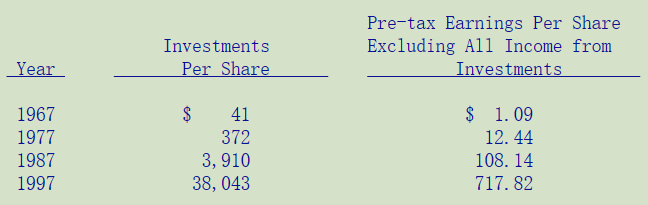
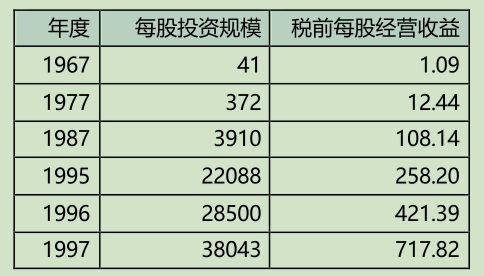
       In our last two annual reports, we furnished you a table that Charlie and I believe is central to estimating Berkshire's intrinsic value. In the updated version of that table, which follows, we trace our two key components of value. The first column lists our per-share ownership of investments (including cash and equivalents) and the second column shows our per-share earnings from Berkshire's operating businesses before taxes and purchase-accounting adjustments (discussed on pages 69 and 70), but after all interest and corporate expenses. The second column excludes all dividends, interest and capital gains that we realized from the investments presented in the first column. In effect, the columns show what Berkshire would look like were it split into two parts, with one entity holding our investments and the other operating all of our businesses and bearing all corporate costs.

在过去两年的年报中,我们提供给各位一张查理跟我认为最能够评估伯克希尔内在价值的表,在下表这个更新版本中,主要有两项跟价值息息相关的指标,第一列是我们平均每股持有的投资金额(包含现金与现金等价物),第二列则是每股在扣除利息与经营费用之后,来自本业的经营收益(但未扣除所得税与购买法会计调整数),当然已经扣除了所有来自第一列投资所实现的所有股利收入、利息收入与资本利得,事实上,若是把伯克希尔看成两家公司话,一家是持有所有投资组合的投资性业务,另一家是经营旗下所有业务并负担全部成本的经营性业务。

       Pundits who ignore what our 38,000 employees contribute to the company, and instead simply view Berkshire as a de facto investment company, should study the figures in the second column. We made our first business acquisition in 1967, and since then our pre-tax operating earnings have grown from $1 million to $888 million. Furthermore, as noted, in this exercise we have assigned all of Berkshire's corporate expenses -- overhead of $6.6 million, interest of $66.9 million and shareholder contributions of $15.4 million -- to our business operations, even though a portion of these could just as well have been assigned to the investment side.

对于那些无视于我们 3.8 万名辛勤奉献员工的存在,而武断地将伯克希尔当做是一家投资公司的权威人士,应该要请他们看看第二列的数字,打从 1967 年我们进行第一次的并购开始,本公司的税前收益已从当时的 100万美元成长到现在的 8.88 亿美元,这还是包含了伯克希尔全部的费用:660 万美元的企业营运费用、6,690 万美元的利息支出以及 1,540 万美元的股东指定捐赠款,虽然这其中有一部分是与投资活动相关的支出。

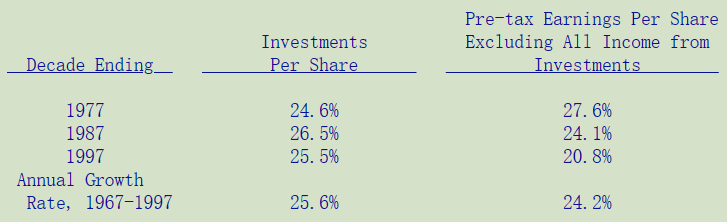
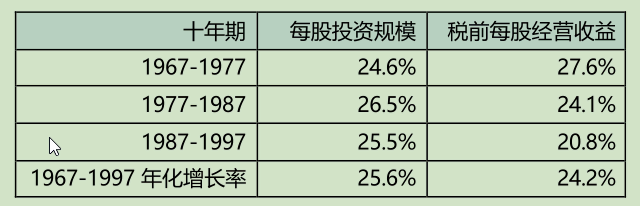
       Here are the growth rates of the two segments by decade:

下表是这两个部门每十年的成长率:

       During 1997, both parts of our business grew at a satisfactory rate, with investments increasing by $9,543 per share, or 33.5%, and operating earnings growing by $296.43 per share, or 70.3%. One important caveat: Because we were lucky in our super-cat insurance business (to be discussed later) and because GEICO's underwriting gain was well above what we can expect in most years, our 1997 operating earnings were much better than we anticipated and also more than we expect for 1998.

回顾 1997 年伯克希尔两个业务部分都缴出漂亮的成绩单,每股投资金额增加了 9,543 美元,约 33.5%;而每股经营收益则增加了 296.43 美元,约 70.3%,需要指出的是,我们的巨灾再保险业务的运气不错(后面还会在详加说明),同时 GEICO 保险的表现甚至优于以往,这使得 1997 年的经营表现超乎当初的预期,甚至超过我们对1998 年的预期表现。

       Our rate of progress in both investments and operations is certain to fall in the future. For anyone deploying capital, nothing recedes like success. My own history makes the point: Back in 1951, when I was attending Ben Graham's class at Columbia, an idea giving me a $10,000 gain improved my investment performance for the year by a full 100 percentage points. Today, an idea producing a $500 million pre-tax profit for Berkshire adds one percentage point to our performance. It's no wonder that my annual results in the 1950s were better by nearly thirty percentage points than my annual gains in any subsequent decade. Charlie's experience was similar. We weren't smarter then, just smaller. At our present size, any performance superiority we achieve will be minor.

我相信未来不管是投资或经营收益的成长速度一定会向下滑落,对于任何负责资本配置的人而言,成功必然导致衰退,我个人的投资历史说明了这一点,回想当初我在 1951 年进入哥伦大学拜在格雷厄姆名下时,只要抓住能够赚到 1 万美元的投资机会就能让我的投资绩效超过 100%,不过时至今日,一笔能赚 5 亿美元的成功投资个案,只能为伯克希尔的业绩增加 1%,也难怪个人在 1950 年代早期的投资绩效会比接下来几十年的年度绩效高出 30%,而查理本身的经历也很相似,不是我们变笨了,而是因为我们目前的规模实在是太大了,现在任何一项重大进展都会因为庞大的规模而显得微不足道。

       We will be helped, however, by the fact that the businesses to which we have already allocated capital -- both operating subsidiaries and companies in which we are passive investors -- have splendid long-term prospects. We are also blessed with a managerial corps that is unsurpassed in ability and focus. Most of these executives are wealthy and do not need the pay they receive from Berkshire to maintain their way of life. They are motivated by the joy of accomplishment, not by fame or fortune.

当然只要我们运营的子公司以及投资的股票具有长期远景,我们绝对能够因此受益,同时我们有幸拥有一支兼具卓越能力与专注力的经营团队,大家要知道这些经理人本身大多都已经很富有了,根本就不需要靠伯克希尔这份薪水过活,他们不为名利,纯粹是冲着那份成就感。

       Though we are delighted with what we own, we are not pleased with our prospects for committing incoming funds. Prices are high for both businesses and stocks. That does not mean that the prices of either will fall -- we have absolutely no view on that matter -- but it does mean that we get relatively little in prospective earnings when we commit fresh money.

虽然对于现有的投资组合感到相当满意,但是我们也对于陆续进来的资金找不到理想的去处而感到忧心,目前不管是整家公司或是单一股票的市场价格都过高,但我并不是要预言股价将会下跌,我们从来就不对股市发表任何看法,这样说的意思只是要提醒大家未来新投入资金的预期回报将会大大减少。

       Under these circumstances, we try to exert a Ted Williams kind of discipline. In his book The Science of Hitting, Ted explains that he carved the strike zone into 77 cells, each the size of a baseball. Swinging only at balls in his "best" cell, he knew, would allow him to bat .400; reaching for balls in his "worst" spot, the low outside corner of the strike zone, would reduce him to .230. In other words, waiting for the fat pitch would mean a trip to the Hall of Fame; swinging indiscriminately would mean a ticket to the minors.

在这种情况下,我们试着学习职棒传奇明星 Ted Williams 的作法,他在《击球的科学》一书中解释说,他把打击区域划分为 77 个球区,每个球区相当于一个棒球的大小,只有当球进入最佳的球区时,他才挥棒击球,因为只有这样做,他才能维持 40%的超高打击率,反之要是勉强去挥击较差的球区,将会使得他的打击率骤降到 23%以下,换句话说,只有耐心等待超甜的好球,才是通往名人堂的大道,好坏球照单全收的人,迟早会面临被降到小联盟的命运。

       If they are in the strike zone at all, the business "pitches" we now see are just catching the lower outside corner. If we swing, we will be locked into low returns. But if we let all of today's balls go by, there can be no assurance that the next ones we see will be more to our liking. Perhaps the attractive prices of the past were the aberrations, not the full prices of today. Unlike Ted, we can't be called out if we resist three pitches that are barely in the strike zone; nevertheless, just standing there, day after day, with my bat on my shoulder is not my idea of fun.

目前迎面朝我们而来的投资机会大多只在好球带边缘,如果我们选择挥棒,则得到的成绩可能会不太理想,但要是我们选择放弃不打,则没有人敢跟你保证下一球会更好,或许过去那种吸引人的超低价格已不复存在,所幸我们不必像 Ted Williams 一样,可能因为连续三次不挥棒而遭三振出局,只是光是扛着棒子站在那里,日复一日,也不是一件令人感到愉快的事。

〔译文源于芒格书院整理的巴菲特致股东的信〕

© Copyright 2023 Meitiandudian. All Rights Reserved.