巴菲特致股东的信(1999年)
⑪投资业务


Investments

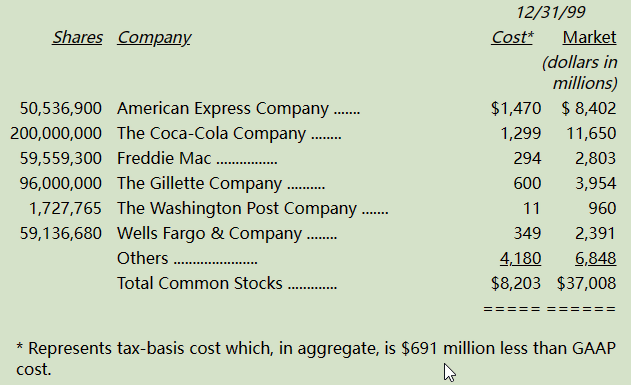
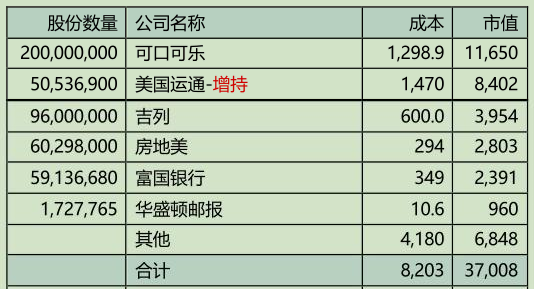
     Below we present our common stock investments. Those that had a market value of more than $750 million at the end of 1999 are itemized.

投资业务

下表是伯克希尔 1999 年市价超过 7.5 亿美元以上的股票投资。

     We made few portfolio changes in 1999. As I mentioned earlier, several of the companies in which we have large investments had disappointing business results last year. Nevertheless, we believe these companies have important competitive advantages that will endure over time. This attribute, which makes for good long-term investment results, is one Charlie and I occasionally believe we can identify. More often, however, we can't -- not at least with a high degree of conviction. This explains, by the way, why we don't own stocks of tech companies, even though we share the general view that our society will be transformed by their products and services. Our problem -- which we can't solve by studying up -- is that we have no insights into which participants in the tech field possess a truly durable competitive advantage.

1999 年我们只做了些许的变动,如同先前我曾提到的,去年有几家我们拥有重大投资部位的被投资公司其经营状况令人不甚满意,尽管如此,我们仍然相信这些公司拥有相当的竞争优势,可协助其继续稳定经营下去,这种可以让长期投资有不错成果的特点,是查理跟我还有点自信可以分辨得出的地方,只是有时我们也不敢百分之百保证一定没问题,这也是为什么我们从来不买高科技股票的原因,即使我们不得不承认它们所提供的产品与服务将会改变整个社会,问题是:就算是我们再想破头,也没有能力分辨出在众多的高科技公司中,到底是哪一些公司拥有长远的竞争优势。

     Our lack of tech insights, we should add, does not distress us. After all, there are a great many business areas in which Charlie and I have no special capital-allocation expertise. For instance, we bring nothing to the table when it comes to evaluating patents, manufacturing processes or geological prospects. So we simply don't get into judgments in those fields.

不过我必须强调,不懂高科技一点都不会让我感到沮丧,毕竟在这个世界上本来就有很多产业是查理跟我自认没有什么特殊的经验,举例来说,专利权评估、工厂制程与地区发展前景等,我们就一窍不通,所以我们从来不会想要在这些领域妄下评论。

     If we have a strength, it is in recognizing when we are operating well within our circle of competence and when we are approaching the perimeter. Predicting the long-term economics of companies that operate in fast-changing industries is simply far beyond our perimeter. If others claim predictive skill in those industries -- and seem to have their claims validated by the behavior of the stock market -- we neither envy nor emulate them. Instead, we just stick with what we understand. If we stray, we will have done so inadvertently, not because we got restless and substituted hope for rationality. Fortunately, it's almost certain there will be opportunities from time to time for Berkshire to do well within the circle we've staked out.  

如果说我们有什么能力,那就是我们深知要在具竞争优势的范围内,把事情尽量做好,以及明了可能的极限在哪里(最差会如何),而要预测在变化快速产业中经营的公司,其长期的经营前景如何,很明显的已超过我们的能力范围之外。如果有人宣称有能力做类似的预测,且以公司的股价表现做为左证,则我们一点也不会羡慕,更不会想要去仿效。相反的,我们会回过头来坚持我们所了解的东西,如果不幸偏离轨道,那也一定是不小心的,绝非着急想要给出合理的解释,还好可以确信的是,伯克希尔永远有机会找到它能力范围内可以做的事。

     Right now, the prices of the fine businesses we already own are just not that attractive. In other words, we feel much better about the businesses than their stocks. That's why we haven't added to our present holdings. Nevertheless, we haven't yet scaled back our portfolio in a major way: If the choice is between a questionable business at a comfortable price or a comfortable business at a questionable price, we much prefer the latter. What really gets our attention, however, is a comfortable business at a comfortable price.

目前我们拥有的这些好公司的股票价格其实不甚吸引人,从另外一个角度来看,我们认为它们的本质比起股价表现要好得多,这也是为什么我们并不急着增加持股,尽管如此,我们也没有大幅降低持股仓位,如果要在股价令人满意但有问题的公司,与股价有问题但令人满意的公司作选择,我们宁愿选择后者,当然真正会引起我们兴趣的,是那种公司令人满意,同时股价也令人满意的标的。

     Our reservations about the prices of securities we own apply also to the general level of equity prices. We have never attempted to forecast what the stock market is going to do in the next month or the next year, and we are not trying to do that now. But, as I point out in the enclosed article, equity investors currently seem wildly optimistic in their expectations about future returns.

我们对于目前大盘的股价表现,与先前对于本身持股投资组合股价的看法一致,我们从来不会想要试图去预测下个月或下一年度的股市走势,过去不会,现在也不会,不过如同我在附录的财富杂志文章中指出的,股市投资人现在对于目前持股所能产生的未来可能的投资回报实在是显得过于乐观。

     We see the growth in corporate profits as being largely tied to the business done in the country (GDP), and we see GDP growing at a real rate of about 3%. In addition, we have hypothesized 2% inflation. Charlie and I have no particular conviction about the accuracy of 2%. However, it's the market's view: Treasury Inflation-Protected Securities (TIPS) yield about two percentage points less than the standard treasury bond, and if you believe inflation rates are going to be higher than that, you can profit by simply buying TIPS and shorting Governments.

我们认为企业盈利的成长幅度,很大程度与一个国家的国内生产总额(GDP)的成长率有关,而我们估计目前GDP 的实际增长率大概只有 3%左右,此外再加上 2%预估通货膨胀,当然查理跟我无法对于 2%的通货膨胀率没有特别的信心,但这至少是市场上一般的共识,通胀保值债券(TIPS)的利率大约比标准政府公债低 2%左右,当然如果你感觉通货膨胀可能比这个数字还高,你大可以买进 TIPS 和放空政府公债来获利。

     If profits do indeed grow along with GDP, at about a 5% rate, the valuation placed on American business is unlikely to climb by much more than that. Add in something for dividends, and you emerge with returns from equities that are dramatically less than most investors have either experienced in the past or expect in the future. If investor expectations become more realistic -- and they almost certainly will -- the market adjustment is apt to be severe, particularly in sectors in which speculation has been concentrated.

而如果公司盈利果真与 GDP 预估 5%的成长走势相当,那么大家在对美国企业进行评价时的预期,就不可能过于乐观,若再加计配发的股利,那么你可以得出的预期股票回报率,可能远低于大部分投资人过去几年的投资绩效以及未来几年的投资预期,而如果投资人的期望能变得更实际一点,我相信总有一天他们一定会,则股市将会进行一波相当大程度的修正,尤其是投机气氛特别重的那类股票。(科网股)

     Berkshire will someday have opportunities to deploy major amounts of cash in equity markets -- we are confident of that. But, as the song goes, "Who knows where or when?" Meanwhile, if anyone starts explaining to you what is going on in the truly-manic portions of this "enchanted" market, you might remember still another line of song: "Fools give you reasons, wise men never try."

总有一天伯克希尔会有机会将大量的资金再度投入股市,这点我们相当有信心,不过就像有首歌的歌词是这样:“不知在何处?不知在何时?”当然要是有人想要试着跟你解释为何现今股市会如此的疯狂,请记住另一首歌的歌词:“笨蛋总是为不合理的事找理由,而聪明人则避而远之”。

〔译文源于芒格书院整理的巴菲特致股东的信〕

© Copyright 2023 Meitiandudian. All Rights Reserved.