巴菲特致股东的信(2001年)
⑧股票投资


Investments

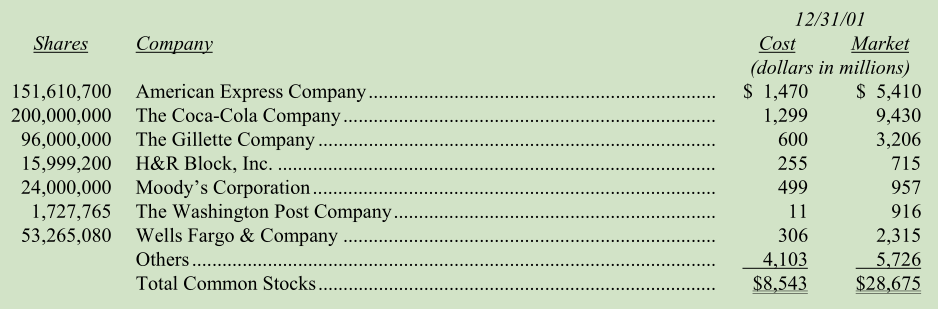
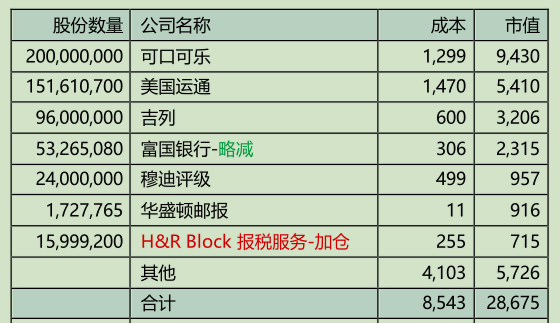
     Below we present our common stock investments. Those that had a market value of more than $500 million at the end of 2001 are itemized.

股票投资

下表是伯克希尔 2001 年市值超过 5 亿美元以上的股票投资。

     We made few changes in our portfolio during 2001. As a group, our larger holdings have performed poorly in the last few years, some because of disappointing operating results. Charlie and I still like the basic businesses of all the companies we own. But we do not believe Berkshire's equity holdings as a group are undervalued.

我们的投资组合在 2001 年几乎没有什么变动,总的来说,我们主要的投资部位近几年来的表现乏善可陈,有些本身的营运本就不尽理想,然而查理跟我还是相当喜爱这些公司的本业经营现况,不过我们也不认为现在这些投资组合的股价有受到任何的低估。

     Our restrained enthusiasm for these securities is matched by decidedly lukewarm feelings about the prospects for stocks in general over the next decade or so. I expressed my views about equity returns in a speech I gave at an Allen and Company meeting in July (which was a follow-up to a similar presentation I had made two years earlier) and an edited version of my comments appeared in a December 10th Fortune article. I'm enclosing a copy of that article. You can also view the Fortune version of my 1999 talk at our website www.berkshirehathaway.com.

我们对于持有股票保留的态度与我们对于当前股市未来十年内的前景不表乐观的看法相一致,我在 7 月份Allen 公司举办的会议中的演讲,表达了个人对于投资股市的看法,(早在两年前的太阳谷会议中我就已经表达过类似的看法),同时在同年 12 月 10 日的财富杂志中有关于个人看法的修正版,我也将之检附在年报之后,各位也可以在公司的网站上 www.berkshirehathaway.com 看到财富杂志 1999 年的文章。

     Charlie and I believe that American business will do fine over time but think that today's equity prices presage only moderate returns for investors. The market outperformed business for a very long period, and that phenomenon had to end. A market that no more than parallels business progress, however, is likely to leave many investors disappointed, particularly those relatively new to the game. 

查理跟我相信就长期而言,我们仍看好美国企业的发展,但目前股票的价格注定了投资人只能得到一般的回报,股市的表现已有好一段时间优于公司本身的表现,而这种现象终将结束,市场不可能永远超越企业本身的发展,我想这将让许多投资人大失所望,尤其是那些股市新手。

     Here's one for those who enjoy an odd coincidence: The Great Bubble ended on March 10, 2000 (though we didn't realize that fact until some months later). On that day, the NASDAQ (recently 1,731) hit its all-time high of 5,132. That same day, Berkshire shares traded at $40,800, their lowest price since mid-1997.

对于一些喜欢奇怪巧合的人来说,这里就有一个特别的:大泡沫在 2000 年 3 月 10 日正式结束(虽然我们实际要等到好几个月后才发现这项事实),纳斯达克指数当天创下 5,132 点的历史新高(现在约为 1,731 点),而在同一天,伯克希尔的股价 40,800 美元则以自 1997 年以来的最低价收盘。

     * * * * * * * * * * * *

     During 2001, we were somewhat more active than usual in "junk" bonds. These are not, we should emphasize, suitable investments for the general public, because too often these securities live up to their name. We have never purchased a newly-issued junk bond, which is the only kind most investors are urged to buy. When losses occur in this field, furthermore, they are often disastrous: Many issues end up at a small fraction of their original offering price and some become entirely worthless.

     * * * * * * * * * * * *

2001 年我们在垃圾债券市场的活动较以往频繁,但我们必须强调,这类投资并不适合一般投资大众,因为在多数情况下,这些垃圾往往名副其实,我们从来没有买过一般投资人最热衷的初次发行的垃圾债券,因为一旦发生违约,其损失必定惨重,有许多债券投资者最后仅能收回一小部分的资金,有的最后甚至变成废纸,使得投资人血本无归。

     Despite these dangers, we periodically find a few ¾ a very few ¾ junk securities that are interesting to us. And, so far, our 50-year experience in distressed debt has proven rewarding. In our 1984 annual report, we described our purchases of Washington Public Power System bonds when that issuer fell into disrepute. We've also, over the years, stepped into other apparent calamities such as Chrysler Financial, Texaco and RJR Nabisco ¾ all of which returned to grace. Still, if we stay active in junk bonds, you can expect us to have losses from time to time.

尽管风险颇大,我们不时还是可以找到极少数能够引起我们兴趣的垃圾债券,而且到目前为止,个人过去 50多年的垃圾债投资经验还算不错,在 1984 年的年报中,我们曾提到当初投资经营发生状况的华盛顿公用电力系统公司债,而这些年来我们也陆续介入其它有问题的公司债,诸如克莱斯勒金融《艾柯卡自传》、德州石油及 RJR纳贝斯克《门口的野蛮人》等公司,事后这些公司也都能重返光采,然而如果我们一直积极投入垃圾债券市场的话,总有一天我们会发生损失。

     Occasionally, a purchase of distressed bonds leads us into something bigger. Early in the Fruit of the Loom bankruptcy, we purchased the company's public and bank debt at about 50% of face value. This was an unusual bankruptcy in that interest payments on senior debt were continued without interruption, which meant we earned about a 15% current return. Our holdings grew to 10% of Fruit's senior debt, which will probably end up returning us about 70% of face value. Through this investment, we indirectly reduced our purchase price for the whole company by a small amount.

不过偶尔买进一些问题债也有可能让我们钓到大鱼,在鲜果布衣宣布破产的初期,我们以相当于面额 50%的价格买进该公司的债券与银行债权,该公司的破产案相当特殊,因为公司并未停止支付优先级债权的利息,这等于让我们获得了约 15%的当期收益,目前我们持有鲜果布衣优先级债权 10%的比例,最后我们很有可能收回相当于面额 70%的本金,经由这笔投资,我们等于间接降低了整个并购案的投资金额(约 1 亿)。

     In late 2000, we began purchasing the obligations of FINOVA Group, a troubled finance company, and that, too, led to our making a major transaction. FINOVA then had about $11 billion of debt outstanding, of which we purchased 13% at about two-thirds of face value. We expected the company to go into bankruptcy, but believed that liquidation of its assets would produce a payoff for creditors that would be well above our cost. As default loomed in early 2001, we joined forces with Leucadia National Corporation to present the company with a prepackaged plan for bankruptcy.

在 2000 年底,我们开始陆续买进 FINOVA 公司的债权,那是一家发生问题的财务金融公司,而此举又间接促成了另一笔投资案,FINOVA 当时约有 110 亿美元的债务流通在外,我们以面额 2/3(67 元)买进了其中约 13%的债权,我们预估这家公司将难逃破产的命运,但确信在清算这家公司之后,债权人可以收回的金额将远超当初投资的成本,该公司在 2001 年初违约,于是我们联合 Leucadia 公司向 FINOVA 提出一项破产重组方案。

     The plan as subsequently modified (and I'm simplifying here) provided that creditors would be paid 70% of face value (along with full interest) and that they would receive a newly-issued 7½% note for the 30% of their claims not satisfied by cash. To fund FINOVA's 70% distribution, Leucadia and Berkshire formed a jointly-owned entity ¾ mellifluently christened Berkadia ¾ that borrowed $5.6 billion through FleetBoston and, in turn, re-lent this sum to FINOVA, concurrently obtaining a priority claim on its assets. Berkshire guaranteed 90% of the Berkadia borrowing and also has a secondary guarantee on the 10% for which Leucadia has primary responsibility. (Did I mention that I am simplifying?).

这个提案后来经过修正(过程简单说明如下),每位债权人可以预先拿到面额 70%的本金(以及所有利息),至于剩下的 30%则用利率 7.5%的分期应付票据支付,而为了 FINOVA 顺利支付这 70%的本金,Leucadia 跟伯克希尔合资成立了一家新公司 Berkadia,通过 FleetBoston 向银团借入了 56 亿美元贷款,然后再将这笔资金转借给FINOVA,并由其取得 FINOVA 资产第一顺位的抵押权,伯克希尔则为 90%的 Berkadia 借款提供担保,剩下的10%则由 Leucadia 担保,伯克希尔则为第二顺位的保证人(我简单说明清楚了吗?)。

     There is a spread of about two percentage points between what Berkadia pays on its borrowing and what it receives from FINOVA, with this spread flowing 90% to Berkshire and 10% to Leucadia. As I write this, each loan has been paid down to $3.9 billion.

在 Berkadia 付给 FleetBoston 的利息费用与收到 FINOVA 的利息收入间,有 2%的利差,这部分利差 90%归伯克希尔,10%归 Leucadia,截至我写年报为止,这笔借款规模还剩下 39 亿美元。

     As part of the bankruptcy plan, which was approved on August 10, 2001, Berkshire also agreed to offer 70% of face value for up to $500 million principal amount of the $3.25 billion of new 7½% bonds that were issued by FINOVA. (Of these, we had already received $426.8 million in principal amount because of our 13% ownership of the original debt.) Our offer, which was to run until September 26, 2001, could be withdrawn under a variety of conditions, one of which became operative if the New York Stock Exchange closed during the offering period. When that indeed occurred in the week of September 11th, we promptly terminated the offer.

在 2001 年 8 月 10 日通过的破产计划中,伯克希尔同意以面额 70%的价格买下 FINOVA 预备发行总额 32.5亿美元 7.5%利率的分期付款票据中的 5 亿美元,(在这之前,我们已先收到 4.268 亿美元,这是我们先前投资13%债权所收回的本金),我们这项报价除了几项特殊的状况外,在 2001 年 9 月 26 日前都有效,其中一条就是纽约证券交易所在报价期间不会关闭,谁知后来竟发生 911 事件,于是我们马上取消这项提案。

     Many of FINOVA's loans involve aircraft assets whose values were significantly diminished by the events of September 11th. Other receivables held by the company also were imperiled by the economic consequences of the attack that day. FINOVA's prospects, therefore, are not as good as when we made our proposal to the bankruptcy court. Nevertheless we feel that overall the transaction will prove satisfactory for Berkshire. Leucadia has day-to-day operating responsibility for FINOVA, and we have long been impressed with the business acumen and managerial talent of its key executives.

FINOVA 许多贷款的价值系于二手飞机资产,在 911 事件发生后,这些资产价值大为减损,而其它应收帐款价值在该事件发生后也产生相当大的质变,也因此 FINOVA 的本质与前景已不若当初我们向破产法庭提案时那般,尽管如此,我们还是觉得整个交易对伯克希尔来说还算有利,Leucadia 对于 FINOVA 日常的营运付全责,我们一直对于其主要经理人精细的商业判断能力与管理才能印象深刻。

     * * * * * * * * * * * *

     It's déjà vu time again: In early 1965, when the investment partnership I ran took control of Berkshire, that company had its main banking relationships with First National Bank of Boston and a large New York City bank. Previously, I had done no business with either.

     * * * * * * * * * * * *

又到了似曾相识的时间了,早在 1965 年,当我管理的投资合伙企业控制了伯克希尔时,公司主要的往来银行是波士顿的第一国民银行以及纽约花旗银行,不过在此之前我个人与这两家银行并无往来。

     Fast forward to 1969, when I wanted Berkshire to buy the Illinois National Bank and Trust of Rockford. We needed $10 million, and I contacted both banks. There was no response from New York. However, two representatives of the Boston bank immediately came to Omaha. They told me they would supply the money for our purchase and that we would work out the details later.

后来到了 1969年,当伯克希尔有意买下伊利诺伊州国民银行和洛克福德信托公司时,我们当时需要 1000 万美元的资金,于是我连络这两家银行,花旗银行方面没有任何响应,但第一波士顿银行却立即派了两位代表到奥马哈,他们明确表示愿意提供并购所需的资金,并且稍后会制定细节。

     For the next three decades, we borrowed almost nothing from banks. (Debt is a four-letter word around Berkshire.) Then, in February, when we were structuring the FINOVA transaction, I again called Boston, where First National had morphed into FleetBoston. Chad Gifford, the company's president, responded just as Bill Brown and Ira Stepanian had back in 1969 ¾ "you've got the money and we'll work out the details later."

在这之后的 30 年内,我们几乎从不向银行借钱,(债务对伯克希尔来说不过是一个普通的名词而已),不过到了去年二月,当我们在规划 FINOVA 的融资架构时,我再度打电话给位于波士顿的这家银行,当时的第一国民银行已经改名为 FleetBoston,该银行的总裁 ChadGifford 的响应与当初 1969 年 BillBrown 及 IraStepanian 一模一样:"你会拿到资金,我们稍后制定细节"。

     And that's just what happened. FleetBoston syndicated a loan for $6 billion (as it turned out, we didn't need $400 million of it), and it was quickly oversubscribed by 17 banks throughout the world. Sooooo . . . if you ever need $6 billion, just give Chad a call ¾ assuming, that is, your credit is AAA.

事情就是这样,由 FleetBoston 组织了一个 60 亿美元的银团贷款案(结果实际上有 4 亿没有用到),立刻得到全世界 17 家银行的超额认购,所以如果你需要 60 亿美元的资金,可以打电话给 Chad,只要你的信用等级是最高的 AAA 等级。

     * * * * * * * * * * * *

     One more point about our investments: The media often report that "Buffett is buying" this or that security, having picked up the "fact" from reports that Berkshire files. These accounts are sometimes correct, but at other times the transactions Berkshire reports are actually being made by Lou Simpson, who runs a $2 billion portfolio for GEICO that is quite independent of me. Normally, Lou does not tell me what he is buying or selling, and I learn of his activities only when I look at a GEICO portfolio summary that I receive a few days after the end of each month. Lou's thinking, of course, is quite similar to mine, but we usually end up in different securities. That's largely because he's working with less money and can therefore invest in smaller companies than I. Oh, yes, there's also another minor difference between us: In recent years, Lou's performance has been far better than mine.

     * * * * * * * * * * * *

关于投资还有一点要说明,媒体经常报导说"巴菲特正在买进"这支或那支股票,其中大多是媒体经由伯克希尔向主管机关申报的文件中推敲出蛛丝马迹,这些报导有时正确,但有时伯克希尔申报的交易也有可能是LouSimpson 的杰作,他个人独立管理 GEICO 旗下 20 亿美元的投资部位,Lou 不会告诉我,他正在买进或卖出什么股票,而通常我是在每个月结束后几天看到投资月报表时才知道他的交易活动,当然 Lou 的投资哲学与我非常相近,但通常我们买进的股票截然不同,主要的原因在于他管理的资金相较于伯克希尔规模小了许多,因此他可以投资一些小型公司。哦!当然我们之间还有一点不太相同,那就是他的投资绩效比起我来要好太多了。

〔译文源于芒格书院整理的巴菲特致股东的信〕

© Copyright 2023 Meitiandudian. All Rights Reserved.