巴菲特致股东的信(2002年)⑦股票投资


Investments

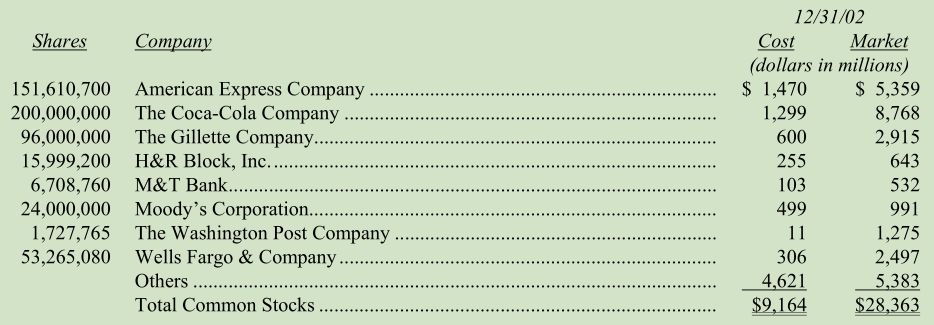
Below we show our common stock investments. Those that had a market value of more than $500 million at the end of 2002 are itemized.

股票投资

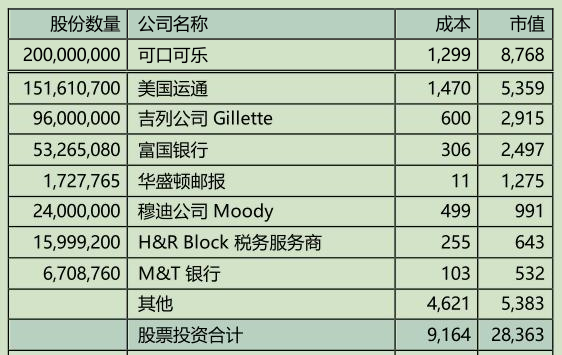
下表是伯克希尔 2002 年市价超过 5 亿美元以上的股票投资。

We continue to do little in equities. Charlie and I are increasingly comfortable with our holdings in Berkshire’s major investees because most of them have increased their earnings while their valuations have decreased. But we are not inclined to add to them. Though these enterprises have good prospects, we don’t yet believe their shares are undervalued.

在股票投资方面,我们依旧没有什么动作,查理跟我对于伯克希尔目前主要的持股组合越来越感到满意,一方面由于被投资公司的收益逐渐增加,同时其估值反而下滑,不过现在我们还是无意增加持股仓位,虽然这些公司的前景都相当不错,但截至目前为止,我们还是不认为他们的股价低估了。

In our view, the same conclusion fits stocks generally. Despite three years of falling prices, which have significantly improved the attractiveness of common stocks, we still find very few that even mildly interest us. That dismal fact is testimony to the insanity of valuations reached during The Great Bubble. Unfortunately, the hangover may prove to be proportional to the binge.

我们认为,这种看法也大体上适用于股票市场。尽管股市连续三年下跌,相对大大增加了投资股票的吸引力,但我们还是很难找到真正能够引起我们兴趣的投资标的,这一令人沮丧的事实证明了,网络大泡沫时期估值的疯狂。而很不幸的,狂欢之后所带来的宿醉截至目前而止仍然尚未完全消退。

The aversion to equities that Charlie and I exhibit today is far from congenital. We love owning common stocks – if they can be purchased at attractive prices. In my 61 years of investing, 50 or so years have offered that kind of opportunity. There will be years like that again. Unless, however, we see a very high probability of at least 10% pre-tax returns (which translate to 6½-7% after corporate tax), we will sit on the sidelines. With short-term money returning less than 1% after-tax, sitting it out is no fun. But occasionally successful investing requires inactivity.

查理跟我现在对于股票退避三舍的态度,并非天生如此,事实上,我们非常喜欢投资股票,我是说如果可以以合理的价格购买的话,在我个人 61 年的投资生涯中,大约有 50 个年头以上,都有这样的机会出现,我想以后也还会有相当多类似的机会,只不过,除非是我们发现,至少可以获得税前 10%回报率的概率相当高时(即税后6-7%的回报),否则我们宁可在旁观望,虽然必须忍受短期闲置资金不到 1%的税后回报,但有时成功的投资本来就必须要有耐性。

Last year we were, however, able to make sensible investments in a few “junk” bonds and loans. Overall, our commitments in this sector sextupled, reaching $8.3 billion by yearend.

所幸,去年我们得以将部分资金运用在一些不错的垃圾债券及债权投资之上,至去年底我们在这方面的累计投资金额增加了 6 倍,达到 83 亿美元。

Investing in junk bonds and investing in stocks are alike in certain ways: Both activities require us to make a price-value calculation and also to scan hundreds of securities to find the very few that have attractive reward/risk ratios. But there are important differences between the two disciplines as well. In stocks, we expect every commitment to work out well because we concentrate on conservatively financed businesses with strong competitive strengths, run by able and honest people. If we buy into these companies at sensible prices, losses should be rare. Indeed, during the 38 years we have run the company’s affairs, gains from the equities we manage at Berkshire (that is, excluding those managed at General Re and GEICO) have exceeded losses by a ratio of about 100 to one.

投资垃圾债券跟投资股票在许多方面相当雷同,两者都需要评估价格与价值比,并在成千上万个标的中挑选出少数风险/回报比率最佳者,当然两者在原则上也有许多明显的不同,在投资股票时,我们预期每一笔投资都会成功,因为我们专注于少数几家财务稳健、具备竞争优势并由才干诚信兼具的经理人所经营的公司上,如果我们以合理的价格买进这类公司时,损失发生的机率通常非常小。事实上在我们经营伯克希尔的 38 年当中(扣除通用再保险与 GEICO 的投资),投资收益的跟亏损的比例约为 100 比 1。

Purchasing junk bonds, we are dealing with enterprises that are far more marginal. These businesses are usually overloaded with debt and often operate in industries characterized by low returns on capital. Additionally, the quality of management is sometimes questionable. Management may even have interests that are directly counter to those of debtholders. Therefore, we expect that we will have occasional large losses in junk issues. So far, however, we have done reasonably well in this field.

但在投资垃圾债券时,我们面对的企业体质就比较差了,这些公司通常都背负大笔的负债,同时所处产业的投资回报率都相当低,此外管理层的素质有时也有问题,其利益有时甚至与债权人相冲突,因此我们预期这类投资难免会出现亏损,所幸到目前为止,我们在这个领域的投资绩效还算相当不错。

〔译文源于芒格书院整理的巴菲特致股东的信〕

© Copyright 2023 Meitiandudian. All Rights Reserved.