巴菲特致股东的信(2003年)②经营收益


Operating Earnings

经营收益

When valuations are similar, we strongly prefer owning businesses to owning stocks. During most of our years of operation, however, stocks were much the cheaper choice. We therefore sharply tilted our asset allocation in those years toward equities, as illustrated by the percentages cited earlier.

当估值相近,我们强烈偏爱拥有一整家企业胜于持有部分股票,当然在我们经营的大多数年头里,股票往往还是比较便宜的选择,也因此在我们的资产组合中,股票投资还是占大多数,其比例如同先前所提到的。

In recent years, however, we’ve found it hard to find significantly undervalued stocks, a difficulty greatly accentuated by the mushrooming of the funds we must deploy. Today, the number of stocks that can be purchased in large enough quantities to move the performance needle at Berkshire is a small fraction of the number that existed a decade ago. (Investment managers often profit far more from piling up assets than from handling those assets well. So when one tells you that increased funds won’t hurt his investment performance, step back: His nose is about to grow.)

然而近年来,我们发现越来越难再找到股价被低估的股票,尤其是当我们手头上可运用的资金不断地大量涌入,时至今日,可以买到的规模足以撼动在伯克希尔绩效指标的股票数量已屈指可数,远不如十年前,(基金经理人通常依靠累积基金规模而非基金业绩而获益,所以如果有人告诉你基金规模不会影响业绩的话,小心点!注意他的鼻子要开始变长了)。

The shortage of attractively-priced stocks in which we can put large sums doesn’t bother us, providing we can find companies to purchase that (1) have favorable and enduring economic characteristics; (2) are run by talented and honest managers and (3) are available at a sensible price. We have purchased a number of such businesses in recent years, though not enough to fully employ the gusher of cash that has come our way. In buying businesses, I’ve made some terrible mistakes, both of commission and omission. Overall, however, our acquisitions have led to decent gains in per-share earnings.

找不到大量价格便宜且能承载我们资金体量的股票对我们并不会造成困扰,只要我们能够找到具备以下三项特点的公司收购:(1)拥有优秀可持续的竞争优势;(2)由才德兼具的经理人所经营,以及(3)可以用合理的价格买到。近年来,尽管仍不足以消化源源不断流入的资金,我们确实买进不少这类的企业,在企业并购方面,我犯过许多可怕的错误,不论是已经造成的或是该做未做的,然而总的来说,这些并购案还是让我们每股收益有不错的表现。

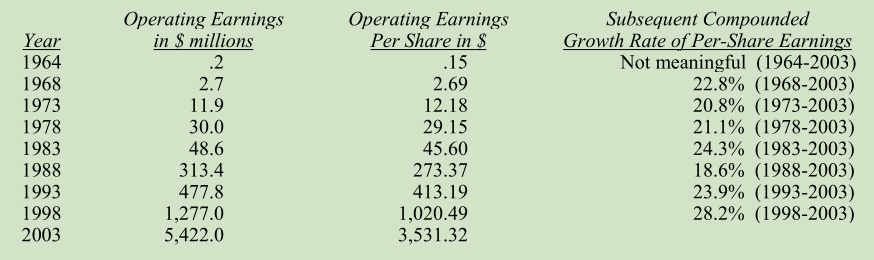
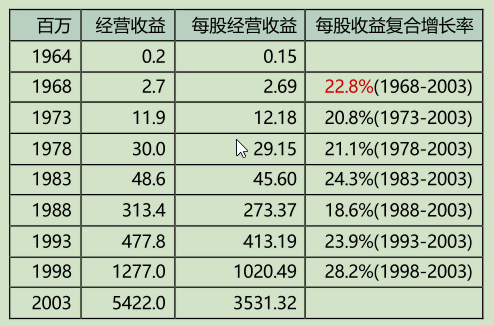
Below is a table that quantifies that point. But first we need to warn you that growth-rate presentations can be significantly distorted by a calculated selection of either initial or terminal dates. For example, if earnings are tiny in a beginning year, a long-term performance that was only mediocre can be made to appear sensational. That kind of distortion can come about because the company at issue was minuscule in the base year – which means that only a handful of insiders actually benefited from the touted performance – or because a larger company was then operating at just above breakeven. Picking a terminal year that is particularly buoyant will also favorably bias a calculation of growth.

下表足以量化以上的论点,但首先我要提醒大家的是,成长率可能因为基期或末期时间点的不同选择,而有相当大的差异,比如说,如果所选择的基期收益很低,那么一个普通的长期业绩也可能让人觉得很可观,实际上却只有少数人能够受益,这种业绩歪曲情况之所以能出现,是因为该公司在起始年份的规模还非常小,这就意味着只有少数内部人员能够因为业绩增长而受惠,或只是一家赚取微薄利润的大公司,同样地,选定收益偏高的末期也可以让成长率特别好看。

The Berkshire Hathaway that present management assumed control of in 1965 had long been sizable. But in 1964, it earned only $175,586 or 15 cents per share, so close to breakeven that any calculation of earnings growth from that base would be meaningless. At the time, however, even those meager earnings looked good: Over the decade following the 1955 merger of Berkshire Fine Spinning Associates and Hathaway Manufacturing, the combined operation had lost $10.1 million and many thousands of employees had been let go. It was not a marriage made in heaven.

自 1965 年现有管理层取得控制权以来,伯克希尔的规模就已经相当大,但 1964 年这家公司只不过赚了175,586 美元,每股收益约当 15 美分,这也就比收支平衡稍微好一点,因此以此基期所计算的成长率可以说毫无意义,但是考量当时的时代背景,如此微薄的收益似乎还可以:自从 1955 年在伯克希尔纺织与哈撒韦工业合并后的十年,该公司累计亏损了 1,010 万美元,数千名员工被解雇,这显然不是天作之合。

Against this background, we give you a picture of Berkshire’s earnings growth that begins in 1968, but also includes subsequent base years spaced five years apart. A series of calculations is presented so that you can decide for yourself which period is most meaningful. I’ve started with 1968 because it was the first full year we operated National Indemnity, the initial acquisition we made as we began to expand Berkshire’s business.

基于这样的背景,我们决定以 1968 年做为基期,来描述在伯克希尔收益成长的幅度,并且另外再以每五年为间距计算成长率,一系列不同的计算方式主要是想让大家得以自行判断选择最合理的解释,之所以选择 1968年,是因为那年是我们经营国民保险的第一个完整年度,该公司是在伯克希尔对外扩张的第一家并购企业。

I don’t believe that using 2003 as the terminal year distorts our calculations. It was a terrific year for our insurance business, but the big boost that gave to earnings was largely offset by the pathetically low interest rates we earned on our large holdings of cash equivalents (a condition that will not last). All figures shown below, it should be noted, exclude capital gains.

另外我也不认为选择 2003 年为末期就会大幅改变我们的计算结果,虽然当年我们保险事业表现极佳,但是这部分的高获利,却被手头上大量闲置资金赚取的微薄利息所抵消掉(相信这种情况不会维持太久),有一点必须特别说明的是,以下所有显示的数字并未包含资本利得在内。

We will continue the capital allocation practices we have used in the past. If stocks become significantly cheaper than entire businesses, we will buy them aggressively. If selected bonds become attractive, as they did in 2002, we will again load up on these securities. Under any market or economic conditions, we will be happy to buy businesses that meet our standards. And, for those that do, the bigger the better. Our capital is underutilized now, but that will happen periodically. It’s a painful condition to be in – but not as painful as doing something stupid. (I speak from experience.)

往后我们仍将维持过去惯用的资本配置方式,如果买股票比买整家公司便宜,我们就会大肆买入,如果特定的债券够吸引人,就像是 2002 年一样,我们就会大量买进这类债券。不管市场或经济状况如何,我们随时都很乐意买进符合我们标准的企业,而且规模最好越大越好,目前我们的资金并未被充分利用,这种情况时而有之,虽然这让人感到不太好受,但那总比干蠢事好得多,(这可是我从惨痛的教训中学来的)。

Overall, we are certain Berkshire’s performance in the future will fall far short of what it has been in the past. Nonetheless, Charlie and I remain hopeful that we can deliver results that are modestly above average. That’s what we’re being paid for.

总的来说,可以确定的是在伯克希尔往后的表现肯定远不及过去的业绩,但尽管如此,查理跟我还是希望我们的成绩能够高于一般平均水平,这也是我们存在的意义。

〔译文源于芒格书院整理的巴菲特致股东的信〕

© Copyright 2023 Meitiandudian. All Rights Reserved.