巴菲特致股东的信(2005年)⑦投资业务


Investments

投资业务

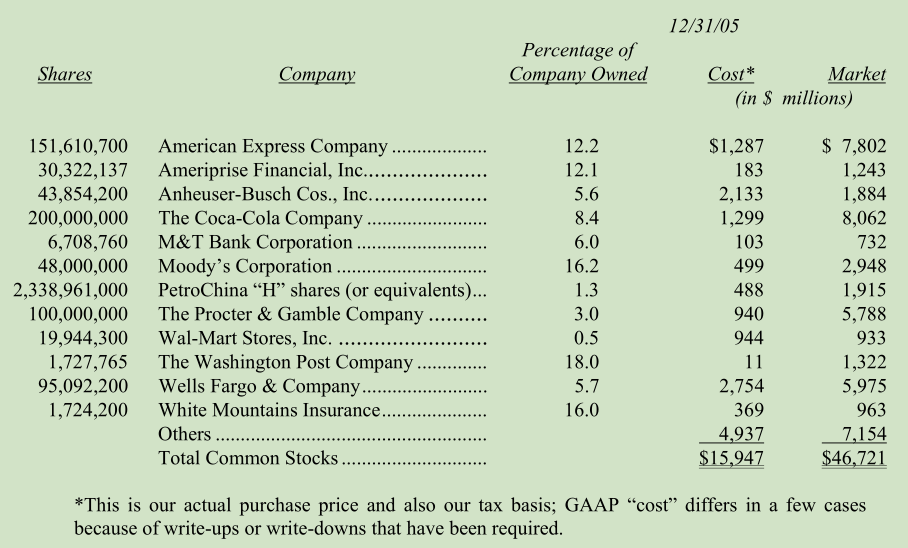
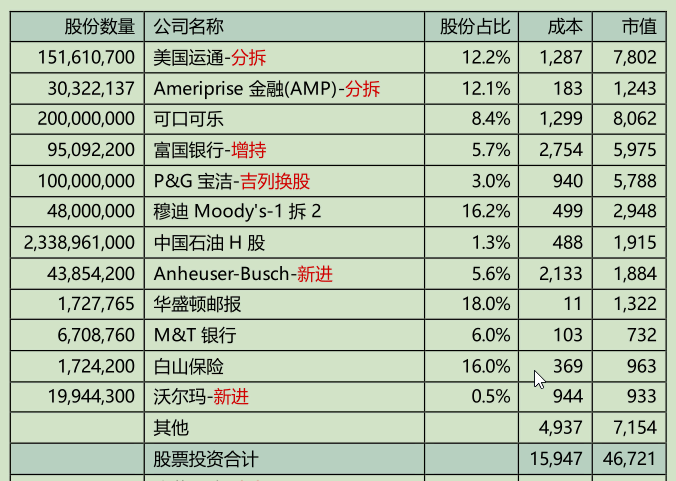
We show below our common stock investments. Those that had a market value of more than $700 million at the end of 2005 are itemized.

以下是我们的普通股投资情况。2005 年年底市值超过 7 亿美元的股票投资明细如下:

A couple of last year’s changes in our portfolio occurred because of corporate events: Gillette was merged into Procter & Gamble, and American Express spun off Ameriprise. In addition, we substantially increased our holdings in Wells Fargo, a company that Dick Kovacevich runs brilliantly, and established positions in Anheuser-Busch and Wal-Mart.

2005 年,我们的投资组合由于公司事件而出现了两个变化:吉列公司被宝洁合并,美国运通将 Ameriprise分拆上市。另外,我们大幅增持了富国银行的股票,这家公司由 DickKovacevich 管理得非常出色,同时在安海斯布希(Anheuser-Busch Cos., Inc.啤酒制造商)和沃尔玛公司股票上大量建仓。

Expect no miracles from our equity portfolio. Though we own major interests in a number of strong, highly-profitable businesses, they are not selling at anything like bargain prices. As a group, they may double in value in ten years. The likelihood is that their per-share earnings, in aggregate, will grow 6-8% per year over the decade and that their stock prices will more or less match that growth. (Their managers, of course, think my expectations are too modest – and I hope they’re right.)

不要期望我们的证券投资组合会出现什么奇迹,尽管我们主要持股一些实力强大且盈利能力很高的企业,但其股价根本谈不上便宜。作为一个整体,它们的价值可能会在 10 年内翻一番,在未来十年内,这些公司的每股收益每年可能增长 6-8%,其股价将或多或少与每股收益的增长相近(当然这些公司的经理人会认为我的预期过于保守,我希望他们是对的)。

* * * * * * * * * * * *

* * * * * * * * * * * *

The P&G-Gillette merger, closing in the fourth quarter of 2005, required Berkshire to record a $5.0 billion pre-tax capital gain. This bookkeeping entry, dictated by GAAP, is meaningless from an economic standpoint, and you should ignore it when you are evaluating Berkshire’s 2005 earnings. We didn’t intend to sell our Gillette shares before the merger; we don’t intend to sell our P&G shares now; and we incurred no tax when the merger took place.

宝洁与吉列的合并于 2005 年第 4 季度结束,这要求伯克希尔记录 50 亿美元的税前收益。从经济的观点来看,美国公认会计准则(GAAP)规定的这种会计分录没有任何意义,你在评估伯克希尔 2005 年收益情况时,应该忽略这笔巨额会计收益。在合并之前,我们从来没有打算卖出吉列的股票,合并之后,我们也不打算卖出宝洁的股票,合并也不会导致我们缴纳任何税费。

It’s hard to overemphasize the importance of who is CEO of a company. Before Jim Kilts arrived at Gillette in 2001, the company was struggling, having particularly suffered from capital-allocation blunders. In the major example, Gillette’s acquisition of Duracell cost Gillette shareholders billions of dollars, a loss never made visible by conventional accounting. Quite simply, what Gillette received in business value in this acquisition was not equivalent to what it gave up. (Amazingly, this most fundamental of yardsticks is almost always ignored by both managements and their investment bankers when acquisitions are under discussion.)

无论如何强调一个 CEO 对公司的重要性也不过分,在 2001 年吉姆·基尔茨进入吉列之前(Jim Kilts,吉列的第一任空降 CEO,著有《刀锋上的舞蹈:我如何挽救了吉列》,临危受命与其搭档 John F.Manfresi 从纳斯贝克一起来到吉列,拯救这家陷入困难的公司),这家公司正在苦苦地挣扎之中(盈利停滞股价腰斩),特别是在资本配置上的失误。吉列收购金霸王电池花费了股东们几十亿美元(1 股金霸王交换 1.8 股吉列,总价约 72 亿美元,KKR于 1988 年花费 18 亿收购金霸王,至 1996 年,多次发行股票已获利 13 亿),而这种代价在传统财务会计上根本看不出任何反映。简而言之,吉列在并购中获得的商业价值与其付出的并购成本并不相等(令人非常吃惊的是,这种非常简单的衡量标准在管理层及其投资银行家讨论并购时几乎总是被忽略)。

Upon taking office at Gillette, Jim quickly instilled fiscal discipline, tightened operations and energized marketing, moves that dramatically increased the intrinsic value of the company. Gillette’s merger with P&G then expanded the potential of both companies. For his accomplishments, Jim was paid very well – but he earned every penny. (This is no academic evaluation: As a 9.7% owner of Gillette, Berkshire in effect paid that proportion of his compensation.) Indeed, it’s difficult to overpay the truly extraordinary CEO of a giant enterprise. But this species is rare.

Jim Kilts 上任吉列以后,马上开始严肃财务纪律(一般管理费用零增长),全面收紧业务(砍掉 50%SKU),推动市场营销(加大广告投入),他的一系列措施大幅度提升了公司的内在价值。吉列并入宝洁进一步增强了两家公司的发展潜力。由于其管理成就,JimKilts 获得了非常丰厚的薪酬——但他所挣的每一分钱都理所应当(这并非一个学术探讨:作为在吉列公司持股 9.7%的股东,伯克希尔实际上支付了相应比例的薪酬)。事实上,向一个巨型企业的能力超凡的 CEO 支付再高的回报也不为过,可惜这种 CEO 实在是太罕见了。

Too often, executive compensation in the U.S. is ridiculously out of line with performance. That won’t change, moreover, because the deck is stacked against investors when it comes to the CEO’s pay. The upshot is that a mediocre-or-worse CEO – aided by his handpicked VP of human relations and a consultant from the ever-accommodating firm of Ratchet, Ratchet and Bingo – all too often receives gobs of money from an ill-designed compensation arrangement.

大多数美国高管的薪酬与经营业绩并不匹配,将来也不会出现什么太大的变化,因为在涉及到 CEO 薪酬问题时,投资者完全处于劣势。结果是,一个平庸或者表现糟糕的 CEO,在他精心物色的人际关系高管和一个非常善于利用棘轮效应的薪酬顾问的协助下,所有人都从一个恶意设计的高管薪酬安排中获得大量的金钱。

Take, for instance, ten year, fixed-price options (and who wouldn’t?). If Fred Futile, CEO of Stagnant, Inc., receives a bundle of these – let’s say enough to give him an option on 1% of the company – his self-interest is clear: He should skip dividends entirely and instead use all of the company’s earnings to repurchase stock.

例如,十年固定价格的股票期权(谁不想要呢?)。假设停滞不前公司的 CEO 废物先生接受了这样一批期权,比如给予他相当于公司 1%的股票期权,那么,他获取个人利益的方法就会显而易见——他肯定不会支付任何红利,而是保留公司所有的收益,用来回购股票。

Let’s assume that under Fred’s leadership Stagnant lives up to its name. In each of the ten years after the option grant, it earns $1 billion on $10 billion of net worth, which initially comes to $10 per share on the 100 million shares then outstanding. Fred eschews dividends and regularly uses all earnings to repurchase shares. If the stock constantly sells at ten times earnings per share, it will have appreciated 158% by the end of the option period. That’s because repurchases would reduce the number of shares to 38.7 million by that time, and earnings per share would thereby increase to $25.80. Simply by withholding earnings from owners, Fred gets very rich, making a cool $158 million, despite the business itself improving not at all. Astonishingly, Fred could have made more than $100 million if Stagnant’s earnings had declined by 20% during the ten-year period.

假设在废物先生的领导下,停滞不前公司恰如其名没有什么增长,在发行期权后的十年间,公司每年在 100亿美元的净资产价值基础上盈利 10 亿美元,相当于所发行的 1 亿股股票每股盈利 10 美元。废物先生拒绝向股东派发红利,用全部收益来回购股票。如果股价一直保持 10 倍市盈率的水平,那么,在期权到期之日股价将增值158%。这是因为持续回购使股份减少到 3870 万股,每股收益将因此提高到 25.80 美元/股。通过将股东收益全部保留不作分配,废物先生就能获得 1.58 亿美元的巨额财富,尽管公司业务没有任何增长。更令人吃惊的是,即使停滞不前公司的收益在这十年间下降了 20%,废物先生仍然可以赚到 1 亿美元以上。

Fred can also get a splendid result for himself by paying no dividends and deploying the earnings he withholds from shareholders into a variety of disappointing projects and acquisitions. Even if these initiatives deliver a paltry 5% return, Fred will still make a bundle. Specifically – with Stagnant’s p/e ratio remaining unchanged at ten – Fred’s option will deliver him $63 million. Meanwhile, his shareholders will wonder what happened to the “alignment of interests” that was supposed to occur when Fred was issued options.

通过不分配红利而将留存收益投资到各种令人失望的项目和并购上,废物先生仍然会获得巨大的回报,即使这些投资只能取得微不足道的 5%的收益率,废物先生个人仍然能有大笔金钱进账。具体来说,在停滞不前公司的市盈率在十年间保持不变的情况下,废物先生的期权会让他赚到 630 万美元。与此同时,所有股东会开始怀疑:当时向废物先生发行期权时所声称的股东与管理层结成"利益同盟"究竟是什么回事?

A “normal” dividend policy, of course – one-third of earnings paid out, for example – produces less extreme results but still can provide lush rewards for managers who achieve nothing.

一种"正常"的红利政策,比如将收益的三分之一派发红利,虽然不会导致如此极端的结果出现,但仍然会让那些根本没有任何成就的经理人获得极其丰厚的回报。

CEOs understand this math and know that every dime paid out in dividends reduces the value of all outstanding options. I’ve never, however, seen this manager-owner conflict referenced in proxy materials that request approval of a fixed-priced option plan. Though CEOs invariably preach internally that capital comes at a cost, they somehow forget to tell shareholders that fixed-price options give them capital that is free.

CEO 们非常明白这个数学道理,他们知道支付给股东的每一分钱红利都会相应减少已发行期权的价值,可是我从未见在要求批准固定价格股票期权计划的股东大会委托材料中,看到过管理层与股东之间发生冲突。尽管CEO 们总是在公司内部宣扬资本是有成本的,但他们不知为何总是忘记告诉股东们,固定价格股票期权给 CEO 们带来的资本却是免费的。

It doesn’t have to be this way: It’s child’s play for a board to design options that give effect to the automatic build-up in value that occurs when earnings are retained. But – surprise, surprise – options of that kind are almost never issued. Indeed, the very thought of options with strike prices that are adjusted for retained earnings seems foreign to compensation “experts,” who are nevertheless encyclopedic about every management-friendly plan that exists. (“Whose bread I eat, his song I sing.”)

事情本来并非注定必须如此,对于一家公司的董事会来说,当保留收益时,实行一种自动调整计算期权价值的做法简直是轻而易举的。但让我吃惊又吃惊的是,这种期权几乎从来没有发行过。实际上,期权履约价格随着留存收益而调整的期权激励计划,对于管理层激励"专家"来说似乎十分陌生,然而这些专家对所有出现过的有利于管理层的期权计划,却像百科全书一样了如指掌,(吃谁的面包就唱谁的歌)。

Getting fired can produce a particularly bountiful payday for a CEO. Indeed, he can “earn” more in that single day, while cleaning out his desk, than an American worker earns in a lifetime of cleaning toilets. Forget the old maxim about nothing succeeding like success: Today, in the executive suite, the all-too-prevalent rule is that nothing succeeds like failure.

被解雇会给 CEO 带来特别丰厚的薪水,事实上,在清理他的办公桌走人的那一天,他"挣"到的钱要比一个清扫厕所的美国环卫工人一年所挣的钱还要多得多(可口可乐 CEO 道格拉斯·伊维斯特离职近 1 亿遣散费)。忘掉那句古老的格言:"一事成功事事成功"(nothing succeeding like success)。如今,在公司管理层中,一个风靡一时的定律是:"失败是成功之母"。(nothing succeeds like failure)

Huge severance payments, lavish perks and outsized payments for ho-hum performance often occur because comp committees have become slaves to comparative data. The drill is simple: Three or so directors – not chosen by chance – are bombarded for a few hours before a board meeting with pay statistics that perpetually ratchet upwards. Additionally, the committee is told about new perks that other managers are receiving. In this manner, outlandish “goodies” are showered upon CEOs simply because of a corporate version of the argument we all used when children: “But, Mom, all the other kids have one.” When comp committees follow this “logic,” yesterday’s most egregious excess becomes today’s baseline.

为管理层毫不起眼的平平业绩支付巨额的离职补偿、慷慨的福利和超标的奖金,早已司空见惯,因为公司薪酬委员会已经成为数据比较的奴隶。搞定董事会的方法很简单,选择三名董事,当然并非随机选择,在董事会会议召开前几个小时,用薪酬支付永远逐步提高的统计数据对他们进行一番狂轰乱炸。如此这般,董事会就会把一大堆稀奇古怪的"糖果"撒向 CEO 们,而原因只是我们儿时都会用的小把戏:"但是,妈妈,所有其他小朋友都有一个"。当公司薪酬委员会遵循类似的逻辑时,昨天令人震惊的过分要求,就会成为今天的底线。

Comp committees should adopt the attitude of Hank Greenberg, the Detroit slugger and a boyhood hero of mine. Hank’s son, Steve, at one time was a player’s agent. Representing an outfielder in negotiations with a major league club, Steve sounded out his dad about the size of the signing bonus he should ask for. Hank, a true pay-for-performance guy, got straight to the point, “What did he hit last year?” When Steve answered “.246,” Hank’s comeback was immediate: “Ask for a uniform.”

公司董事会应该采取我儿时的偶像底特律队著名强击手(打出许多本垒打的击球手)Hank Greenberg 的态度。Hank 的儿子 Steve 曾经是一个球手的代理人,在代表一个外场手与一家职业棒球大联盟俱乐部谈判时,Steve 试探性地问他的老爸,他应该要求多少签约奖金。Hank 这位真正的按劳付酬主义者一针见血地问:"去年他的击打成功率是多少?"Steve 说:"0.246。"Hank 的回答直截了当:"要一件队服。"

(Let me pause for a brief confession: In criticizing comp committee behavior, I don’t speak as a true insider. Though I have served as a director of twenty public companies, only one CEO has put me on his comp committee. Hmmmm . . .)

(让我停下来简短地坦白一下:在批评公司薪酬委员会的行为时,我并非作为一个真正的内幕人士进行爆料,尽管我曾经担任过 20 家上市公司的董事,但只有一家公司的 CEO 把我安排进入公司薪酬委员会。嗯……)

* * * * * * * * * * * *

* * * * * * * * * * * *

My views on America’s long-term problem in respect to trade imbalances, which I have laid out in previous reports, remain unchanged. My conviction, however, cost Berkshire $955 million pre-tax in 2005. That amount is included in our earnings statement, a fact that illustrates the differing ways in which GAAP treats gains and losses. When we have a long-term position in stocks or bonds, year-to-year changes in value are reflected in our balance sheet but, as long as the asset is not sold, are rarely reflected in earnings. For example, our Coca-Cola holdings went from $1 billion in value early on to $13.4 billion at yearend 1998 and have since declined to $8.1 billion – with none of these moves affecting our earnings statement. Long-term currency positions, however, are daily marked to market and therefore have an effect on earnings in every reporting period. From the date we first entered into currency contracts, we are $2.0 billion in the black.

我认为美国经济的长期问题在于贸易不平衡,对此,我已经在过去的年报中详细陈述,我的观点仍旧不变。我的这一信念却让伯克希尔 2005 年度税前利润减少了 9.55 亿美元,这一数据包括在我们的损益表中,也反映了美国公认会计准则(GAAP)对待收益和损失的不同方式。我们在股票或债券上持有长期头寸时,每年的持仓市值变化会反映在资产负债中,但只要我们没有出售,这笔资产就极少反映在损益表中。比如,我们的可口可乐股票价值从 1998 年年底的 134 亿美元下跌到 2005 年年底的 81 亿美元,市值下降了 53 亿美元之巨,却不会影响我们的损益表。可是长期外汇头寸却是根据当日市价每日计价的,因此,每个报表日都会影响我们的收益情况,从我们第一次涉足外汇交易起至今,我们一共赚了 20 亿美元。

We reduced our direct position in currencies somewhat during 2005. We partially offset this change, however, by purchasing equities whose prices are denominated in a variety of foreign currencies and that earn a large part of their profits internationally. Charlie and I prefer this method of acquiring non-dollar exposure. That’s largely because of changes in interest rates: As U.S. rates have risen relative to those of the rest of the world, holding most foreign currencies now involves a significant negative “carry.” The carry aspect of our direct currency position indeed cost us money in 2005 and is likely to do so again in 2006. In contrast, the ownership of foreign equities is likely, over time, to create a positive carry – perhaps a substantial one.

2005 年我们减少了一些美元现汇看跌头寸,可是通过买入以多种外汇计价的股票,我们部分抵消了这一变化,而且他们大部分利润来自国际市场。查理和我更喜欢以这种方式获得非美元风险敞口。这主要是由于利率的变化:当美国利率相对于其他国家上升时,持有资产大部分为外汇就会形成一个显著的负盈利。2005 年,我们持有美元头寸的这种盈利变化实际上给我们造成了损失,2006 年可能会继续如此。与之相反,持有国外股票经过一段时间之后,形成一个正盈利的可能性会相当大。(负盈利,持有的市场头寸利率较低而借贷货币要支付较高的利率从而导致负值现金流,也就是融资成本高于证券或期货投资收益率的交易。与负盈利相反,正盈利指持有的市场头寸利率较高而借贷货币要支付较低的利率从而导致正值现金流。也就是证券或期货投资收益率高于融资成本的交易)。

The underlying factors affecting the U.S. current account deficit continue to worsen, and no letup is in sight. Not only did our trade deficit – the largest and most familiar item in the current account – hit an all-time high in 2005, but we also can expect a second item – the balance of investment income – to soon turn negative. As foreigners increase their ownership of U.S. assets (or of claims against us) relative to U.S. investments abroad, these investors will begin earning more on their holdings than we do on ours. Finally, the third component of the current account, unilateral transfers, is always negative.

影响美国经常账户赤字的潜在因素继续恶化,而且看起来没有中止的迹象,不仅我们的贸易赤字——经常账户中最大也是最常见的项目——在 2005 年创下了历史新高,而且我们预计第二大项目——投资收支也将很快由正转负。由于相对于美国海外投资而言,外国投资者所持有的美国资产(或者对美国的索取权)增加得更多,因此,这些外国投资者通过他们所持有的美国资产所获得的收益,将开始超过我们美国所持有的海外资产获得的收益。最后,经常账户的第三个项目国际收支中的单边资金转移总是负的。

The U.S., it should be emphasized, is extraordinarily rich and will get richer. As a result, the huge imbalances in its current account may continue for a long time without their having noticeable deleterious effects on the U.S. economy or on markets. I doubt, however, that the situation will forever remain benign. Either Americans address the problem soon in a way we select, or at some point the problem will likely address us in an unpleasant way of its own.

应该强调的是,美国特别富裕,并且将更加富裕。结果是,美国经常账户的巨大不平衡如果对美国经济或市场没有产生显而易见的有害影响的话,可能会持续很长一段时间。可是我不太相信这种情况会永远是有利的,要么美国人尽快用我们所选择的方式来处理这个问题,要么到了某种程度,这个问题可能将会以一种不太令人愉快的方式引起我们的注意。

〔译文源于芒格书院整理的巴菲特致股东的信〕

© Copyright 2023 Meitiandudian. All Rights Reserved.