巴菲特致股东的信(2006年)④保险业务


Insurance

保险业务

Next month marks the 40th anniversary of our entrance into the insurance business. It was on March 9, 1967, that Berkshire purchased National Indemnity and its companion company, National Fire & Marine, from Jack Ringwalt for $8.6 million.

下个月是我们进入保险业务的 40 周年。1967 年 3 月 9 日,伯克希尔从杰克·林沃尔特(Jack Ringwalt)手中以860 万美元,买下国民保险公司(National Indemnity)、及其伙伴企业国民火险及海运险公司。

Jack was a long-time friend of mine and an excellent, but somewhat eccentric, businessman. For about ten minutes every year he would get the urge to sell his company. But those moods – perhaps brought on by a tiff with regulators or an unfavorable jury verdict – quickly vanished.

Jack 是我的老朋友,他是一位杰出、但脾气有些古怪的生意人。每年有大约 10 分钟的时间,他会产生想要出售公司的冲动。而这样的情绪,也许是因为与监管机关意见相左、或是法院判决不利,但却稍纵即逝。

In the mid-1960s, I asked investment banker Charlie Heider, a mutual friend of mine and Jack’s, to alert me the next time Jack was “in heat.” When Charlie’s call came, I sped to meet Jack. We made a deal in a few minutes, with me waiving an audit, “due diligence” or anything else that would give Jack an opportunity to reconsider. We just shook hands, and that was that.

在 1960 年代中期,我告诉一位投资银行家朋友查理·海德(Charlie Heider),当下次 Jack"上火"时,赶快联络我。Charlie 是 Jack 和我的共同朋友,之后 Charlie 来电,我便火速安排与 Jack 会面。我们在几分钟内就达成协议,而且我刻意放弃审计、尽职调查、以及其它任何会使他重新考虑的机会。我们只是握手达成了初步协议。

When we were due to close the purchase at Charlie’s office, Jack was late. Finally arriving, he explained that he had been driving around looking for a parking meter with some unexpired time. That was a magic moment for me. I knew then that Jack was going to be my kind of manager.

而我们在 Charlie 办公室等待签约以完成收购那天,Jack 迟到了,他到达时解释说,他一直开车在附近寻找定时器还未用完的免费车位。此刻对我来说,实在是妙不可言,因为我知道 Jack 就是我想找的那一种经理人。

When Berkshire purchased Jack’s two insurers, they had “float” of $17 million. We’ve regularly offered a long explanation of float in earlier reports, which you can read on our website. Simply put, float is money we hold that is not ours but which we get to invest.

伯克希尔买下他的两家保险公司,共有 1700 万的浮存金。在过去年报中,我们对浮存金作了详尽的解释,你也可以在我们的网站上查阅。简单来说,浮存金是我们持有,虽然不属于我们,但却可以用来投资的钱。

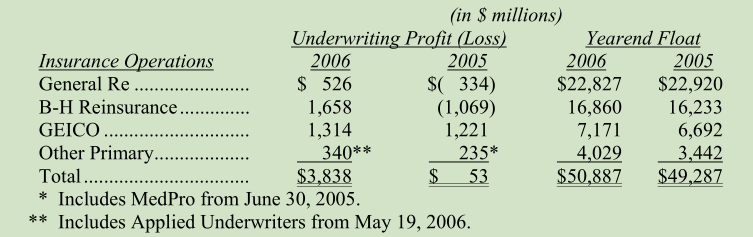
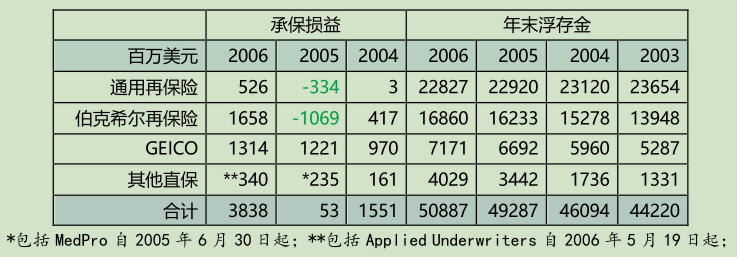
At the end of 2006, our float had grown to $50.9 billion, and we have since written a huge retroactive reinsurance contract with Equitas – which I will describe in the next section – that boosts float by another $7 billion. Much of the gain we’ve made has come through our acquisition of other insurers, but we’ve also had outstanding internal growth, particularly at Ajit Jain’s amazing reinsurance operation. Naturally, I had no notion in 1967 that our float would develop as it has. There’s much to be said for just putting one foot in front of the other every day.

到 2006 年底,我们的浮存金已成长至 509 亿美元,我们已经跟 Equitas 签订了巨额的追溯再保险合约(我会在下个部分加以说明),浮存金规模又增加了 70 亿美元。浮存金的增长,大多是来自于我们收购其他保险公司,但我们自身经营的保险业务,也有显著的内生性成长,尤其是阿吉特·贾恩所管理的再保险业务。我在 1967 年,自然无法想象浮存金可以发展至此一规模,但这都归功于每天的一步一个脚印,所创造出积少成多的效果。

The float from retroactive reinsurance contracts, of which we have many, automatically drifts down over time. Therefore, it will be difficult for us to increase float in the future unless we make new acquisitions in the insurance field. Whatever its size, however, the all-important cost of Berkshire’s float over time is likely to be significantly below that of the industry, perhaps even falling to less than zero. Note the words “over time.” There will be bad years periodically. You can be sure of that.

我们目前持有许多追溯再保险合约,其所产生的浮存金,将随着时间而日益减少。所以,除非我们在此方面不断有新收购案的完成,否则浮存金在未来的增加上,或有相当的困难。然而,无论浮存金的规额大小,对伯克希尔来说最重要的,是浮存金的成本,随着时间推移,可能远低于业界的标准,甚至可能低于零。请注意"随着时间的推移"这个词,会周期性的出现不好的年份,这一点是可以确定的。

In 2006, though, everything went right in insurance – really right. Our managers – Tony Nicely (GEICO), Ajit Jain (B-H Reinsurance), Joe Brandon and Tad Montross (General Re), Don Wurster (National Indemnity Primary), Tom Nerney (U.S. Liability), Tim Kenesey (Medical Protective), Rod Eldred (Homestate Companies and Cypress), Sid Ferenc and Steve Menzies (Applied Underwriters), John Kizer (Central States) and Don Towle (Kansas Bankers Surety) – simply shot the lights out. When I recite their names, I feel as if I’m at Cooperstown, reading from the Hall of Fame roster. Of course, the overall insurance industry also had a terrific year in 2006. But our managers delivered results generally superior to those of their competitors.

不过,保险业务 2006 年的状况相当不错,可以说非常棒。我们的经理人,包括 Tony Nicely(GEICO 保险),Ajit Jain(B-H 再保险),Joe Brandon 和 Tad Montross(General Re),Don Wurster(国民保险直保业务),TomNerney(U.S.责任险),Tim Kenesey(Medical Protective 医疗事故保险),Rod Eldred(HomeState 和 Cypress保险),Sid Ferenc 和 Steve Menzies(Applied Underwriter 工伤保险),John Kizer(Central States 中部州保险)和 Don Towle(Kansas 银行家担保),表现发光发热。在朗诵他们的名字时,我觉得好像在棒球发源地库伯斯敦Cooperstown,照着名人堂上的名单一一念出。当然,整个保险业在 2006 年都有亮丽的演出,但伯克希尔经理人的表现,却普遍优于竞争对手。

Below is the tally on our underwriting and float for each major sector of insurance. Enjoy the view, because you won’t soon see another like it.

以下是我们每个主要保险业务的承保业绩,及其浮存金的数字。请仔细的回味,因为近期内,你将很难再看到如此精彩的报告了。

* * * * * * * * * * * *

* * * * * * * * * * * *

In 2007, our results from the bread-and-butter lines of insurance will deteriorate, though I think they will remain satisfactory. The big unknown is super-cat insurance. Were the terrible hurricane seasons of 2004-05 aberrations? Or were they our planet’s first warning that the climate of the 21st Century will differ materially from what we’ve seen in the past? If the answer to the second question is yes, 2006 will soon be perceived as a misleading period of calm preceding a series of devastating storms. These could rock the insurance industry. It’s naïve to think of Katrina as anything close to a worst-case event.

2007 年,在伯克希尔赖以为生的保险事业方面,将很难再创造出更好的结果,但我认为,应该可以维持不错的表现,但超级巨灾保险,却是最大的未知数。2004-2005 年飓风的接踵而来,是脱离常轨的吗?或者这些天灾只是警讯,告诉我们 21 世纪的地球气候,已经变得跟过去截然不同?如果第二个问题的答案是肯定的,2006 年将可能是未来一连串暴风雨前的宁静。如此一来,整个保险业势必将天翻地覆,故若将前年的 Katrina 飓风视为最坏的情况,可能是过于天真的想法。

Neither Ajit Jain, who manages our super-cat operation, nor I know what lies ahead. We do know that it would be a huge mistake to bet that evolving atmospheric changes are benign in their implications for insurers.

无论是负责巨灾保险业务的阿吉特,还是我本人,都不知道未来将如何演变。我们只知道,若保险业者押注在地球气候变化对保险业的影响是正面良性的话,那将是一个巨大的错误。

Don’t think, however, that we have lost our taste for risk. We remain prepared to lose $6 billion in a single event, if we have been paid appropriately for assuming that risk. We are not willing, though, to take on even very small exposures at prices that don’t reflect our evaluation of loss probabilities. Appropriate prices don’t guarantee profits in any given year, but inappropriate prices most certainly guarantee eventual losses. Rates have recently fallen because a flood of capital has entered the super-cat field. We have therefore sharply reduced our wind exposures. Our behavior here parallels that which we employ in financial markets: Be fearful when others are greedy, and be greedy when others are fearful.

然而,不要认为伯克希尔已经失去了承担风险的兴趣。假若为承保特定风险,我们获得了适当的保费收入,我们仍准备为单一事件承担 60 亿美元的理赔金。但是,对于一些经过评估,在保费上无法反映可能的损失的风险,就算理赔的金额不大,我们也不愿承保。合理的保费,并不确保特定年度的获利,但只要保费不合理,肯定会保证最后以亏损收场。由于大量资金涌入巨灾保险业,使得近来的保费价格降低,因此伯克希尔将大幅减少飓风保险的承保额。伯克希尔在保险事业上的经营,和我们在金融市场上的作法,可说是如出一辙:当别人贪婪时要提高警觉,当别人恐惧时要贪婪。

Lloyd’s, Equitas and Retroactive Reinsurance

Lloyd's,Equitas 以及追溯再保险

Last year – we are getting now to Equitas – Berkshire agreed to enter into a huge retroactive reinsurance contract, a policy that protects an insurer against losses that have already happened, but whose cost is not yet known. I’ll give you details of the agreement shortly. But let’s first take a journey through insurance history, following the route that led to our deal.

接下来,就要谈到 Equitas 了。去年,伯克希尔签订了金额庞大的追溯再保险合约,该合同是为了保护保险业者,免受已经发生的损失,但尚不清楚确切的理赔金额所带来的可能风险。稍待片刻,我将会讲解一下这合约的相关细节。但先来回顾一下保险的历史,然后大家自然就会了解这笔交易的来龙去脉。

Our tale begins around 1688, when Edward Lloyd opened a small coffee house in London. Though no Starbucks, his shop was destined to achieve worldwide fame because of the commercial activities of its clientele – shipowners, merchants and venturesome British capitalists. As these parties sipped Edward’s brew, they began to write contracts transferring the risk of a disaster at sea from the owners of ships and their cargo to the capitalists, who wagered that a given voyage would be completed without incident. These capitalists eventually became known as “underwriters at Lloyd’s.”

故事发生在 1668 年左右,当时 Edward Lloyd 在伦敦经营一家小咖啡店,因为顾客(包括船主、商人、以及爱冒险的英国资本家)都在店里从事商业交易,所以在那个没有星巴克的年代里,他的店就注定远近驰名。这些顾客品尝着咖啡,并与资本家签下能转移他们货船、货物海上风险的合约。这些签下合约的资本家,是押注在此次出海,可以顺利平安的想法上,最后就变成所谓的"位于 Lloyd's 的保险业者"。

Though many people believe Lloyd’s to be an insurance company, that is not the case. It is instead a place where many member-insurers transact business, just as they did centuries ago.

虽然有很多人认为 Lloyd 是家保险公司,但实情并非如此。就跟一个世纪前一样,Lloyd's 仅是许多保险业者处理交易的场所而已。

Over time, the underwriters solicited passive investors to join in syndicates. Additionally, the business broadened beyond marine risks into every imaginable form of insurance, including exotic coverages that spread the fame of Lloyd’s far and wide. The underwriters left the coffee house, found grander quarters and formalized some rules of association. And those persons who passively backed the underwriters became known as “names.”

经过时间的演变,保险业者吸引了一些被动投资人,加入共同承保的行列。除此之外,业务范围也扩展至海运险以外的领域,几乎任何可能的保险形式,其中包括一些无奇不有的保单。因此,Lloyd's 声名远播。保险业者们后来走出 Lloyd's 咖啡厅,各自找更雄伟的总部,并订立合作规范。而那些提供资金给保险业者的被动投资人,就变成所谓的"财团"。

Eventually, the names came to include many thousands of people from around the world, who joined expecting to pick up some extra change without effort or serious risk. True, prospective names were always solemnly told that they would have unlimited and everlasting liability for the consequences of their syndicate’s underwriting – “down to the last cufflink,” as the quaint description went. But that warning came to be viewed as perfunctory. Three hundred years of retained cufflinks acted as a powerful sedative to the names poised to sign up.

最后,来自世界各地成千上万的财团都加入了这个行列,期望不费吹灰之力或不冒风险就能获得赚钱之道。当然,这些潜在的财团们,在加入保险业者的共同承保前,都被理性地告知,他们将对其承保的后果,承担无限和永久的责任,简单点就是"赔到脱裤子"。但是这样的警告根本只是敷衍,根本没人理会。由于过去三百年来,并没有人真的"赔到脱裤子",对于财团来说,这是极具说服力的证明,因此许多安心地加入共同承保。

Then came asbestos. When its prospective costs were added to the tidal wave of environmental and product claims that surfaced in the 1980s, Lloyd’s began to implode. Policies written decades earlier – and largely forgotten about – were developing huge losses. No one could intelligently estimate their total, but it was certain to be many tens of billions of dollars. The specter of unending and unlimited losses terrified existing names and scared away prospects. Many names opted for bankruptcy; some even chose suicide.

随后就出现了石棉问题。在 1980 年代,因为环保及产品索赔的声浪风起云涌而来,使保险业者的理赔成本,如滚雪球般膨胀,Lloyd's 开始瓦解。数十年前所签下的保单(许多早就被人遗忘的合约),亏损金额大幅攀升,再精明的人恐都难以估计总数,但必定是数百亿美元之巨。无穷无尽的巨大损失吓坏许多财团,以及潜在进入者。许多财团最后只能选择破产,有些人甚至选择自杀了结。

From these shambles, there came a desperate effort to resuscitate Lloyd’s. In 1996, the powers that be at the institution allotted £11.1 billion to a new company, Equitas, and made it responsible for paying all claims on policies written before 1993. In effect, this plan pooled the misery of the many syndicates in trouble. Of course, the money allotted could prove to be insufficient – and if that happened, the names remained liable for the shortfall.

动荡中,有些人不顾一切的想要重振 Lloyd's 的雄风。1996 年,该机构的高层,决定以 111 亿英镑的资金,成立一家新公司 Equitas,来承担 1993 年以前的所有未了结保险合约。其实,这个计划是将许多悲惨财团们的问题集中处理,当然,拨出的资金是绝对是入不敷出,但若如此,财团们仍要为资金缺口负责。

But the new plan, by concentrating all of the liabilities in one place, had the advantage of eliminating much of the costly intramural squabbling that went on among syndicates. Moreover, the pooling allowed claims evaluation, negotiation and litigation to be handled more intelligently than had been the case previously. Equitas embraced Ben Franklin’s thinking: “We must all hang together, or assuredly we shall hang separately.”

但是,集中所有债务一起处理的新计划,至少可以让财团间的内斗告一段落。此外,将这些保险合约集合起来,也可以在评估、谈判以及诉讼上,较先前的决策更为明智。Equitas 计划,怀抱的是富兰克林的思想:"我们必须团结一致,否则一定会被各个击破。"

From the start, many people predicted Equitas would eventually fail. But as Ajit and I reviewed the facts in the spring of 2006 – 13 years after the last exposed policy had been written and after the payment of £11.3 billion in claims – we concluded that the patient was likely to survive. And so we decided to offer a huge reinsurance policy to Equitas.

起初,许多人预期,Equitas 终将走上失败一途。但在 2006 年春天(在距离最后一张保单被承保 13 年后,(1993-2006 年)累计支付 113 亿英磅理赔金),我和阿吉特审视所有的数据后,得出的结论是它还是有存活下去的可能。于是我们决定,愿提供 Equitas 巨额的再保险合约。

Because plenty of imponderables continue to exist, Berkshire could not provide Equitas, and its 27,972 names, unlimited protection. But we said – and I’m simplifying – that if Equitas would give us $7.12 billion in cash and securities (this is the float I spoke about), we would pay all of its future claims and expenses up to $13.9 billion. That amount was $5.7 billion above what Equitas had recently guessed its ultimate liabilities to be. Thus the names received a huge – and almost certainly sufficient – amount of future protection against unpleasant surprises. Indeed the protection is so large that Equitas plans a cash payment to its thousands of names, an event few of them had ever dreamed possible.

由于仍存在许多不可知的变量,故伯克希尔并不能提供 Equitas、及其 27972 名财团无上限的保障。但我们提出(用尽量简单的说法),只要 Equitas 支付伯克希尔 71.2 亿美元的现金及证券(这就是先前提到的浮存金),我们就愿意负担其未来的理赔金,上限为 139 亿美元。此一金额,较 Equitas 最近评估的所有债务,还多出 57 亿美元。如此一来,财团得到了巨大(几乎保证是足够)的未来保障,能够杜绝不幸意外的打击。而伯克希尔提供的保障之大,甚至让 Equitas 计划支付现金红利给数千名财团,这是他们做梦都想不到的。

And how will Berkshire fare? That depends on how much “known” claims will end up costing us, how many yet-to-be-presented claims will surface and what they will cost, how soon claim payments will be made and how much we earn on the cash we receive before it must be paid out. Ajit and I think the odds are in our favor. And should we be wrong, Berkshire can handle it.

这对伯克希尔的影响为何?这取决于"已知"的理赔最终有多少成本,以及将有多少尚未提交理赔的保单会付出水面要求我们负责,这些理赔金何时正式支付,以及伯克希尔能在这笔钱支付前、创造出多少现金。我跟阿吉特认为情况将对伯克希尔有利,而且即使判断出了差错,伯克希尔也能应付自如。

Scott Moser, the CEO of Equitas, summarized the transaction neatly: “Names wanted to sleep easy at night, and we think we’ve just bought them the world’s best mattress.”

Equitas 的 CEO 斯科特·莫泽(Scott Moser),对此项交易的评语十分简洁。他说:"财团们希望晚上能安然入睡,而我们刚为他们买了世界上最好的床垫。"

* * * * * * * * * * *

* * * * * * * * * * *

Warning: It’s time to eat your broccoli – I am now going to talk about accounting matters. I owe this to those Berkshire shareholders who love reading about debits and credits. I hope both of you find this discussion helpful. All others can skip this section; there will be no quiz.

注意:吃西兰花的时间到了(意思是对健康有益),现在开始来讨论会计上的处理。对于喜欢阅读会计报表、研究借贷关系的伯克希尔股东,希望后面的讨论可以满足各位,并有所收获。其它人可以跳过此一部分,不必担心有随堂测验。

Berkshire has done many retroactive transactions – in both number and amount a multiple of such policies entered into by any other insurer. We are the reinsurer of choice for these coverages because the obligations that are transferred to us – for example, lifetime indemnity and medical payments to be made to injured workers – may not be fully satisfied for 50 years or more. No other company can offer the certainty that Berkshire can, in terms of guaranteeing the full and fair settlement of these obligations. This fact is important to the original insurer, policyholders and regulators.

伯克希尔已进行许多追溯再保险的交易,不管是在数量或是金额上,都比其它的保险业者的承保上,多出许多倍。由于我们是这类保险的首选再保险业者,因为这些将移转给我们的义务(例如对于受伤员工的终身伤害医疗给付)可能在 50 年或更长时间内无法完全履行。在保障这些债务得到全面公平的清算方面,没有别的公司,可以像伯克希尔一样做到这一点。这一事实对于原保险公司、保户、及监管机关来说,都是非常重要的。

The accounting procedure for retroactive transactions is neither well known nor intuitive. The best way for shareholders to understand it, therefore, is for us to simply lay out the debits and credits. Charlie and I would like to see this done more often. We sometimes encounter accounting footnotes about important transactions that leave us baffled, and we go away suspicious that the reporting company wished it that way. (For example, try comprehending transactions “described” in the old 10-Ks of Enron, even after you know how the movie ended.)

追溯交易的会计程序既不是众所皆知,也不直观。为了让伯克希尔股东了解,最好的方法,就是简单列出会计的借方及贷方。查理和我希望看到更多人这么做。许多公司的重要交易放在会计附注里,这往往令人摸不着头绪。对这种故意将财务报告作如此呈现的公司,我们一向抱着怀疑态度、而不想理会。(例如,即使是知晓了最后的结局,也不妨试着解读安然公司过去年报中,对于"描述"交易上的呈现方式。)

So let us summarize our accounting for the Equitas transaction. The major debits will be to Cash and Investments, Reinsurance Recoverable, and Deferred Charges for Reinsurance Assumed (“DCRA”). The major credit will be to Reserve for Losses and Loss Adjustment Expense. No profit or loss will be recorded at the inception of the transaction, but underwriting losses will thereafter be incurred annually as the DCRA asset is amortized downward. The amount of the annual amortization charge will be primarily determined by how our end-of-the-year estimates as to the timing and amount of future loss payments compare to the estimates made at the beginning of the year. Eventually, when the last claim has been paid, the DCRA account will be reduced to zero. That day is 50 years or more away.

因此,让我们总结一下 Equitas 的会计处理。主要的借方项目是现金与投资、再保摊回,以及再保险的递延费用资产 DCRA。主要的贷方项目为赔偿准备金以及赔偿调整费用准备金。在交易之初,并没有损益入帐,但是每年摊销再保险的递延费用资产 DCRA 时,保险损失就会跟着出现。而每年摊销的费用最主要取决于,我们对未来赔偿支付的时点、及赔偿金额的年终估计值,与年初的估计值相比。最后,当赔偿最后一张保单之后,再保险的递延收费资产账户就会降低为零,而这一天会是 50 年或是更久之后。

What’s important to remember is that retroactive insurance contracts always produce underwriting losses for us. Whether these losses are worth experiencing depends on whether the cash we have received produces investment income that exceeds the losses. Recently our DCRA charges have annually delivered $300 million or so of underwriting losses, which have been more than offset by the income we have realized through use of the cash we received as a premium. Absent new retroactive contracts, the amount of the annual charge would normally decline over time. After the Equitas transaction, however, the annual DCRA cost will initially increase to about $450 million a year. This means that our other insurance operations must generate at least that much underwriting gain for our overall float to be cost-free. That amount is quite a hurdle but one that I believe we will clear in many, if not most, years.

但重点是要记住,追溯再保险合约,总是会给我们带来损失。而这样的损失是否值得承受,就取决于我们是否能创造出超越损失的投资收益。最近,我们的 DCRA 摊销费用每年带来约 3 亿美元左右的承保损失,大约和我们将所收保费、用于投资所产生的收益相互抵消。如果没有新的追溯合约,每年费用将随着时间持续下降。然而,在与 Equitas 签订合约之后,每年的 DCRA 费用将增加到 4.5 亿美元左右。这意味着我们其它的保险事业,必须创造出相同金额的承保收益,伯克希尔才能让浮存金成本降为零。此一目标具有相当的挑战性,但我相信,我们将在许多年份实现浮存金零成本(可能不是大多数年份)。

Aren’t you glad that I promised you there would be no quiz?

我答应过不会有随堂测验,各位是不是很高兴?

〔译文源于芒格书院整理的巴菲特致股东的信〕

© Copyright 2023 Meitiandudian. All Rights Reserved.