
巴菲特致股东的信(2017年)③保险业务


Insurance

保险业务

Before I discuss our 2017 insurance results, let me remind you of how and why we entered the field. We began by purchasing National Indemnity and a smaller sister company for $8.6 million in early 1967. With our purchase we received $6.7 million of tangible net worth that, by the nature of the insurance business, we were able to deploy in marketable securities. It was easy to rearrange the portfolio into securities we would otherwise have owned at Berkshire itself. In effect, we were “trading dollars” for the net worth portion of the cost.

在讨论2017年的保险业绩之前,让我先带各位回顾一下我们是如何以及为何进入这个行业的。1967年初,我们以860万美元收购了国民保险公司 (National Indemnity) 和一家规模较小的姊妹公司。通过这笔收购,我们获得了670万美元的净有形资产,按照保险业务的特性,这些资产可以投入到有价证券中。把这个投资组合重新配置为伯克希尔本来就想持有的证券是轻而易举的事。实质上,我们以"美元换美元"的方式获取了收购成本中净资产的那部分。

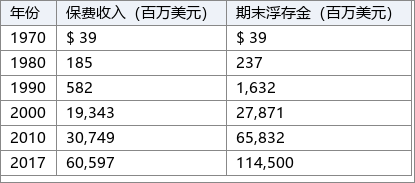
The $1.9 million premium over net worth that Berkshire paid brought us an insurance business that usually delivered an underwriting profit. Even more important, the insurance operation carried with it $19.4 million of “float” – money that belonged to others but was held by our two insurers.

至于伯克希尔支付的超出净资产的190万美元溢价,为我们换来了一个通常能够实现承保盈利的保险业务。更重要的是,保险业务附带了1,940万美元的"浮存金"——这些资金归保户所有,但由我们的两家保险公司暂时持有。

Ever since, float has been of great importance to Berkshire. When we invest these funds, all dividends, interest and gains from their deployment belong to Berkshire. (If we experience investment losses, those, of course, are on our tab as well.)

从那以后,浮存金对伯克希尔一直至关重要。当我们运用这些资金进行投资时,所有的股息、利息和资本利得都归伯克希尔所有。(当然,如果我们遭遇了投资损失,那也得自己兜着。)

Float materializes at p/c insurers in several ways: (1) Premiums are generally paid to the company upfront whereas losses occur over the life of the policy, usually a six-month or one-year period; (2) Though some losses, such as car repairs, are quickly paid, others – such as the harm caused by exposure to asbestos – may take many years to surface and even longer to evaluate and settle; (3) Loss payments are sometimes spread over decades in cases, say, of a person employed by one of our workers’ compensation policyholders being permanently injured and thereafter requiring expensive lifetime care.

财产意外险的浮存金主要通过以下几种方式产生:(1)保费通常是预先支付给公司的,而损失发生在保单有效期内,通常为六个月或一年;(2)尽管有些损失(比如汽车维修)很快就能理赔,但其他损失——比如石棉暴露造成的伤害——可能需要多年才会浮出水面,评估和理赔则需要更长时间;(3)有些赔付会延续数十年,比如我们工伤赔偿保单中的投保人遭受了永久性伤害,此后需要昂贵的终身护理。

Float generally grows as premium volume increases. Additionally, certain p/c insurers specialize in lines of business such as medical malpractice or product liability – business labeled “long-tail” in industry jargon – that generate far more float than, say, auto collision and homeowner policies, which require insurers to almost immediately make payments to claimants for needed repairs.

通常浮存金会随着保费规模的增长而增长。此外,某些财产意外险公司专门经营医疗事故或产品责任等业务——行业术语称之为"长尾"业务——它们产生的浮存金远远超过汽车碰撞和房屋保险,后者要求保险公司几乎立即向索赔人支付维修费用。

Berkshire has been a leader in long-tail business for many years. In particular, we have specialized in jumbo reinsurance policies that leave us assuming long-tail losses already incurred by other p/c insurers. As a result of our emphasizing that sort of business, Berkshire’s growth in float has been extraordinary. We are now the country’s second largest p/c company measured by premium volume and its leader, by far, in float.

多年来,伯克希尔一直是长尾业务的领导者。尤其是我们专门从事大型再保险业务,承担其他财产意外险公司已经发生的长尾损失。由于专注于此类业务,伯克希尔的浮存金增长极为可观。以保费收入衡量,我们目前是全美第二大财产意外险公司;而论浮存金规模,则遥遥领先于所有同行。

Here’s the record:

以下是历史记录:

Our 2017 volume was boosted by a huge deal in which we reinsured up to $20 billion of long-tail losses that AIG had incurred. Our premium for this policy was $10.2 billion, a world’s record and one we won’t come close to repeating. Premium volume will therefore fall somewhat in 2018.

我们2017年的保费收入因一笔巨额交易而大幅增加:我们为美国国际集团 (AIG) 最高200亿美元的长尾损失提供再保险,保费收入高达102亿美元,创下了世界纪录——我们不可能再接近这个数字了。因此,2018年的保费收入将有所下降。

Float will probably increase slowly for at least a few years. When we eventually experience a decline, it will be modest – at most 3% or so in any single year. Unlike bank deposits or life insurance policies containing surrender options, p/c float can’t be withdrawn. This means that p/c companies can’t experience massive “runs” in times of widespread financial stress, a characteristic of prime importance to Berkshire that we factor into our investment decisions.

至少未来几年内,浮存金可能会继续缓慢增长。当最终出现下滑时,幅度将非常有限——任何一年最多下降3%左右。与银行存款或包含退保选择权的人寿保单不同,财产意外险的浮存金是不能被提取的。这意味着财产意外险公司不会在金融危机时遭遇大规模"挤兑"——这是伯克希尔最看重的特质之一,也是我们纳入投资决策考量的重要因素。

Charlie and I never will operate Berkshire in a manner that depends on the kindness of strangers – or even that of friends who may be facing liquidity problems of their own. During the 2008-2009 crisis, we liked having Treasury Bills – loads of Treasury Bills – that protected us from having to rely on funding sources such as bank lines or commercial paper. We have intentionally constructed Berkshire in a manner that will allow it to comfortably withstand economic discontinuities, including such extremes as extended market closures.

查理和我永远不会以一种依赖陌生人善意的方式经营伯克希尔——哪怕是那些自身可能也面临流动性困难的朋友的善意。在2008至2009年金融危机期间,我们庆幸自己持有大量短期国库券——大量的国库券——这使我们不必依赖银行信用额度或商业票据等融资渠道。我们是有意识地把伯克希尔打造成了一个能够从容应对各种经济冲击的架构,包括市场长期关闭这样的极端情况。

* * * * * * * * * * * *

* * * * * * * * * * * *

The downside of float is that it comes with risk, sometimes oceans of risk. What looks predictable in insurance can be anything but. Take the famous Lloyds insurance market, which produced decent results for three centuries. In the 1980’s, though, huge latent problems from a few long-tail lines of insurance surfaced at Lloyds and, for a time, threatened to destroy its storied operation. (It has, I should add, fully recovered.)

浮存金的不利面在于它伴随着风险,有时甚至是滔天大浪般的风险。保险业中看似可预测的东西可能完全出乎意料。以赫赫有名的劳合社 (Lloyds) 保险市场为例,它在长达三个世纪里业绩不错。但到了1980年代,几条长尾保险业务线暴露出巨大的潜伏问题,一度威胁到其传奇的运营。(我必须补充一句,他们后来已经完全恢复了。)

Berkshire’s insurance managers are conservative and careful underwriters, who operate in a culture that has long prioritized those qualities. That disciplined behavior has produced underwriting profits in most years, and in such instances, our cost of float was less than zero. In effect, we got paid then for holding the huge sums tallied in the earlier table.

伯克希尔的保险经理人都是保守谨慎的承保人,他们所处的企业文化长期以来一直将这些品质放在首位。这种自律的行为在大多数年份都实现了承保盈利,在这些年里,我们的浮存金成本低于零。实际上,我们反而因为持有前面表格中所列的那些巨额浮存金而获得了报酬。

I have warned you, however, that we have been fortunate in recent years and that the catastrophe-light period the industry was experiencing was not a new norm. Last September drove home that point, as three significant hurricanes hit Texas, Florida and Puerto Rico.

不过我也提醒过你们,近些年我们运气一直不错,行业经历的这段巨灾稀少期并非新常态。去年9月的事实证明了这一点——三场强飓风接连袭击了得克萨斯州、佛罗里达州和波多黎各。

My guess at this time is that the insured losses arising from the hurricanes are $100 billion or so. That figure, however, could be far off the mark. The pattern with most mega-catastrophes has been that initial loss estimates ran low. As well-known analyst V.J. Dowling has pointed out, the loss reserves of an insurer are similar to a self-graded exam. Ignorance, wishful thinking or, occasionally, downright fraud can deliver inaccurate figures about an insurer’s financial condition for a very long time.

我目前估计,这些飓风造成的保险损失大约在1,000亿美元左右。不过这个数字可能远远不够准确。绝大多数特大灾难的惯例是,最初的损失估计都偏低。正如知名分析师V.J.·道林 (V.J. Dowling) 所指出的那样,保险公司的损失准备金就像是自己给自己打分的考试。无知、一厢情愿、甚至偶尔的弄虚作假,都可能使保险公司的财务状况在很长一段时间内失真。

We currently estimate Berkshire’s losses from the three hurricanes to be $3 billion (or about $2 billion after tax). If both that estimate and my industry estimate of $100 billion are close to accurate, our share of the industry loss was about 3%. I believe that percentage is also what we may reasonably expect to be our share of losses in future American mega-cats.

我们目前估计伯克希尔在三场飓风中的损失约为30亿美元(税后约20亿美元)。如果这个估计和我对行业1,000亿美元的损失估计都大致准确的话,我们在行业损失中占比约3%。我认为这一比例也是我们在未来美国特大巨灾中合理预期的损失份额。

It’s worth noting that the $2 billion net cost from the three hurricanes reduced Berkshire’s GAAP net worth by less than 1%. Elsewhere in the reinsurance industry there were many companies that suffered losses in net worth ranging from 7% to more than 15%. The damage to them could have been far worse: Had Hurricane Irma followed a path through Florida only a bit to the east, insured losses might well have been an additional $100 billion.

值得注意的是,三场飓风造成的20亿美元税后净损失,使伯克希尔GAAP口径下的净资产减少了不到1%。再保险行业中的许多其他公司,净资产损失幅度在7%到超过15%不等。对它们来说,情况本可以糟糕得多:如果艾尔玛 (Irma) 飓风穿越佛罗里达的路径稍微偏东一些,保险损失很可能会再增加1,000亿美元。

We believe that the annual probability of a U.S. mega-catastrophe causing $400 billion or more of insured losses is about 2%. No one, of course, knows the correct probability. We do know, however, that the risk increases over time because of growth in both the number and value of structures located in catastrophe-vulnerable areas.

我们认为,美国每年发生造成4,000亿美元或以上保险损失的特大巨灾的概率约为2%。当然,没有人知道准确的概率。但我们确实知道,由于灾害易发地区建筑物的数量和价值都在增长,这一风险随着时间的推移在不断上升。

No company comes close to Berkshire in being financially prepared for a $400 billion mega-cat. Our share of such a loss might be $12 billion or so, an amount far below the annual earnings we expect from our non-insurance activities. Concurrently, much – indeed, perhaps most – of the p/c world would be out of business. Our unparalleled financial strength explains why other p/c insurers come to Berkshire – and only Berkshire – when they, themselves, need to purchase huge reinsurance coverages for large payments they may have to make in the far future.

没有哪家公司能像伯克希尔一样为4,000亿美元的特大巨灾做好充分的财务准备。我们在此类损失中的份额大约是120亿美元左右,远低于我们预期每年从非保险业务中获得的收益。与此同时,财产意外险行业中的大部分——甚至可能是绝大部分——公司都将破产。我们无与伦比的财务实力解释了为什么其他财产意外险公司要来伯克希尔——也只能来伯克希尔——购买大额再保险,以应对遥远的未来它们可能不得不支付的大额赔偿。

Prior to 2017, Berkshire had recorded 14 consecutive years of underwriting profits, which totaled $28.3 billion pre-tax. I have regularly told you that I expect Berkshire to attain an underwriting profit in a majority of years, but also to experience losses from time to time. My warning became fact in 2017, as we lost $3.2 billion pre-tax from underwriting.

2017年之前,伯克希尔保险业务已连续14年实现承保盈利,累计税前收益达283亿美元。我经常告诉你们,我预计伯克希尔在大多数年份能实现承保盈利,但也会不时遭遇亏损。我的警告在2017年成为了现实——我们因承保亏损了32亿美元(税前)。

A large amount of additional information about our various insurance operations is included in the 10-K at the back of this report. The only point I will add here is that you have some extraordinary managers working for you at our various p/c operations. This is a business in which there are no trade secrets, patents, or locational advantages. What counts are brains and capital. The managers of our various insurance companies supply the brains and Berkshire provides the capital.

有关我们各类保险业务的更多信息,请参阅本报告附录的10-K表格。我在此唯一要补充的一点是:你们拥有一批杰出的经理人,在我们的各项财产意外险业务中为你们效力。这是一个没有商业秘密、专利或地理优势的行业。最重要的是头脑和资本。我们旗下各保险公司的经理人贡献了头脑,伯克希尔提供了资本。

* * * * * * * * * * * *

* * * * * * * * * * * *

For many years, this letter has described the activities of Berkshire’s many other businesses. That discussion has become both repetitious and partially duplicative of information regularly included in the 10-K that follows the letter. Consequently, this year I will give you a simple summary of our dozens of non-insurance businesses. Additional details can be found on pages K-5 – K-22 and pages K-40 – K-50.

多年来,这封信一直在逐个描述伯克希尔旗下众多业务的经营状况。这种讨论已经变得既重复,又与紧随信后的10-K表格中的信息部分雷同。因此,今年我将给你们做一个简要的总结。详细信息可参见10-K表格K-5至K-22页和K-40至K-50页。

Viewed as a group – and excluding investment income – our operations other than insurance delivered pre- tax income of $20 billion in 2017, an increase of $950 million over 2016. About 44% of the 2017 profit came from two subsidiaries. BNSF, our railroad, and Berkshire Hathaway Energy (of which we own 90.2%). You can read more about these businesses on pages K-5 – K-10 and pages K-40 – K-44.

作为一个整体来看——不含投资收益——我们旗下的非保险业务在2017年实现了200亿美元的税前利润,比2016年增加了9.5亿美元。2017年约44%的利润来自两家子公司:BNSF铁路和伯克希尔·哈撒韦能源 (Berkshire Hathaway Energy)(我们持有90.2%的股权)。你们可以在K-5至K-10页和K-40至K-44页读到更多关于这两家公司的内容。

Proceeding down Berkshire’s long list of subsidiaries, our next five non-insurance businesses, as ranked by earnings (but presented here alphabetically) Clayton Homes, International Metalworking Companies, Lubrizol, Marmon and Precision Castparts had aggregate pre-tax income in 2017 of $5.5 billion, little changed from the $5.4 billion these companies earned in 2016.

在伯克希尔一长串子公司中,按盈利排名紧随其后的五家非保险业务——克莱顿之家、国际金属加工公司 (International Metalworking Companies)、路博润 (Lubrizol)、马蒙集团 (Marmon) 和精密铸件公司——2017年的税前利润合计为55亿美元,与2016年的54亿美元基本持平。(以上按字母顺序排列。)

The next five, similarly ranked and listed (Forest River, Johns Manville, MiTek, Shaw and TTI) earned $2.1 billion last year, up from $1.7 billion in 2016.

再接下来的五家——森林河公司 (Forest River)、约翰曼维尔 (Johns Manville)、MiTek、肖氏 (Shaw) 和TTI——去年盈利21亿美元,高于2016年的17亿美元。(同样按字母顺序排列。)

The remaining businesses that Berkshire owns – and there are many – recorded little change in pre-tax income, which was $3.7 billion in 2017 versus $3.5 billion in 2016.

伯克希尔旗下的其余企业——数量众多——税前利润变化不大,2017年为37亿美元,2016年为35亿美元。

Depreciation charges for all of these non-insurance operations totaled $7.6 billion; capital expenditures were $11.5 billion. Berkshire is always looking for ways to expand its businesses and regularly incurs capital expenditures that far exceed its depreciation charge. Almost 90% of our investments are made in the United States. America’s economic soil remains fertile.

所有这些非保险业务的折旧费用合计76亿美元;资本支出为115亿美元。伯克希尔始终在寻找扩大业务的途径,资本支出经常大幅超过折旧费用。我们近90%的投资都在美国进行。美国的经济土壤依然肥沃。

Amortization charges were an additional $1.3 billion. I believe that in large part this item is not a true economic cost. Partially offsetting this good news is the fact that BNSF (like all other railroads) records depreciation charges that fall well short of the sums regularly needed to keep the railroad in first-class shape.

摊销费用另有13亿美元。我相信这项费用在很大程度上并非真正的经济成本。但部分抵消这个好消息的是,BNSF铁路(和所有其他铁路公司一样)记录的折旧费用远低于维持铁路一流运营状态所需的经常性支出。

Berkshire’s goal is to substantially increase the earnings of its non-insurance group. For that to happen, we will need to make one or more huge acquisitions. We certainly have the resources to do so. At yearend Berkshire held $116.0 billion in cash and U.S. Treasury Bills (whose average maturity was 88 days), up from $86.4 billion at yearend 2016. This extraordinary liquidity earns only a pittance and is far beyond the level Charlie and I wish Berkshire to have. Our smiles will broaden when we have redeployed Berkshire’s excess funds into more productive assets.

伯克希尔的目标是大幅提升非保险业务群的盈利水平。为此,我们需要进行一笔或多笔大规模收购。我们当然有资源做到这一点。截至2017年底,伯克希尔持有1,160亿美元的现金和美国国库券(平均期限88天),高于2016年底的864亿美元。如此超常的流动性只能获得微不足道的回报,远远超出查理和我希望伯克希尔保持的水平。等到我们把伯克希尔的冗余资金重新配置到更具生产力的资产中时,我们的笑容才会更灿烂。

〔译文源于芒格书院整理的巴菲特致股东的信〕

© Copyright 2023 Meitiandudian. All Rights Reserved.