巴菲特致股东的信(2000年)
⑤股票投资


Investments

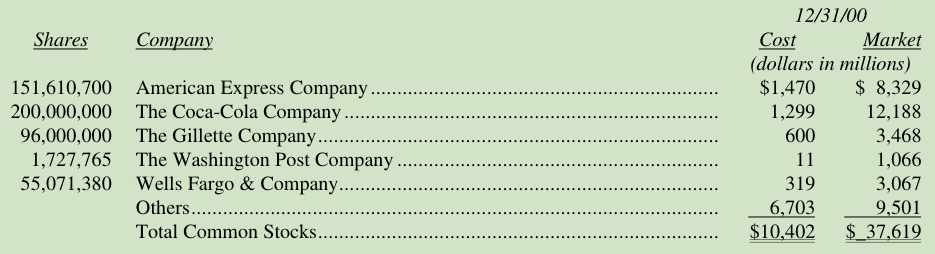
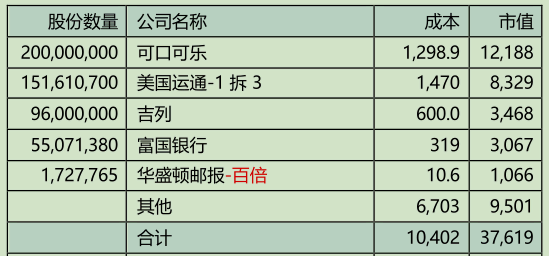
     Below we present our common stock investments. Those that had a market value of more than $1 billion at the end of 2000 are itemized.

股票投资

下表是伯克希尔 2000 年市价超过 10 亿美元以上的股票投资。

     In 2000, we sold nearly all of our Freddie Mac and Fannie Mae shares, established 15% positions in several mid-sized companies, bought the high-yield bonds of a few issuers (very few ¾ the category is not labeled junk without reason) and added to our holdings of high-grade, mortgage-backed securities. There are no "bargains" among our current holdings: We’re content with what we own but far from excited by it.

在 2000 年我们几乎将所有房地美与房利美的持股出清,同时利用 15%的资金买进几家中型的公司以及一些高收益的债券(少部分属于垃圾债券等级),另外加码一些优先顺位的高等级抵押证券(Finova),目前我们的投资组合并没有便宜货,虽然对于这样的投资组合我们感到满意,但却没有什么可以令人期待的地方。

     Many people assume that marketable securities are Berkshire’s first choice when allocating capital, but that’s not true: Ever since we first published our economic principles in 1983, we have consistently stated that we would rather purchase businesses than stocks. (See number 4 on page 60.) One reason for that preference is personal, in that I love working with our managers. They are high-grade, talented and loyal. And, frankly, I find their business behavior to be more rational and owner-oriented than that prevailing at many public companies.

许多人以为股票是伯克希尔投资时的第一选择,这样的想法不太正确,自从 1983 年我们首次公开经营原则以来,我们就一再声明,我们偏爱买下整家公司而非部分股权,其中一部分是私人理由,那就是我喜欢与经理人一起共事,他们是一群高水平、有才干同时忠诚度高的伙伴,而我必须坦言他们的商业行为远较一般上市大公司的经理人还要理性,更以公司股东的利益为重。

     But there’s also a powerful financial reason behind the preference, and that has to do with taxes. The tax code makes Berkshire’s owning 80% or more of a business far more profitable for us, proportionately, than our owning a smaller share. When a company we own all of earns $1 million after tax, the entire amount inures to our benefit. If the $1 million is upstreamed to Berkshire, we owe no tax on the dividend. And, if the earnings are retained and we were to sell the subsidiary ¾ not likely at Berkshire! ¾ for $1 million more than we paid for it, we would owe no capital gains tax. That’s because our "tax cost" upon sale would include both what we paid for the business and all earnings it subsequently retained.

当然除此之外还有一个重大的财务理由,而且是跟税负有关,根据税法规定,持有 80%以上的股权比起拥有少数股权对伯克希尔要有利的多,当一家完全由我们持有的公司税后赚了 100 万美元,这笔钱将全数纳到伯克希尔的口袋里,而不会被征股利税,而且如果子公司将收益全数保留,之后再把这家子公司出售(当然伯克希尔是不可能做这样的事),那么就算保留收益卖价超过 100 万美元,我们也不必为此支付任何的资本利得税,原因在于我们在税法上的成本,已包含我们先前买下该公司所支付成本,以及以后年度所有的保留收益。

     Contrast that situation to what happens when we own an investment in a marketable security. There, if we own a 10% stake in a business earning $10 million after tax, our $1 million share of the earnings is subject to additional state and federal taxes of (1) about $140,000 if it is distributed to us (our tax rate on most dividends is 14%); or (2) no less than $350,000 if the $1 million is retained and subsequently captured by us in the form of a capital gain (on which our tax rate is usually about 35%, though it sometimes approaches 40%). We may defer paying the $350,000 by not immediately realizing our gain, but eventually we must pay the tax. In effect, the government is our "partner" twice when we own part of a business through a stock investment, but only once when we own at least 80%. 

这与我们一般单纯持有上市公司的股票有相当大的不同,如果我们持有一家一年赚 1000 万美元公司 10%的股权时,则我们依比例分得的 100 万美元将必须负担额外的州政府与联邦所得税,那包含(1)大约 14 万美元股利税(我们大部分的股利税率为 14%);(2)最少 35 万美元的资本利得税,如果这 100 万没有分配,而事后我们又把该公司处分(我们适用的税率约在 35%左右,但有时也可能接近 40%),当然只要我们不处分该项投资,这笔税负将可以一直递延下去,但最终我们还是必须支付这笔税金。事实上政府可以说是分享我们利润的主要合伙人之一,只是投资股票政府要分两次,当我们拥有至少 80% 的股份时政府只能分一次。

     Leaving aside tax factors, the formula we use for evaluating stocks and businesses is identical. Indeed, the formula for valuing all assets that are purchased for financial gain has been unchanged since it was first laid out by a very smart man in about 600 B.C. (though he wasn’t smart enough to know it was 600 B.C.).

扣除税负因素,我们分析评估股票与企业的方式并无二致,事实上,公元前 600 年某位先知头一次揭示这个原理,虽然他可能也没有能力预知当时是公元前 600 年,这个评估所有资产投资的估值方式从来就未曾改变。

     The oracle was Aesop and his enduring, though somewhat incomplete, investment insight was "a bird in the hand is worth two in the bush." To flesh out this principle, you must answer only three questions. How certain are you that there are indeed birds in the bush? When will they emerge and how many will there be? What is the risk-free interest rate (which we consider to be the yield on long-term U.S. bonds)? If you can answer these three questions, you will know the maximum value of the bush ¾ and the maximum number of the birds you now possess that should be offered for it. And, of course, don’t literally think birds. Think dollars.

神谕就在伊索寓言里,这个历久弥新但不太完整的投资观念,就是”一鸟在手胜过二鸟在林”,要进一步诠释这项原则,你必须再回答三个问题:你如何确定树林里有鸟儿?它们何时会出现,同时数量有多少?无风险利率是多少?(我们认为是美国长期公债的利率),如果你能回答以上三个问题,那么你将知道这个树林最高的价值有多少,以及你占有这些鸟儿需要付出的最大成本。当然小鸟儿只是比喻,真正实际的标的还是美元。

     Aesop’s investment axiom, thus expanded and converted into dollars, is immutable. It applies to outlays for farms, oil royalties, bonds, stocks, lottery tickets, and manufacturing plants. And neither the advent of the steam engine, the harnessing of electricity nor the creation of the automobile changed the formula one iota ¾ nor will the Internet. Just insert the correct numbers, and you can rank the attractiveness of all possible uses of capital throughout the universe.

伊索的投资寓言除了可以进一步扩大来解释美元投资,也一样可以适用在农业、油田、债券、股票、乐透彩券以及工厂等,就算是蒸汽引擎的发明、电力设备的引用或汽车的问世一点都不会改变这样的定律,就连互联网也一样,只要输入正确的数字,你就可以为世上所有的资金可能去处的吸引力进行排名。

     Common yardsticks such as dividend yield, the ratio of price to earnings or to book value, and even growth rates have nothing to do with valuation except to the extent they provide clues to the amount and timing of cash flows into and from the business. Indeed, growth can destroy value if it requires cash inputs in the early years of a project or enterprise that exceed the discounted value of the cash that those assets will generate in later years. Market commentators and investment managers who glibly refer to "growth" and "value" styles as contrasting approaches to investment are displaying their ignorance, not their sophistication. Growth is simply a component ¾ usually a plus, sometimes a minus ¾ in the value equation.

一般的估值准则,诸如股利回报率、市盈率、市净率甚至是成长率,都与估值无关,除非他们能为一家企业未来现金流入流出的数量和时间提供线索。事实上,如果一项投资早期的现金流出大于之后的现金流入折现,那么这种成长就是价值破坏。有些市场的分析师与基金经理人信誓旦旦地将“成长型”与“价值型”列为两种截然不同的投资典型,可以说是非常无知,那绝不是真知灼见。成长只是价值要素之一,在评估价值时,可能是正面,也有可能是负面。

     Alas, though Aesop’s proposition and the third variable ¾ that is, interest rates ¾ are simple, plugging in numbers for the other two variables is a difficult task. Using precise numbers is, in fact, foolish; working with a range of possibilities is the better approach.

可惜的是,虽然伊索寓言的公式与第三个变量利率相当简单易懂,但要弄清楚另外两个变量却有相当的困难,想要明确算出这两个变量根本就不可能,求出两者可能的范围倒是有可行的办法。

     Usually, the range must be so wide that no useful conclusion can be reached. Occasionally, though, even very conservative estimates about the future emergence of birds reveal that the price quoted is startlingly low in relation to value. (Let’s call this phenomenon the IBT ¾ Inefficient Bush Theory.) To be sure, an investor needs some general understanding of business economics as well as the ability to think independently to reach a well-founded positive conclusion. But the investor does not need brilliance nor blinding insights.

只不过范围过大,通常无法得出有效的结论,而且对树丛最终出现鸟儿的数量估计越保守,所得出的价格相较于价值就越低,(我们姑且把这个现象称之为 IBT:低效树丛理论)。但可以肯定的是,投资人除了必须对于一家企业的商业模式有充分的了解外,还要具备独立思考的能力,以便得出论据坚实的肯定结论,除此之外,投资人既不需要聪明绝顶,也不需要什么歪理学说。

     At the other extreme, there are many times when the most brilliant of investors can’t muster a conviction about the birds to emerge, not even when a very broad range of estimates is employed. This kind of uncertainty frequently occurs when new businesses and rapidly changing industries are under examination. In cases of this sort, any capital commitment must be labeled speculative.

另一个极端,在很多时候,即使是最聪明的投资人都没有办法作出小鸟确实会出现的确定性,即使是在最宽松的假设下仍是如此,在检验新公司或是快速变化的行业,这种不确定性尤其明显,在这种状况下,任何投资都难脱投机的嫌疑。

     Now, speculation ¾ in which the focus is not on what an asset will produce but rather on what the next fellow will pay for it ¾ is neither illegal, immoral nor un-American. But it is not a game in which Charlie and I wish to play. We bring nothing to the party, so why should we expect to take anything home?

现在,投机关注的重点不是一种资产将会产生什么,而是下一个人将会为此付出什么。投机既不违法,也不道德,也不违反美国精神,但这不是查理和我想玩的游戏。我们没有带任何东西参加聚会,所以我们为什么要带任何东西回家呢?

     The line separating investment and speculation, which is never bright and clear, becomes blurred still further when most market participants have recently enjoyed triumphs. Nothing sedates rationality like large doses of effortless money. After a heady experience of that kind, normally sensible people drift into behavior akin to that of Cinderella at the ball. They know that overstaying the festivities ¾ that is, continuing to speculate in companies that have gigantic valuations relative to the cash they are likely to generate in the future ¾ will eventually bring on pumpkins and mice. But they nevertheless hate to miss a single minute of what is one helluva party. Therefore, the giddy participants all plan to leave just seconds before midnight. There’s a problem, though: They are dancing in a room in which the clocks have no hands.

投资和投机之间的界限从来都不明确,当最近所有市场的参与者都取得成功时,这条界限变得更加模糊。再也没有比大笔不劳而获的金钱更能让人失去理智。在经历过这类令人陶醉的体验之后,再理性的人也会像参加舞会的灰姑娘一样被冲昏了头,他们明知在舞会中待得过久,南瓜马车与老鼠终将现出原形。换句话说,继续将大笔的资金投入到投机的活动之上血本无归的机率就越来越高,但他们还是舍不得错过这场盛大舞会的每一分钟,所有人都打算继续待到最后一刻才离开,但问题是这场舞会中的时钟根本就没有指针!

     Last year, we commented on the exuberance ¾ and, yes, it was irrational ¾ that prevailed, noting that investor expectations had grown to be several multiples of probable returns. One piece of evidence came from a Paine Webber-Gallup survey of investors conducted in December 1999, in which the participants were asked their opinion about the annual returns investors could expect to realize over the decade ahead. Their answers averaged 19%. That, for sure, was an irrational expectation: For American business as a whole, there couldn’t possibly be enough birds in the 2009 bush to deliver such a return.

去年我们对于这种非理性繁荣大加批评,这实在是太不合理了。投资人的预期回报已经超过可能回报的数倍,一份普惠证券公司( Paine Webber )在 1999 年进行的调查报告显示,当投资人被问到自己预期未来十年内的年平均投资回报有多少,答案平均是 19%。这显然是不合理的预期,对整个美国商业来说,2009 年的树林中根本就不可能藏有这么多鸟儿来提高这样的回报。

     Far more irrational still were the huge valuations that market participants were then putting on businesses almost certain to end up being of modest or no value. Yet investors, mesmerized by soaring stock prices and ignoring all else, piled into these enterprises. It was as if some virus, racing wildly among investment professionals as well as amateurs, induced hallucinations in which the values of stocks in certain sectors became decoupled from the values of the businesses that underlay them.

更疯狂的是,市场参与者对于一些长期而言明显没有太多价值或毫无价值的公司,给予了极高的估值,然而投资人依然被持续飙涨的股价所迷惑,不顾一切地将资金蜂拥投入到这类企业,这情形就好象是病毒一样,在专业机构与散户间广为散播,引发不合理的股价预期幻觉,与其企业本身应有的价值明显脱钩。

     This surreal scene was accompanied by much loose talk about "value creation." We readily acknowledge that there has been a huge amount of true value created in the past decade by new or young businesses, and that there is much more to come. But value is destroyed, not created, by any business that loses money over its lifetime, no matter how high its interim valuation may get.

伴随着不切实际市场而来的还有一种叫做“价值创造”的荒唐说法。我们承认过去数十年来,许多新的年轻公司确实为这个世界创造出许多价值,未来还会出现更多。但是,那些终其一生不赚钱甚至是亏钱的企业,根本是在摧毁价值而不是创造价值,无论期间他们的市值曾经有多高。

     What actually occurs in these cases is wealth transfer, often on a massive scale. By shamelessly merchandising birdless bushes, promoters have in recent years moved billions of dollars from the pockets of the public to their own purses (and to those of their friends and associates). The fact is that a bubble market has allowed the creation of bubble companies, entities designed more with an eye to making money off investors rather than for them. Too often, an IPO, not profits, was the primary goal of a company’s promoters. At bottom, the "business model" for these companies has been the old-fashioned chain letter, for which many fee-hungry investment bankers acted as eager postmen.

在这些案例中,真正发生的只是财富移转的效应,而且通常都是大规模的。部分厚颜无耻的推销人员利用根本就没有半只鸟的树林,从社会大众的口袋中骗走数十亿美元,这其中也包含他们自己的朋友与亲人,事实证明泡沫市场创造出泡沫公司,这些公司的设计,更多是为了赚走投资人手中的钱而不是帮投资人赚钱。通常这些幕后推手的最终目标是为了让公司上市,而不是让公司赚钱。归根结底,这些公司的商业模式只不过老式连锁信骗局的现代版,而靠手续费维生的投资银行家就成了专门送信的帮凶邮差。

     But a pin lies in wait for every bubble. And when the two eventually meet, a new wave of investors learns some very old lessons: First, many in Wall Street ¾ a community in which quality control is not prized ¾ will sell investors anything they will buy. Second, speculation is most dangerous when it looks easiest.

然而任何泡沫都有一根针在等待。当泡沫被刺破,不可避免的会有一大票菜鸟学到教训。首先,不论是什么东西只要有人要买,不管质量的华尔街都会拿来销售。第二,投机看似简单,其实非常危险。

     At Berkshire, we make no attempt to pick the few winners that will emerge from an ocean of unproven enterprises. We’re not smart enough to do that, and we know it. Instead, we try to apply Aesop’s 2,600-year-old equation to opportunities in which we have reasonable confidence as to how many birds are in the bush and when they will emerge (a formulation that my grandsons would probably update to "A girl in a convertible is worth five in the phonebook."). Obviously, we can never precisely predict the timing of cash flows in and out of a business or their exact amount. We try, therefore, to keep our estimates conservative and to focus on industries where business surprises are unlikely to wreak havoc on owners. Even so, we make many mistakes: I’m the fellow, remember, who thought he understood the future economics of trading stamps, textiles, shoes and second-tier department stores.

在伯克希尔,我们从来没有妄想要从一堆不成气候的公司中,挑出幸运儿,我们自认没有这种超能力,这点我们绝对有自知之明。相反的我们试着遵循 2600 年来既有的古老伊索寓言,耐心研究某些树丛里到底有多少鸟儿,以及他们出现的时机。(或许以后我的孙子可能会把它改为五个电话簿上的女孩,不如一个敞篷车上的女孩),当然我们永远没有办法精准预估一家公司每年现金流入与流出的状况,所以我们试着用比较保守的角度去估算,同时将重心锁定在那些即使业务发生意外也不会让股东遭受严重损失的公司上。即便是如此,我们还是常常犯错,别忘了 ,我就是那个曾经自称是相当熟悉印花票、纺织、制鞋以及二流百货公司商业模式的人。

     Lately, the most promising "bushes" have been negotiated transactions for entire businesses, and that pleases us. You should clearly understand, however, that these acquisitions will at best provide us only reasonable returns. Really juicy results from negotiated deals can be anticipated only when capital markets are severely constrained and the whole business world is pessimistic. We are 180 degrees from that point.

近来,我们最看好的树林要算是经协议买下整家公司的并购交易,这种方法确实让我们感到相当满意,不过大家要记住,这类的交易顶多让我们有一个合理的回报,想要有超额的回报一定要等到资本市场非常惨淡,整个企业界普遍感到悲观之时,机会才会出现,目前我们离那种状况还很远。

〔译文源于芒格书院整理的巴菲特致股东的信〕

© Copyright 2023 Meitiandudian. All Rights Reserved.