巴菲特致股东的信(2001年)
③财产意外险的经营哲学


The Economics of Property/Casualty Insurance

     Our main business ¾ though we have others of great importance ¾ is insurance. To understand Berkshire, therefore, it is necessary that you understand how to evaluate an insurance company. The key determinants are: (1) the amount of float that the business generates; (2) its cost; and (3) most critical of all, the long-term outlook for both of these factors.

财产意外险的经营哲学

我们最主要的业务就是保险,当然其它事业也相当重要,想要了解伯克希尔,你就必须知道如何去评估一家保险公司,其中主要的关键因素是(1)保险业务所能产生的浮存金数量(2)以及获得浮存金的成本(3)最重要的是这两个因素的长期前景。

     To begin with, float is money we hold but don't own. In an insurance operation, float arises because premiums are received before losses are paid, an interval that sometimes extends over many years. During that time, the insurer invests the money. This pleasant activity typically carries with it a downside: The premiums that an insurer takes in usually do not cover the losses and expenses it eventually must pay. That leaves it running an "underwriting loss," which is the cost of float. An insurance business has value if its cost of float over time is less than the cost the company would otherwise incur to obtain funds. But the business is a lemon if its cost of float is higher than market rates for money.

首先浮存金是一项我们持有但却不属于我们的资金,在保险公司的营运中,浮存金产生的原因在于,保险公司在真正支付损失理赔之前,一般会先向保户收取保费,这个间隔有时会持续许多年。在这期间保险公司会将资金运用在其它投资之上,当然这样的好处也必须要付出代价,通常保险业者收取的保费并不足以覆盖最后要支付出去的损失赔偿与运营费用,于是保险公司便会发生承保损失,这就是浮存金的成本,而当一家公司取得浮存金成本,就长期而言低于从其它渠道获得资金的成本时,它就有存在的价值,否则一旦保险业取得浮存金的成本远高于货币市场利率时,它就像是一颗极酸的柠檬。

     Historically, Berkshire has obtained its float at a very low cost. Indeed, our cost has been less than zero in about half of the years in which we've operated; that is, we've actually been paid for holding other people's money. Over the last few years, however, our cost has been too high, and in 2001 it was terrible.

根据过去的记录显示,伯克希尔一向能够以很低的成本取得浮存金,确实在伯克希尔经营的这些年来,有半数以上的年头,浮存金的成本甚至低于零,也就是说,这实际上等于是因为持有别人的资金而获得了收益,然而过去这几年,我们的浮存金成本大幅飙涨,2001 年尤其恐怖。 

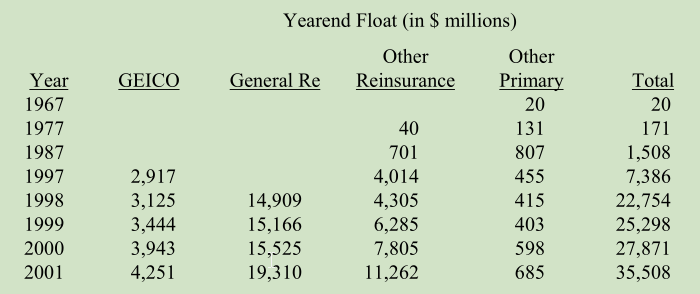
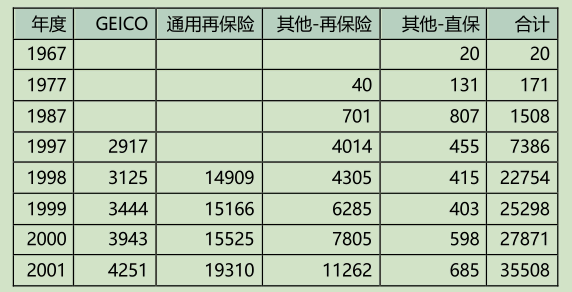
     The table that follows shows (at intervals) the float generated by the various segments of Berkshire's insurance operations since we entered the business 35 years ago upon acquiring National Indemnity Company (whose traditional lines are included in the segment "Other Primary"). For the table we have calculated our float ¾ which we generate in large amounts relative to our premium volume ¾ by adding net loss reserves, loss adjustment reserves, funds held under reinsurance assumed and unearned premium reserves, and then subtracting insurance-related receivables, prepaid acquisition costs, prepaid taxes and deferred charges applicable to assumed reinsurance. (Got that?)

下表中所显示的数字是,伯克希尔自取得国民保险公司经营权(其中传统业务包含在其它主险项下),进入保险业务 35 年以来所贡献的浮存金,在这张计算浮存金的表中,(相对于收到的保费收入,我们产生的浮存金规模是相当大的),我们将所有的损失准备金、损失费用调整准备金、假设再保险预先收取的资金与未赚取保费加总后,再扣除应付佣金、预付并购成本、预付税款以及再保业务相关递延费用,得出浮存金的数额,弄清楚了吗?

     Last year I told you that, barring a mega-catastrophe, our cost of float would probably drop from its 2000 level of 6%. I had in mind natural catastrophes when I said that, but instead we were hit by a man-made catastrophe on September 11th ¾ an event that delivered the insurance industry its largest loss in history. Our float cost therefore came in at a staggering 12.8%. It was our worst year in float cost since 1984, and a result that to a significant degree, as I will explain in the next section, we brought upon ourselves.

去年我曾告诉各位,除非发生什么重大的灾难,否则我们浮存金的成本将从 2000 年的 6%高位下降,当时我心里只想到的是自然天灾之类的意外,但怎么也没想到,发生的竟是 911 恐怖袭击事件这样的人祸,它造成保险业有史以来最重大的损失,也让我们的浮存金成本大举飙高到 12.8%,这是自 1984 年以来最惨的记录,而且大部分的责任,在后段我还会再详加解释,要归咎于我们自己。

     If no mega-catastrophe occurs, I ¾ once again ¾ expect the cost of our float to be low in the coming year. We will indeed need a low cost, as will all insurers. Some years back, float costing, say, 4% was tolerable because government bonds yielded twice as much, and stocks prospectively offered still loftier returns. Today, fat returns are nowhere to be found (at least we can't find them) and short-term funds earn less than 2%. Under these conditions, each of our insurance operations, save one, must deliver an underwriting profit if it is to be judged a good business. The exception is our retroactive reinsurance operation (a business we explained in last year's annual report), which has desirable economics even though it currently hits us with an annual underwriting loss of about $425 million. 

如果没有发生重大的灾害,我个人再度预期,明年度我们的浮存金成本将会大幅降低,我们确实极需要降低成本,所有保险公司都一样,几年前,4%的浮存金成本还算可以忍受,因为当时政府的公债利率是其两倍以上,而股市预期也能提供相当不错的回报,然而时至今日,丰厚的投资回报已无处可寻(至少我们无法找到),短期基金的收益率低于 2%,在这种情况下,我们旗下所有的保险事业,都必须能够创造出承保获利才能称得上是好公司。除了去年的年报曾详加介绍过的追溯再保险业务,虽然目前给我们带来 4.25 亿美元的承保损失,但就长期而言却有相当吸引力的经济效益。

〔译文源于芒格书院整理的巴菲特致股东的信〕

© Copyright 2023 Meitiandudian. All Rights Reserved.