巴菲特致股东的信(2004年)⑦股票投资


Investments

股票投资

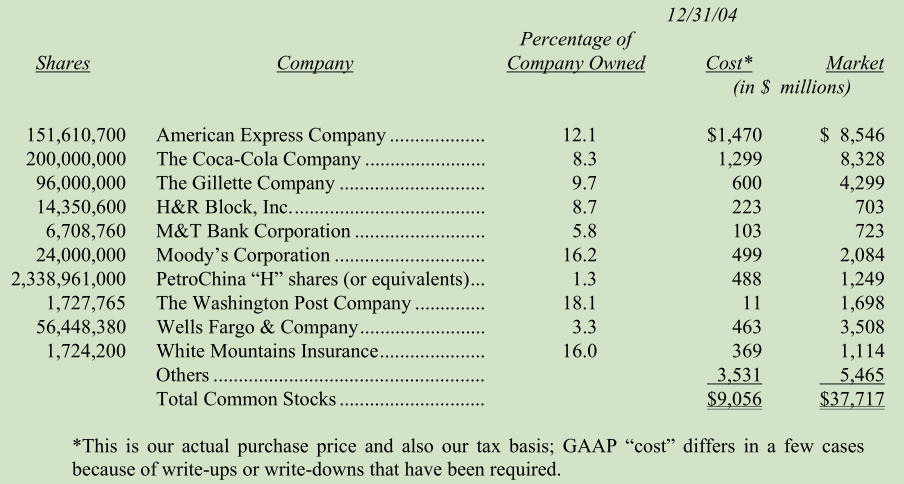
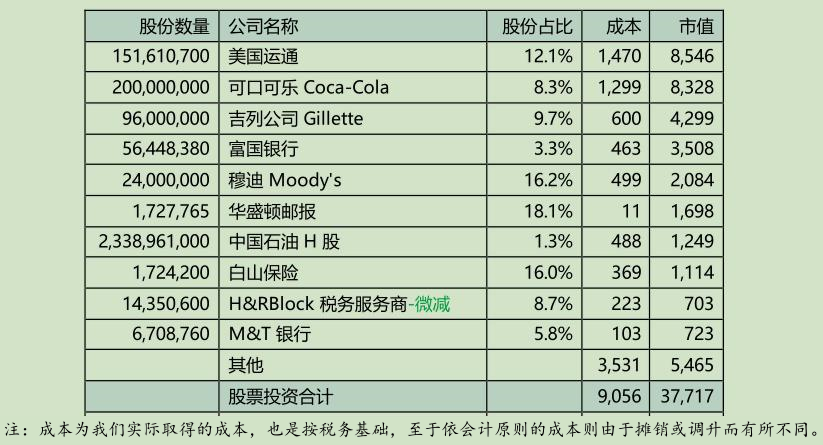
We show below our common stock investments. Those that had a market value of more than $600 million at the end of 2004 are itemized.

下表列示伯克希尔 2004 年市价超过 6 亿美元以上的股票投资。

Some people may look at this table and view it as a list of stocks to be bought and sold based upon chart patterns, brokers’ opinions, or estimates of near-term earnings. Charlie and I ignore such distractions and instead view our holdings as fractional ownerships in businesses. This is an important distinction. Indeed, this thinking has been the cornerstone of my investment behavior since I was 19. At that time I read Ben Graham’s The Intelligent Investor, and the scales fell from my eyes. (Previously, I had been entranced by the stock market, but didn’t have a clue about how to invest.)

看过这张表的人或许会以为这些股票是根据 K 线图、经纪人的建议或是公司近期的获利预估来进行买卖,其实查理跟我本人根本就不理会这些,而是以企业所有权人的角度看事情,这是非常大的区别,事实上,这正是我几十年来投资行为的基石所在,自我 19 岁读到格雷厄姆的《聪明投资者》之后,我便茅塞顿开。在此之前,虽然我早已投入股市,但实际上对投资根本就没有一点概念。

Let’s look at how the businesses of our “Big Four” – American Express, Coca-Cola, Gillette and Wells Fargo – have fared since we bought into these companies. As the table shows, we invested $3.83 billion in the four, by way of multiple transactions between May 1988 and October 2003. On a composite basis, our dollar-weighted purchase date is July 1992. By yearend 2004, therefore, we had held these “business interests,” on a weighted basis, about 12½ years.

接下来看看我们的四大天王美国运通、可口可乐、吉列及富国银行的表现如何,如上表所示,在 1988 年 5月至 2003 年 10 月期间,我们通过多笔交易向这四家公司的投资了 38.3 亿美元,总的来说,我们平均买进的日期是 1992 年 7 月,截止 2004 年底,我们平均持股的时间是 12.5 年。

In 2004, Berkshire’s share of the group’s earnings amounted to $1.2 billion. These earnings might legitimately be considered “normal.” True, they were swelled because Gillette and Wells Fargo omitted option costs in their presentation of earnings; but on the other hand they were reduced because Coke had a non-recurring write-off.

依持股比例,2004 年伯克希尔可分配到的收益份额高达 12 亿美元,这个数字可以称得上合理,虽然吉列与富国银行因为期权成本不计入费用而收益高估,但同时可口可乐却也提列了一笔非经常性的损失。

Our share of the earnings of these four companies has grown almost every year, and now amounts to about 31.3% of our cost. Their cash distributions to us have also grown consistently, totaling $434 million in 2004, or about 11.3% of cost. All in all, the Big Four have delivered us a satisfactory, though far from spectacular, business result.

我们从这四大天王所占的收益份额几乎每年都稳定的成长,现在已占当初投资成本的 31.3%,所分配的现金股利也同步成长,2004 年达到 4.34 亿美元,约占成本的 11.3%。总的来说,这四大天王给了我们还算满意的回报,尽管远没有达到惊人的程度。

That’s true as well of our experience in the market with the group. Since our original purchases, valuation gains have somewhat exceeded earnings growth because price/earnings ratios have increased. On a year-to-year basis, however, the business and market performances have often diverged, sometimes to an extraordinary degree. During The Great Bubble, market-value gains far outstripped the performance of the businesses. In the aftermath of the Bubble, the reverse was true.

在股价方面的感受也是如此,自我们买进以后,由于市盈率 PE 提升缘故,股价的增幅还高于收益成长的幅度,就个别单一年度而言,股价与企业本身经营状况往往有所分岐,在大泡沫期间,股价的涨幅远远超过本业的表现,至于泡沫破灭之后,其表现则恰恰相反。

Clearly, Berkshire’s results would have been far better if I had caught this swing of the pendulum. That may seem easy to do when one looks through an always-clean, rear-view mirror. Unfortunately, however, it’s the windshield through which investors must peer, and that glass is invariably fogged. Our huge positions add to the difficulty of our nimbly dancing in and out of holdings as valuations swing.

当然,要是我能够掌握钟摆摆动的诀窍,伯克希尔的绩效应当会更好,这种事后诸葛的话人人会说,但只可惜投资人真正需要的是先见之明,无奈前方的景象晖暗不明。随着估值的波动,而我们庞大的投资部位更大大提高了灵活进出的困难度。

Nevertheless, I can properly be criticized for merely clucking about nose-bleed valuations during the Bubble rather than acting on my views. Though I said at the time that certain of the stocks we held were priced ahead of themselves, I underestimated just how severe the overvaluation was. I talked when I should have walked.

在股市泡沫期间,我只是对着流鼻血的估值老调重谈价值投资理念,却没有按自己的理念卖出,这一点可以受到适度的批评。虽然那时我说过,我们部分的持股市价高于其应有的价值,但我低估了其间的背离程度。坐而言不够,还须起而行。

What Charlie and I would like is a little action now. We don’t enjoy sitting on $43 billion of cash equivalents that are earning paltry returns. Instead, we yearn to buy more fractional interests similar to those we now own or – better still – more large businesses outright. We will do either, however, only when purchases can be made at prices that offer us the prospect of a reasonable return on our investment.

查理跟我实在是应该起来行动了,手上这 430 亿现金不能只靠微薄的利息过日子,我们渴望购买类似于我们手上持有的这些公司的部分权益,当然若是能买断整家公司会更好,然而,只有购买价格能够为我们提供合理投资回报时,我们才会采取行动。

* * * * * * * * * * * *

* * * * * * * * * * * *

We’ve repeatedly emphasized that the “realized” gains that we report quarterly or annually are meaningless for analytical purposes. We have a huge amount of unrealized gains on our books, and our thinking about when, and if, to cash them depends not at all on a desire to report earnings at one specific time or another. A further complication in our reported gains occurs because GAAP requires that foreign exchange contracts be marked to market, a stipulation that causes unrealized gains or losses in these holdings to flow through our published earnings as if we had sold our positions.

我们一再强调,单一会计期间所示的已实现资本利得不具任何意义。虽然帐上享有大量的未实现资本利得,但我们绝对不会为了让帐面数字好看而去兑现。另外由于 GAAP 会计原则规定外汇投资每季必须按市价调整损益,这使得我们每季的收益波动幅度更为加剧。

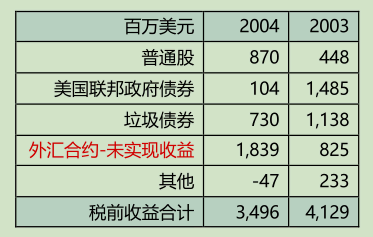
Despite the problems enumerated, you may be interested in a breakdown of the gains we reported in 2003 and 2004. The data reflect actual sales except in the case of currency gains, which are a combination of sales and marks to market.

虽然多了以上几项变量,大家可能还是想要了解近两年报告的收益明细。以下数字,除了外汇投资,其余多属已实现资本收益。
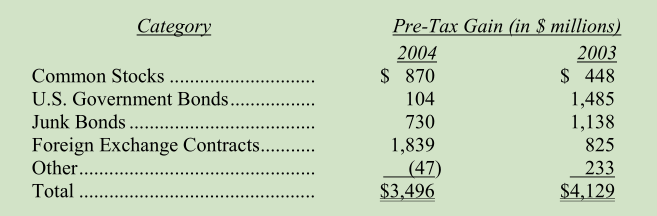
The junk bond profits include a foreign exchange component. When we bought these bonds in 2001 and 2002, we focused first, of course, on the credit quality of the issuers, all of which were American corporations. Some of these companies, however, had issued bonds denominated in foreign currencies. Because of our views on the dollar, we favored these for purchase when they were available.

垃圾债券收益包含部分汇兑利益,几年前我们买下这些债券时,首先考量的当然是发行人的债信,他们都是美国公司,其中部分系以外币计价,由于我们认为美元长期走势看贬,所以当初投资时优先购买。

As an example, we bought €254 million of Level 3 bonds (10 ¾% of 2008) in 2001 at 51.7% of par, and sold these at 85% of par in December 2004. This issue was traded in Euros that cost us 88¢ at the time of purchase but that brought $1.29 when we sold. Thus, of our $163 million overall gain, about $85 million came from the market’s revised opinion about Level 3’s credit quality, with the remaining $78 million resulting from the appreciation of the Euro. (In addition, we received cash interest during our holding period that amounted to about 25% annually on our dollar cost.)

举例来说,我们在 2001 年以 51.7%的折价买进 Level3 公司面值 2.54 亿欧元的债券(2008 年到期年息率 10.75%),并在 2004年 12 月以 85%的票面价格售出,当初买进的时候,欧元对美元的汇率是 1 比 0.88,等到我们卖出时,欧元对美元的汇率已涨升为 1 比 1.29,所以在总计 1.63 亿美元的资本利得当中,8,500 万美元来自市场对于该公司债信的修正,另外 7,800 万则来自于欧元的升值,此外在持有期间我们每年还收到相当于投资成本 25%的利息收入。

* * * * * * * * * * * *

* * * * * * * * * * * *

The media continue to report that “Buffett buys” this or that stock. Statements like these are almost always based on filings Berkshire makes with the SEC and are therefore wrong. As I’ve said before, the stories should say “Berkshire buys.”

不论我如何澄清,媒体还是一再报导,「巴菲特买进某些股票」,这些讯息主要的来源是伯克希尔向证券主管机关申报的文件,这样的说法其实并不正确,就像我一再强调的,他们应该要说,这是「伯克希尔买进的」。

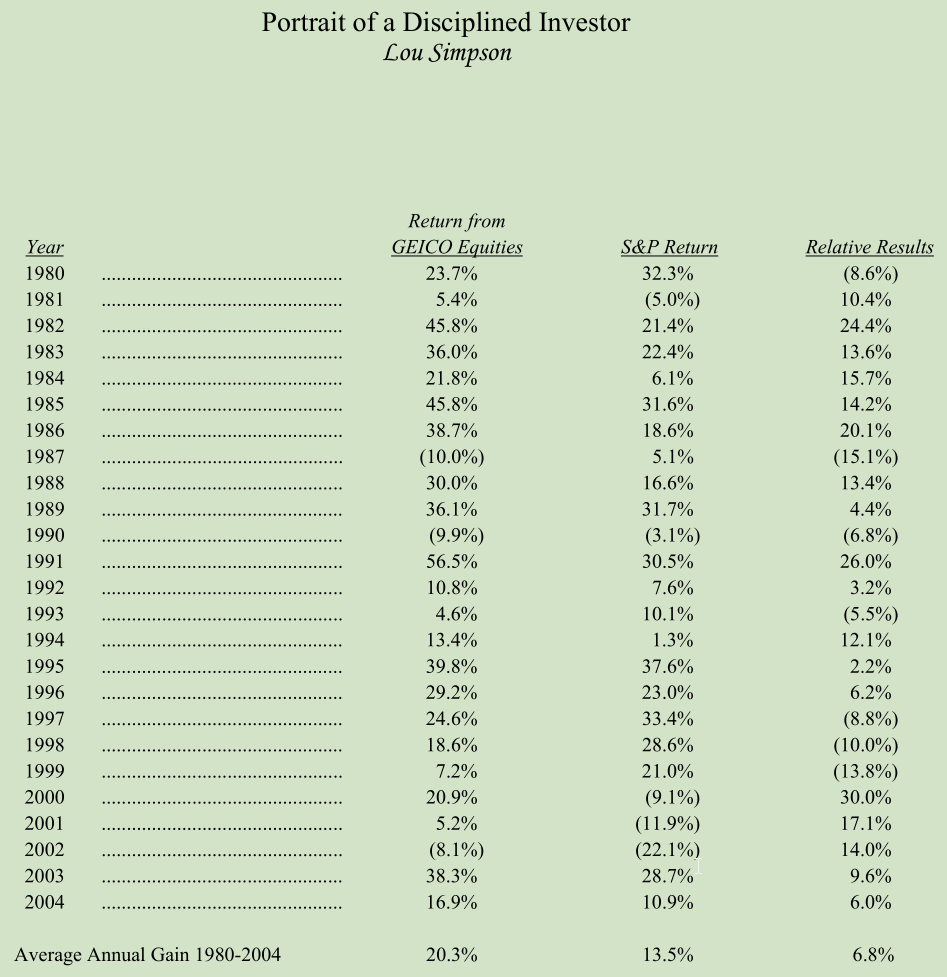
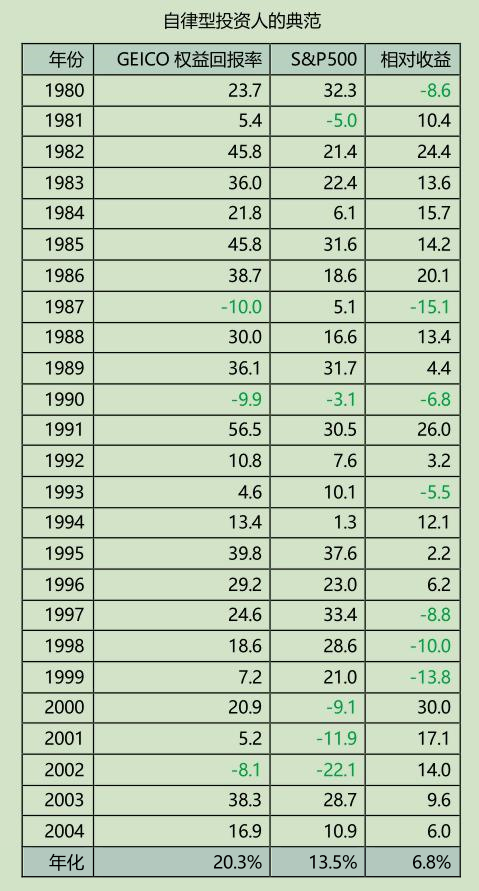
Even then, it is typically not I who make the buying decisions. Lou Simpson manages about $2½ billion of equities that are held by GEICO, and it is his transactions that Berkshire is usually reporting. Customarily his purchases are in the $200-$300 million range and are in companies that are smaller than the ones I focus on. Take a look at the facing page to see why Lou is a cinch to be inducted into the investment Hall of Fame.

其实那些投资决策也并非由我所做出,LouSimpson 管理的 GEICO 投资组合规模约 25 亿美元,伯克希尔申报的交易大多指的是这一部分,一般而言,他买进的标的规模约在 2-3 亿美元之间,比我关注的公司规模要小,对照下表的投资绩效,你就知道 LouSimpson 进入投资界的名人堂几乎是十拿九稳的事。

You may be surprised to learn that Lou does not necessarily inform me about what he is doing. When Charlie and I assign responsibility, we truly hand over the baton – and we give it to Lou just as we do to our operating managers. Therefore, I typically learn of Lou’s transactions about ten days after the end of each month. Sometimes, it should be added, I silently disagree with his decisions. But he’s usually right.

大家或许不相信,路易事前不须跟我报告他的进出动作,当查理跟我授权给经理人时,我们是真的交出指挥大棒,路易是这样,其它旗下业务经理人也是如此。因此,我通常是在每个月结束后十天才知道路易又从事了那些交易,虽然有时候老实说,我并不一定认同他的看法,不过事后证明他总是对的。

Portrait of a Disciplined Investor Lou Simpson

下表是 Lou Simpson 管理的GEICO 投资组合的长期绩效:

〔译文源于芒格书院整理的巴菲特致股东的信〕

© Copyright 2023 Meitiandudian. All Rights Reserved.