巴菲特致股东的信(2014年)⑧投资业务


Investments

投资业务

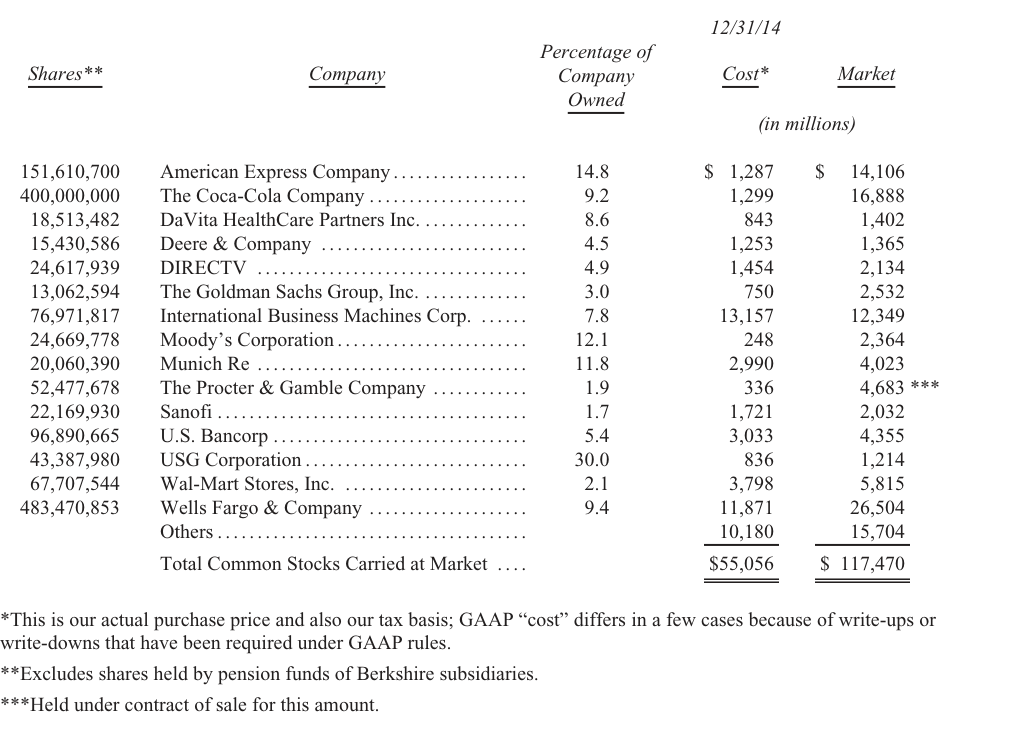
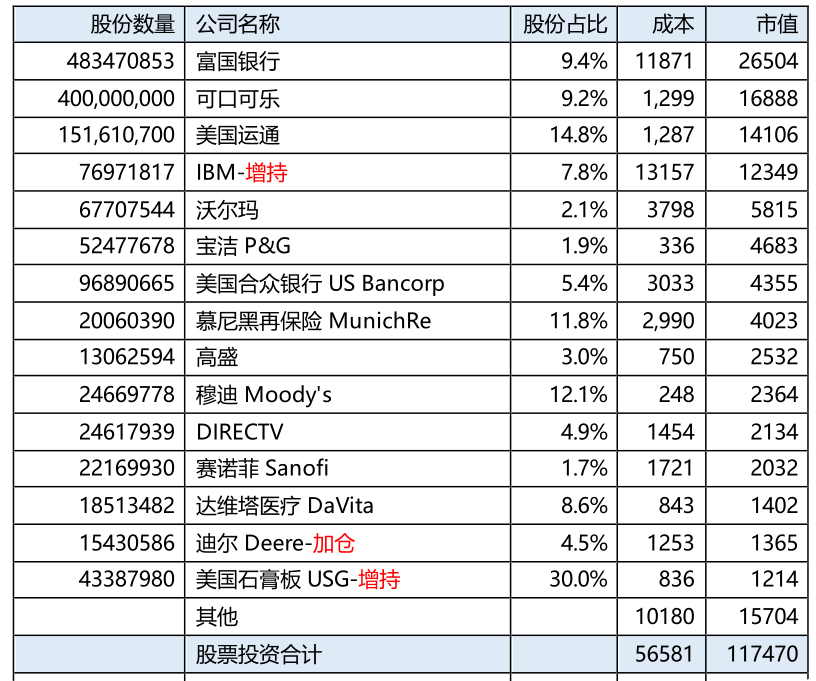
Below we list our fifteen common stock investments that at yearend had the largest market value.

以下是截至去年年末,伯克希尔持有的市值最大的15 只普通股投资。

Berkshire has one major equity position that is not included in the table: We can buy 700 million shares of Bank of America at any time prior to September 2021 for $5 billion. At yearend these shares were worth $12.5 billion. We are likely to purchase the shares just before expiration of our option. In the meantime, it is important for you to realize that Bank of America is, in effect, our fourth largest equity investment – and one we value highly.

伯克希尔还有一个主要的股权投资并未计入上表:我们在2021 年9 月以前任何时间都有权以50 亿美元买入7 亿股美国银行股票。在去年末这部分价值是125 亿美元。我们可能会在我们的期权到期前行权。同时,你必须意识到,美国银行实质上是我们的第四大股权投资,并且是我们极重视的一个投资。

* * * * * * * * * * * *

* * * * * * * * * * * *

Attentive readers will notice that Tesco, which last year appeared in the list of our largest common stock investments, is now absent. An attentive investor, I’m embarrassed to report, would have sold Tesco shares earlier. I made a big mistake with this investment by dawdling.

细心的读者可能会注意到,去年出现在我们投资清单上的乐购(Tesco)如今已不复存在。我不得不尴尬地向大家报告,专注的投资者应该早就卖掉了乐购的股票,而我在这项投资上犯了一个巨大的错误,那就是磨蹭。

At the end of 2012 we owned 415 million shares of Tesco, then and now the leading food retailer in the U.K. and an important grocer in other countries as well. Our cost for this investment was $2.3 billion, and the market value was a similar amount.

2012 年底,我们拥有4.15 亿股乐购股票,当时和现在乐购都是英国领先的食品零售商,在其他国家也是一个重要的食杂商。我们这一投资的成本是23 亿美元,与这些股票的市值差不多。

In 2013, I soured somewhat on the company’s then-management and sold 114 million shares, realizing a profit of $43 million. My leisurely pace in making sales would prove expensive. Charlie calls this sort of behavior “thumb-sucking.” (Considering what my delay cost us, he is being kind.)

2013 年,我对乐购当时的管理层略感失望,因此卖出了1.14 亿股,实现4300 万美元的收益。事后证明,我懒散卖出方式代价高昂。查理把这类行为称为"吮拇指"。(考虑到我的拖延给我们造成的损失,他这样说真是宽宏大量)。

During 2014, Tesco’s problems worsened by the month. The company’s market share fell, its margins contracted and accounting problems surfaced. In the world of business, bad news often surfaces serially: You see a cockroach in your kitchen; as the days go by, you meet his relatives.

2014 年,乐购的问题逐月恶化。公司市场份额大幅下降,利润率萎缩,会计问题浮出水面。在商界坏消息经常是接踵而至:一旦你在厨房里看到一只蟑螂,几天后你就会遇到它的"亲戚"。

We sold Tesco shares throughout the year and are now out of the position. (The company, we should mention, has hired new management, and we wish them well.) Our after-tax loss from this investment was $444 million, about 1/5 of 1% of Berkshire’s net worth. In the past 50 years, we have only once realized an investment loss that at the time of sale cost us 2% of our net worth. Twice, we experienced 1% losses. All three of these losses occurred in the 1974-1975 period, when we sold stocks that were very cheap in order to buy others we believed to be even cheaper.

我们在去年全年都在卖出乐购股票,现在已经卖光了。(我们要指出的是,这家公司已聘用了新的管理层,我们希望他们一切顺利)。我们这笔投资的税后亏损是4.44 亿美元,相当于伯克希尔账面价值的0.2%。过去50 年中,我们仅有一次投资在卖出时亏损超过账面价值的2%。另外有两次亏损超过账面价值1%。这三次亏损都发生在1974-1975 年间,当时我们以非常便宜的价格出售股票,以购买其他我们认为更为便宜的股票。

* * * * * * * * * * * *

* * * * * * * * * * * *

Our investment results have been helped by a terrific tailwind. During the 1964-2014 period, the S&P 500 rose from 84 to 2,059, which, with reinvested dividends, generated the overall return of 11,196% shown on page 2. Concurrently, the purchasing power of the dollar declined a staggering 87%. That decrease means that it now takes $1 to buy what could be bought for 13¢ in 1965 (as measured by the Consumer Price Index).

我们的投资业绩得益于一股强劲的顺风。1964-2014 年期间,标普500 指数从84 点涨至2059 点,加上股息再投资,整体回报达到11196%。与此同时,美元的购买力下降了令人吃惊的87%。这样的下跌意味着现在需要1 美元才能买到的东西,在1965 年花13 美分就可以买到(根据消费者价格指数衡量)。

There is an important message for investors in that disparate performance between stocks and dollars. Think back to our 2011 annual report, in which we defined investing as “the transfer to others of purchasing power now with the reasoned expectation of receiving more purchasing power – after taxes have been paid on nominal gains – in the future.” The unconventional, but inescapable, conclusion to be drawn from the past fifty years is that it has been far safer to invest in a diversified collection of American businesses than to invest in securities – Treasuries, for example – whose values have been tied to American currency. That was also true in the preceding half-century, a period including the Great Depression and two world wars. Investors should heed this history. To one degree or another it is almost certain to be repeated during the next century.

股票和美元表现的巨大差异向投资者发出了一个重要信号。回顾我们2011 年的年度报告,我们在报告中将投资定义为:现在将购买力让渡给他人,同时合理预期在未来将获得更多的购买力(在名义收益税后)。 从过去50 年得出一个非常规但不容辩驳的结论是,投资于一个多元化的美国企业组合,比投资于价值与美元挂钩的证券(如美国国债)要安全得多。之前的半个世纪也是如此,即使包括了大萧条和两次世界大战在内。投资者应该关注这段历史。在某种程度上,这种情况肯定会在未来一个世纪重演。

Stock prices will always be far more volatile than cash-equivalent holdings. Over the long term, however, currency-denominated instruments are riskier investments – far riskier investments – than widely-diversified stock portfolios that are bought over time and that are owned in a manner invoking only token fees and commissions. That lesson has not customarily been taught in business schools, where volatility is almost universally used as a proxy for risk. Though this pedagogic assumption makes for easy teaching, it is dead wrong: Volatility is far from synonymous with risk. Popular formulas that equate the two terms lead students, investors and CEOs astray.

股票价格的波动性总是会比持有现金等价物高得多。但是,从长期来看,货币计价的投资品风险更高,相比以象征性手续费和佣金的方式购买的广泛多元化的股票组合,其风险甚至要高出很多。商学院通常不教授这样的知识,在那里波动性普遍被用作衡量风险的指标。尽管这样的学术假设使教学变得容易,但它错得离谱:波动性远不是风险的同义词。流行观念将二者等同起来,导致学生、投资者和CEO 们误入歧途。

It is true, of course, that owning equities for a day or a week or a year is far riskier (in both nominal and purchasing-power terms) than leaving funds in cash-equivalents. That is relevant to certain investors – say, investment banks – whose viability can be threatened by declines in asset prices and which might be forced to sell securities during depressed markets. Additionally, any party that might have meaningful near-term needs for funds should keep appropriate sums in Treasuries or insured bank deposits.

当然,毫无疑问的是,拥有股票一天一周或一年的风险(无论从名义值还是购买力衡量),都远高于将资金投入现金等价物中。这对于某些投资者(比如说投行)有意义,因为它们的生存可能受到资产价格大幅下跌的威胁,并可能在市场低迷时被迫出售证券。此外,任何可能有重大的近期内资金需求的人,他们都应该在美国国债或有保险的银行存款中保留适当的金额。

For the great majority of investors, however, who can – and should – invest with a multi-decade horizon, quotational declines are unimportant. Their focus should remain fixed on attaining significant gains in purchasing power over their investing lifetime. For them, a diversified equity portfolio, bought over time, will prove far less risky than dollar-based securities.

但是,对绝大多数投资者来说,股价的下跌并不重要,因为他们能够(也应该)以几十年的眼光进行投资。他们的关注重点仍然是,在投资生命周期内获得购买力的大幅增长。对他们来说,随着时间推移买入而建立的多元化的股票组合将被证明风险远低于基于美元的证券。

If the investor, instead, fears price volatility, erroneously viewing it as a measure of risk, he may, ironically, end up doing some very risky things. Recall, if you will, the pundits who six years ago bemoaned falling stock prices and advised investing in “safe” Treasury bills or bank certificates of deposit. People who heeded this sermon are now earning a pittance on sums they had previously expected would finance a pleasant retirement. (The S&P 500 was then below 700; now it is about 2,100.) If not for their fear of meaningless price volatility, these investors could have assured themselves of a good income for life by simply buying a very low-cost index fund whose dividends would trend upward over the years and whose principal would grow as well (with many ups and downs, to be sure).

相反,如果投资者害怕价格波动,错误地把它视为某种风险衡量标准,具有讽刺意味的是,他反而可能会做一些非常冒险的事情。如果你愿意回忆一下6 年前,那些哀叹股价不断下跌,建议投资于"安全"的国债或银行存单的权威人士。听了这些建议的人们现在的回报少得可怜,而他们之前预计这些钱可以为愉快的退休生活提供资金。(标普500 指数当时低于700 点,现在约为2100 点)。如果他们不担心毫无意义的价格波动,这些投资者当时本可以买一只低成本的指数基金来确保自己终生将获得丰厚的收入。因为这些基金的股息将在未来几年增加,本金也将上涨(当然这其中会有很多涨跌起伏)。

Investors, of course, can, by their own behavior, make stock ownership highly risky. And many do. Active trading, attempts to “time” market movements, inadequate diversification, the payment of high and unnecessary fees to managers and advisors, and the use of borrowed money can destroy the decent returns that a life-long owner of equities would otherwise enjoy. Indeed, borrowed money has no place in the investor’s tool kit: Anything can happen anytime in markets. And no advisor, economist, or TV commentator – and definitely not Charlie nor I – can tell you when chaos will occur. Market forecasters will fill your ear but will never fill your wallet.

当然,投资者本身的行为可能会让持有股票变成某种高风险的行为。许多人确实如此。频繁的交易,试图"抓准"市场走势,不充分的多元投资,向基金经理和顾问支付高昂而不必要的费用,使用借来的钱投资,这些行为都可能破坏终生股票持有者原本应该享有的可观回报。事实上,投资者根本不应该用借来的钱投资,因为市场中任何时候都有可能发生意想不到的事情。没有任何经济学家、投资顾问、电视评论员,当然包括查理和我,能够告诉你混乱什么时候会发生。市场预测砖家只能让你的耳朵满满,但永远不能让你的钱包满满。

The commission of the investment sins listed above is not limited to “the little guy.” Huge institutional investors, viewed as a group, have long underperformed the unsophisticated index-fund investor who simply sits tight for decades. A major reason has been fees: Many institutions pay substantial sums to consultants who, in turn, recommend high-fee managers. And that is a fool’s game.

以上列出"投资佣金罪"并不仅限于"散户"。作为一个群体,长期以来大型机构投资者的表现一直跑不赢单纯的指数基金投资者。其中一个重要的原因就是费用:许多机构向咨询机构支付巨额费用,而这些咨询机构又推荐费用高昂的经理。这是一个愚蠢的游戏。

There are a few investment managers, of course, who are very good – though in the short run, it’s difficult to determine whether a great record is due to luck or talent. Most advisors, however, are far better at generating high fees than they are at generating high returns. In truth, their core competence is salesmanship. Rather than listen to their siren songs, investors – large and small – should instead read Jack Bogle’s The Little Book of Common Sense Investing.

当然,也有一些投资经理非常优秀,尽管从短期看难以辨别一个好的记录是运气还是天赋。但大多数投资顾问索取高额费用的本领远高于提供高额回报,事实上他们的核心竞争力是销售能力。不管是大投资者还是散户,不要听他们的花言巧语,而应该读一读JackBogle 写的《投资稳赚》(The Little Book of CommonSenseInvesting)。

Decades ago, Ben Graham pinpointed the blame for investment failure, using a quote from Shakespeare: “The fault, dear Brutus, is not in our stars, but in ourselves.”

几十年前,BenGraham 就准确指出了投资失败的根源,他引用了一句莎士比亚名剧中的台词:"亲爱的Brutus,错误不在我们明星身上,而在我们自己身上。"

〔译文源于芒格书院整理的巴菲特致股东的信〕

© Copyright 2023 Meitiandudian. All Rights Reserved.