巴菲特致股东的信(2018年)②关注森林——忘掉树木


Focus on the Forest – Forget the Trees

关注森林——忘掉树木

Investors who evaluate Berkshire sometimes obsess on the details of our many and diverse businesses – our economic “trees,” so to speak. Analysis of that type can be mind-numbing, given that we own a vast array of specimens, ranging from twigs to redwoods. A few of our trees are diseased and unlikely to be around a decade from now. Many others, though, are destined to grow in size and beauty.

评估伯克希尔时,投资者有时会过度纠结于我们众多不同业务的细节——也就是我们经济"森林"中的一棵棵"树"。考虑到我们拥有的品种从小树苗到参天红杉无所不包,逐一分析会让人头脑发麻。我们有几棵树已经染了病,大概撑不过十年。但其他很多树木,注定会长得更加高大秀美。

Fortunately, it’s not necessary to evaluate each tree individually to make a rough estimate of Berkshire’s intrinsic business value. That’s because our forest contains five “groves” of major importance, each of which can be appraised, with reasonable accuracy, in its entirety. Four of those groves are differentiated clusters of businesses and financial assets that are easy to understand. The fifth – our huge and diverse insurance operation – delivers great value to Berkshire in a less obvious manner, one I will explain later in this letter.

幸运的是,要粗略估计伯克希尔的内在商业价值,并不需要逐棵评估每一棵树。因为我们的森林里有五片非常重要的"树林",每一片都可以相当准确地进行整体评估。其中四片是由容易理解的多元业务集群和金融资产组成的。第五片——我们庞大而多元的保险业务——以一种不太显眼的方式为伯克希尔创造巨大价值,我将在后文加以解释。

Before we look more closely at the first four groves, let me remind you of our prime goal in the deployment of your capital: to buy ably-managed businesses, in whole or part, that possess favorable and durable economic characteristics. We also need to make these purchases at sensible prices.

在我们更仔细地审视前四片树林之前,让我提醒大家我们配置资本的首要目标:买入管理出色的企业——全部或部分——它们必须具备良好且持久的经济特性。我们还需要以合理的价格完成这些收购。

Sometimes we can buy control of companies that meet our tests. Far more often, we find the attributes we seek in publicly-traded businesses, in which we normally acquire a 5% to 10% interest. Our two-pronged approach to huge-scale capital allocation is rare in corporate America and, at times, gives us an important advantage.

有时候我们能够买到符合标准的公司的控制权。但更多时候,我们在上市公司中找到我们所需的特质,通常买入5%到10%的股权。我们这种双管齐下的大规模资本配置方法在美国企业界很少见,但它有时会给我们带来重要的优势。

In recent years, the sensible course for us to follow has been clear: Many stocks have offered far more for our money than we could obtain by purchasing businesses in their entirety. That disparity led us to buy about $43 billion of marketable equities last year, while selling only $19 billion. Charlie and I believe the companies in which we invested offered excellent value, far exceeding that available in takeover transactions.

近年来,我们应该走的路已经很清楚了:买入许多股票所能获得的价值,远超整体收购一家企业。这种差异导致我们去年买入了约430亿美元的上市公司股票,而仅卖出190亿美元。查理和我认为,我们投资的这些公司提供了极佳的价值,远超并购交易中所能获得的。

Despite our recent additions to marketable equities, the most valuable grove in Berkshire’s forest remains the many dozens of non-insurance businesses that Berkshire controls (usually with 100% ownership and never with less than 80%). Those subsidiaries earned $16.8 billion last year. When we say “earned,” moreover, we are describing what remains after all income taxes, interest payments, managerial compensation (whether cash or stock-based), restructuring expenses, depreciation, amortization and home-office overhead.

尽管我们最近大量增持了上市股票,但伯克希尔森林中最有价值的那片树林,依然是伯克希尔控股的数十家非保险企业(通常拥有100%的所有权,从未低于80%)。这些子公司去年赚了168亿美元。而且我们说的"赚",是扣除了全部所得税、利息支出、管理层薪酬(无论是现金还是股票形式)、重组费用、折旧、摊销和总部管理费用之后剩下的。

That brand of earnings is a far cry from that frequently touted by Wall Street bankers and corporate CEOs. Too often, their presentations feature “adjusted EBITDA,” a measure that redefines “earnings” to exclude a variety of all-too-real costs.

这种收益标准与华尔街银行家和企业CEO们经常吹嘘的大相径庭。他们的报告往往以"调整后EBITDA"(息税折旧摊销前利润)为亮点,这个指标通过排除各种非常真实的成本来重新定义"收益"。

For example, managements sometimes assert that their company’s stock-based compensation shouldn’t be counted as an expense. (What else could it be – a gift from shareholders?) And restructuring expenses? Well, maybe last year’s exact rearrangement won’t recur. But restructurings of one sort or another are common in business – Berkshire has gone down that road dozens of times, and our shareholders have always borne the costs of doing so.

比如,管理层有时候会声称,公司的股票薪酬不该算作费用。(那它是什么——股东送的礼物?)还有重组费用呢?好吧,也许去年那次特定的调整不会再发生了。但大大小小的重组在企业经营中太常见了——伯克希尔就走过几十次这样的路,而我们的股东每一次都得承担成本。

Abraham Lincoln once posed the question: “If you call a dog’s tail a leg, how many legs does it have?” and then answered his own query: “Four, because calling a tail a leg doesn’t make it one.” Abe would have felt lonely on Wall Street.

亚伯拉罕·林肯 (Abraham Lincoln) 曾经提出一个问题:"如果你把狗尾巴叫做腿,它有几条腿?"然后他自问自答:"四条,因为把尾巴叫做腿并不能让它变成腿。"林肯要是到了华尔街,恐怕会很孤独。

Charlie and I do contend that our acquisition-related amortization expenses of $1.4 billion (detailed on page K-84) are not a true economic cost. We add back such amortization “costs” to GAAP earnings when we are evaluating both private businesses and marketable stocks.

查理和我确实认为,我们14亿美元的收购相关摊销费用(详见K-84页)并非真正的经济成本。在评估私营企业和上市股票时,我们会将这种摊销"成本"加回到GAAP收益中。

In contrast, Berkshire’s $8.4 billion depreciation charge understates our true economic cost. In fact, we need to spend more than this sum annually to simply remain competitive in our many operations. Beyond those “maintenance” capital expenditures, we spend large sums in pursuit of growth. Overall, Berkshire invested a record $14.5 billion last year in plant, equipment and other fixed assets, with 89% of that spent in America.

相比之下,伯克希尔84亿美元的折旧费用低估了我们真正的经济成本。事实上,仅仅为了保持我们各项业务的竞争力,我们每年需要花费的资金就超过这个数字。在这些"维持性"资本支出之外,我们还花费巨额资金追求增长。总体而言,伯克希尔去年在厂房、设备和其他固定资产上投资了创纪录的145亿美元,其中89%花在了美国。

Berkshire’s runner-up grove by value is its collection of equities, typically involving a 5% to 10% ownership position in a very large company. As noted earlier, our equity investments were worth nearly $173 billion at yearend, an amount far above their cost. If the portfolio had been sold at its yearend valuation, federal income tax of about $14.7 billion would have been payable on the gain. In all likelihood, we will hold most of these stocks for a long time. Eventually, however, gains generate taxes at whatever rate prevails at the time of sale.

按价值排名,伯克希尔第二片树林是我们的股票投资组合,通常持有一家大型公司5%到10%的股权。如前所述,截至年底我们的股票投资市值接近1730亿美元,远高于成本。如果年底时全部卖出,需要缴纳约147亿美元的联邦所得税。我们很可能会长期持有其中大部分股票。不过归根结底,卖出时实现的收益将按照当时的税率纳税。

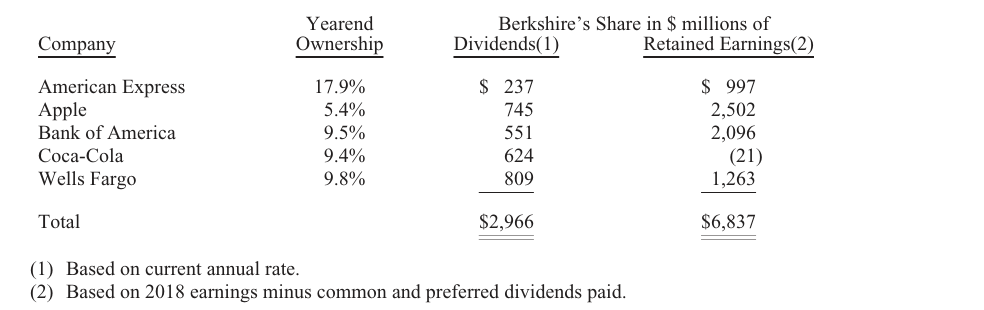
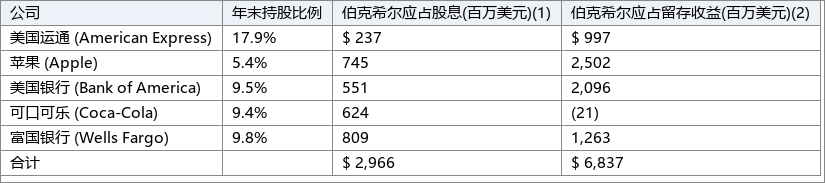
Our investees paid us dividends of $3.8 billion last year, a sum that will increase in 2019. Far more important than the dividends, though, are the huge earnings that are annually retained by these companies. Consider, as an indicator, these figures that cover only our five largest holdings.

我们的被投资公司去年向我们支付了38亿美元的股息,这一金额在2019年还会增加。但比股息重要得多的,是这些公司每年留存的巨额利润。下面是一组数据作为参考,只涵盖我们最大的五个持仓。

(1) 根据当前年度分红率计算。(2) 根据2018年收益减去已支付的普通股和优先股股息。

GAAP – which dictates the earnings we report – does not allow us to include the retained earnings of investees in our financial accounts. But those earnings are of enormous value to us: Over the years, earnings retained by our investees (viewed as a group) have eventually delivered capital gains to Berkshire that totaled more than one dollar for each dollar these companies reinvested for us.

GAAP——即规定我们如何报告收益的准则——不允许我们将被投资公司的留存收益计入我们的财务报表。但这些收益对我们有着巨大的价值:多年来,被投资公司(作为一个整体)的留存收益最终为伯克希尔带来的资本利得,超过了这些公司为我们再投资的每一美元。

All of our major holdings enjoy excellent economics, and most use a portion of their retained earnings to repurchase their shares. We very much like that: If Charlie and I think an investee’s stock is underpriced, we rejoice when management employs some of its earnings to increase Berkshire’s ownership percentage.

我们所有的主要持仓公司都有出色的经济效益,大多数都将部分留存收益用于回购股份。我们非常喜欢这一点:如果查理和我认为一家被投资公司的股价被低估了,我们就会很高兴看到管理层用部分收益来提高伯克希尔的持股比例。

Here’s one example drawn from the table above: Berkshire’s holdings of American Express have remained unchanged over the past eight years. Meanwhile, our ownership increased from 12.6% to 17.9% because of repurchases made by the company. Last year, Berkshire’s portion of the $6.9 billion earned by American Express was $1.2 billion, about 96% of the $1.3 billion we paid for our stake in the company. When earnings increase and shares outstanding decrease, owners – over time – usually do well.

上表中有一个例子:过去八年来,伯克希尔在美国运通 (American Express) 的持股数量一直没变。但由于美国运通不断回购,我们的持股比例从12.6%上升到了17.9%。去年美国运通69亿美元的收益中,属于伯克希尔的份额是12亿美元,大约相当于我们买入这笔股份时所付13亿美元的96%。当收益不断增长而流通股不断减少时,长期持有的股东通常会日子过得不错。

A third category of Berkshire’s business ownership is a quartet of companies in which we share control with other parties. Our portion of the after-tax operating earnings of these businesses – 26.7% of Kraft Heinz, 50% of Berkadia and Electric Transmission Texas, and 38.6% of Pilot Flying J – totaled about $1.3 billion in 2018.

伯克希尔的第三类企业资产是我们与其他方共享控制权的四家公司。2018年,我们在这些企业税后经营收益中应占的份额合计约13亿美元——分别是卡夫亨氏 (Kraft Heinz) 的26.7%、Berkadia的50%、德州输电公司 (Electric Transmission Texas) 的50%,以及Pilot Flying J的38.6%。

In our fourth grove, Berkshire held $112 billion at yearend in U.S. Treasury bills and other cash equivalents, and another $20 billion in miscellaneous fixed-income instruments. We consider a portion of that stash to be untouchable, having pledged to always hold at least $20 billion in cash equivalents to guard against external calamities. We have also promised to avoid any activities that could threaten our maintaining that buffer.

在我们的第四片树林中,伯克希尔年末持有1120亿美元的美国国库券和其他现金等价物,另有200亿美元的各类固定收益工具。我们认为这些储备中有一部分是不可动用的——我们承诺永远持有至少200亿美元的现金等价物,以防范外部灾难。我们还承诺避免任何可能威胁到这一缓冲资金的行为。

Berkshire will forever remain a financial fortress. In managing, I will make expensive mistakes of commission and will also miss many opportunities, some of which should have been obvious to me. At times, our stock will tumble as investors flee from equities. But I will never risk getting caught short of cash.

伯克希尔将永远是一座金融堡垒。在管理过程中,我会犯一些代价高昂的错误,也会错过很多机会——其中一些本该对我来说显而易见。有时候,投资者逃离股市,我们的股票也会大跌。但我永远不会冒现金短缺的风险。

In the years ahead, we hope to move much of our excess liquidity into businesses that Berkshire will permanently own. The immediate prospects for that, however, are not good: Prices are sky-high for businesses possessing decent long-term prospects.

未来几年,我们希望将大量过剩流动资金投入到伯克希尔将永久拥有的业务中去。然而,眼下的前景不太乐观:拥有良好长期前景的企业,价格高得离谱。

That disappointing reality means that 2019 will likely see us again expanding our holdings of marketable equities. We continue, nevertheless, to hope for an elephant-sized acquisition. Even at our ages of 88 and 95 – I’m the young one – that prospect is what causes my heart and Charlie’s to beat faster. (Just writing about the possibility of a huge purchase has caused my pulse rate to soar.)

这一令人失望的现实意味着,2019年我们可能会再次扩大上市股票的持仓。尽管如此,我们仍然期待着一笔"大象"级的收购。即使在我们88岁和95岁的年纪——我是年轻的那位——这种前景也会让我和查理心跳加速。(光是写下可能有一笔大买卖的可能性,我的脉搏就飙升了。)

My expectation of more stock purchases is not a market call. Charlie and I have no idea as to how stocks will behave next week or next year. Predictions of that sort have never been a part of our activities. Our thinking, rather, is focused on calculating whether a portion of an attractive business is worth more than its market price.

我预期会买更多股票,这不是一个看涨市场的信号。查理和我不知道股市下周或明年会怎么走。这类预测从来不是我们的事。我们的思考集中在:一个有吸引力的企业的一部分,其价值是否高于它的市场价格。


I believe Berkshire’s intrinsic value can be approximated by summing the values of our four asset-laden groves and then subtracting an appropriate amount for taxes eventually payable on the sale of marketable securities.

我相信,将我们四大类资产的价值加总,然后减去出售有价证券最终应缴纳的税款,就可以大致估算出伯克希尔的内在价值。

You may ask whether an allowance should not also be made for the major tax costs Berkshire would incur if we were to sell certain of our wholly-owned businesses. Forget that thought: It would be foolish for us to sell any of our wonderful companies even if no tax would be payable on its sale. Truly good businesses are exceptionally hard to find. Selling any you are lucky enough to own makes no sense at all.

你可能会问,如果我们出售某些全资子公司,是不是也该扣除这笔重大税款?忘了这个念头吧:即使卖掉完全不用交税,卖掉我们任何一家出色的公司也是愚蠢的。真正好的生意极其难找。卖掉你有幸拥有的好企业毫无道理。

The interest cost on all of our debt has been deducted as an expense in calculating the earnings at Berkshire’s non-insurance businesses. Beyond that, much of our ownership of the first four groves is financed by funds generated from Berkshire’s fifth grove – a collection of exceptional insurance companies. We call those funds “float,” a source of financing that we expect to be cost-free – or maybe even better than that – over time. We will explain the characteristics of float later in this letter.

在计算伯克希尔非保险业务的收益时,我们所有债务的利息成本都已作为费用扣除。除此之外,我们持有的前四类资产中有很大一部分,其资金来源于伯克希尔的第五片树林——一系列出色的保险公司。我们称这些资金为"浮存金",长期而言,我们预计获取这些资金是零成本的——甚至可能更好。我们将在本信后面解释浮存金的特性。

Finally, a point of key and lasting importance: Berkshire’s value is maximized by our having assembled the five groves into a single entity. This arrangement allows us to seamlessly and objectively allocate major amounts of capital, eliminate enterprise risk, avoid insularity, fund assets at exceptionally low cost, occasionally take advantage of tax efficiencies, and minimize overhead.

最后,有一点至关重要且意义深远:伯克希尔的价值之所以能最大化,是因为我们将五片树林整合成了一个有机的整体。这种安排使我们能够无缝且客观地配置大量资本,消除企业风险,避免各自为政,以极低成本为资产融资,偶尔利用税收优势,并将管理费用降至最低。

At Berkshire, the whole is greater – considerably greater – than the sum of the parts.

在伯克希尔,整体远远大于各部分之和。

〔译文源于芒格书院整理的巴菲特致股东的信〕

© Copyright 2023 Meitiandudian. All Rights Reserved.